The hard part of an enterprise AI strategy is not choosing a model or a tool. It is deciding where to put limited resources. AI solutions keep multiplying, and almost every department can find a use case where it could “give AI a try.” But more pilots do not mean more value. The companies that genuinely benefit from AI tend to be those that choose a small number of well-selected use cases and drive organizational change alongside them.
So how do you get out of the “many pilots, few results” trap? In this article, we look at why most AI projects struggle to scale, how to judge whether a use case is worth pursuing, and how to build an actionable AI strategy step by step. We also discuss the role people and culture play, and how to measure whether your strategy is actually working.
Why do most companies' AI projects stall at the pilot stage?
AI adoption in business is moving fast, but scaled deployment is moving far more slowly. The problem usually lies not in the technology itself, but in the lack of a mechanism for deciding what to do, what to do first and what not to do.
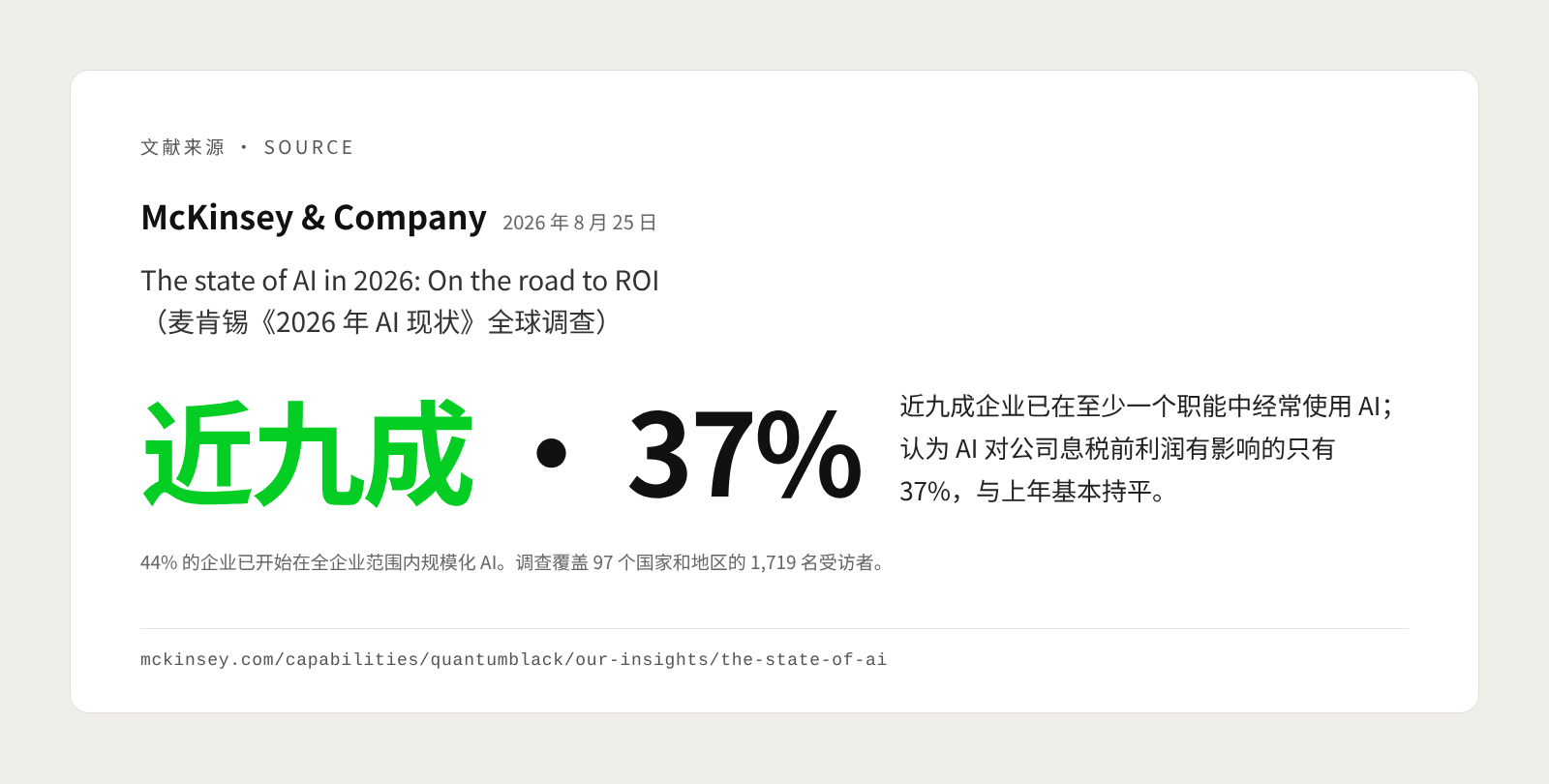
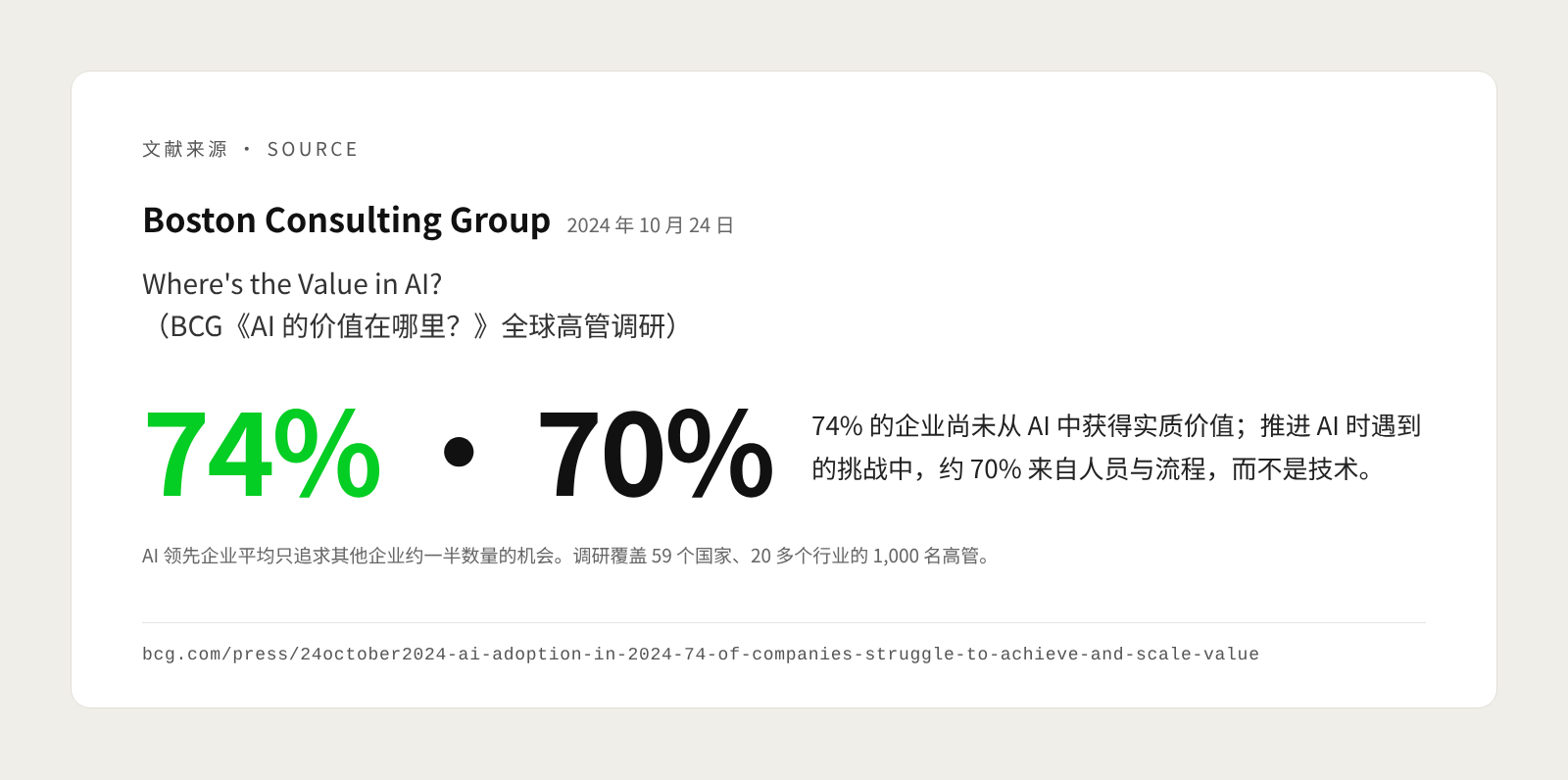
Several studies confirm this. McKinsey's “The state of AI in 2026,” published in August 2026, surveyed 1,719 respondents worldwide: nearly nine in ten organizations regularly use AI in at least one function and 44% have begun scaling it across the enterprise, yet only 37% say AI has had an impact on earnings before interest and taxes (EBIT), roughly unchanged from the previous year (source). A 2024 BCG survey of 1,000 executives likewise found that 74% of companies have yet to see tangible value from AI (source). Gartner, for its part, predicted in 2024 that at least 30% of generative AI projects would be abandoned after proof of concept (PoC) by the end of 2025, due to poor data quality, inadequate risk controls, escalating costs or unclear business value (source).
In practice, this gap usually shows up as one of two extremes:
- Fragmented resources. As the barrier to experimentation falls, departments launch their own projects, and budget and talent are spread across a large number of unconnected pilots. Each pilot demos well, but none receives the data, systems integration and operational investment it needs to scale.
- Delayed decisions. Other companies hold back because the technology is changing so fast and regulation remains unclear. But waiting is not free: data, organizational experience and talent all take time to build, and the later you start, the more it costs to catch up.
For example, a retailer might run small pilots in parallel on marketing copy generation, a customer service chatbot, inventory forecasting and internal knowledge search, yet a year later none of them is connected to its core systems. This is not because the technology doesn't work, but because no single project received enough priority or resources.
How do you decide whether an AI use case is worth pursuing?
Before debating which project to pursue, a company first needs to agree on how to judge. Every candidate use case should be assessed against the same criteria before it receives budget, so that ideas from different departments can be compared side by side. Here are the four basic criteria.
Business value. First, confirm that the use case addresses a real, important business problem, such as shortening order processing time, reducing customer churn or improving sales conversion. If a project is merely “technically interesting” but cannot articulate its business impact, it should not be prioritized.
Measurability. The value must be quantifiable. Before approving a project, define the baseline and the target, for example “reduce average customer service response time from 6 hours to 2 hours.” A simple test: if the project owner cannot say in one sentence which metric the project will change, and by how much, it is probably not ready to start.
Implementation readiness. Even the best idea is hard to deliver if data quality is insufficient, systems are difficult to integrate or there is no business owner. When assessing, check whether the data is available, whether the process is clearly defined and whether someone is willing to own the outcome.
Scalability. Finally, consider whether the project, once successful, can be replicated in more departments or scenarios. The more data, components and lessons that can be reused, the lower the marginal cost of each subsequent project.
The table below summarizes the four criteria and can serve as a starting point for internal assessment:
| Criterion | Key question | Indicators |
|---|---|---|
| Business value | Does it address a strategically important problem? | Revenue impact, cost savings, risk reduction, customer experience |
| Measurability | Can results be quantified against a clear baseline and target? | Definable KPIs, baseline data, value attribution method |
| Implementation readiness | Are the data, systems, processes and people ready? | Data quality, integration complexity, business owner in place |
| Scalability | Can it be reused in more departments or scenarios? | Share of reusable components, cross-departmental applicability, marginal deployment cost |
The assessment results are a guide for prioritization only, and the weight of each criterion should reflect the company's strategic priorities. Use cases that are not yet ready need not be rejected outright; they can go into a backlog and be reassessed once data or process conditions mature.
How to build an enterprise AI strategy from scratch: a step-by-step guide
With assessment criteria in place, the next step is to turn them into an executable roadmap. An AI strategy is not a technology shopping list; it is an action plan that connects business goals with AI capabilities. Because the technology changes so quickly, a phased approach, with each step informed by the results of the last, is more reliable than writing a three-year plan in one go.
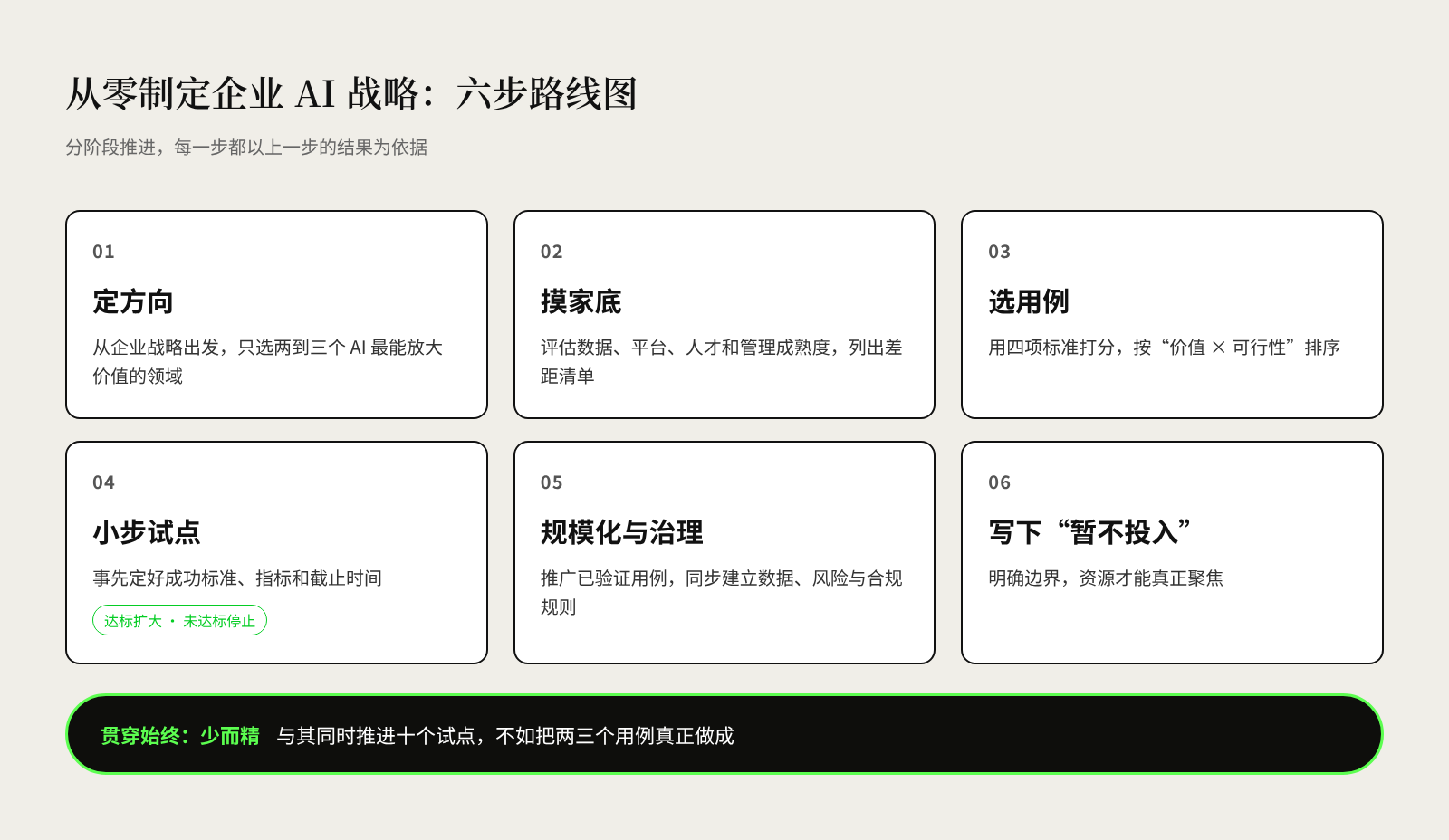
Step 1: Start from business goals and set priority areas. Go back to the corporate strategy and identify the two or three areas where AI can amplify value most, such as customer experience, supply chain or sales efficiency. The fewer the areas, the more concentrated the resources and the higher the chance of success. BCG's research shows that AI leaders pursue, on average, only about half as many opportunities as other companies, yet bring more projects to scale.
Step 2: Take stock and identify capability gaps. Before investing, honestly assess data quality, technology platforms, talent mix and management maturity. For example, check whether key business data is scattered across multiple systems, whether anyone is responsible for data governance and how familiar teams are with AI tools. The output of this step is a clear list of gaps and a plan to close them.
Step 3: Screen and rank use cases. Score candidate use cases against the four criteria above, then rank them by “value × feasibility.” Prioritize use cases with clear value, manageable risk and results visible within a few months, and use early wins to build confidence and internal support.

Step 4: Pilot on a small scale with clear validation thresholds. Define success criteria, metrics and a deadline for every pilot in advance. When the deadline arrives, review the results: if the pilot meets its targets, scale up investment; if it partly meets them, adjust the approach; if it misses, stop decisively. The willingness to shut a project down matters as much as the willingness to start one.
Step 5: Scale up and put governance in place. Validated use cases move into rollout. At the same time, establish rules for data use, model risk management and compliance review, and make accountability clear. The earlier governance comes in, the lower the cost of remediation later.
Step 6: Write a “not now” list. A mature AI strategy states not only what you will do but also what you will not do for now. Clear boundaries are a precondition for focusing resources, and they help departments understand the logic behind priorities, reducing internal competition for resources.
Why do people matter more than technology?
Technology determines what AI can do, but people determine how much value it ultimately creates. A system that nobody uses, dares to use or knows how to use will not deliver a return, however advanced the technology.
BCG's research found that about 70% of the challenges companies face in advancing AI relate to people and processes, 20% to technology and only 10% to the algorithms themselves. Accordingly, AI leaders typically follow a “10-20-70” rule: 10% of effort on algorithms, 20% on data and technology, and 70% on people and processes. McKinsey's survey also shows that nearly three-quarters of AI high performers have fundamentally redesigned workflows around AI, compared with only about a quarter of other companies.

In practice, you can start in three areas:
- Drive genuine adoption. AI tools should be embedded in core business processes rather than offered as a separate tool people have to open on top of their work. Involve frontline users from the design stage, and track adoption metrics such as usage rate and task completion time from day one.
- Build a culture that encourages experimentation, backed by clear governance. Organizations need room to experiment and make mistakes, as well as clear rules on data use, model risk and accountability. The clearer the boundaries, the more willing teams are to innovate. This shift depends on sustained involvement and leadership by example from management.
- Plan for workforce transformation. Employees' fear of being replaced is often the main source of resistance to adoption. Companies should communicate honestly about how AI will affect different roles, provide upskilling paths and redesign job responsibilities so that employees move from repetitive work to higher-value tasks such as analysis, judgment and customer communication.
For example, when introducing an AI-assisted customer service system, training staff only on how to use the tool may leave them following the old process. If you also adjust ticket assignment rules and clarify which issues AI handles and which require human follow-up, the new system can genuinely change how the team works.
How do you measure whether your AI strategy is working?
To judge whether an AI strategy is working, it is not enough to count how many projects have been launched or how many tools have been bought. What matters is whether AI is actually being used, and whether it delivers verifiable business improvement. Metrics should therefore be defined before a project starts and compared with results after implementation.
You can build a metrics framework on four levels:
- Adoption. How many employees use AI tools in their daily work, and how often. The aim is not simply to increase usage, but to confirm that the tools genuinely support specific tasks.
- Quality and efficiency. Whether tasks involving AI are completed faster, with fewer errors and less manual rework. Assessments should also include the time spent reviewing and correcting AI output, to get a true picture of efficiency.
- Business outcomes. Whether business metrics such as revenue, cost, conversion rate and customer satisfaction have changed in ways attributable to AI. This is the core evidence for demonstrating the value of the investment to management.
- Scaling progress. How many use cases have moved from pilot into routine operation, and whether reusable data and components are steadily accumulating.
In addition, regularly gathering feedback from employees and users can surface issues that numerical metrics miss, such as a lack of trust in the tools or a need for more targeted training. With this information, you can adjust the use case portfolio and resource allocation in good time, so your AI strategy evolves alongside business needs.
If you would like to assess your company's current use of AI and identify the use cases most worth prioritizing, book a free consultation.
Frequently asked questions about enterprise AI strategy
Do small and medium-sized businesses need an AI strategy too? Yes, but it can take a lighter form. With limited resources, SMBs should focus even more on the one or two use cases with the clearest value, rather than spreading budget across multiple tools and pilots.
How long does an AI pilot usually take? There is no single standard; it depends on the complexity of the use case and how ready the data is. The key is to set a clear validation period and success criteria before starting, then decide based on the results whether to scale up, adjust or stop.
Who should own the AI strategy? The AI strategy should be led by the business and senior management, not handed over entirely to IT. A common approach is for a senior executive to lead a cross-functional steering group responsible for approving use cases, allocating resources and tracking progress.
How often should an AI strategy be updated? We recommend reviewing the use case portfolio and key metrics at least once a quarter, and adjusting promptly whenever there are significant changes in technology, business priorities or regulatory requirements.
References
- The state of AI in 2026: On the road to ROI, McKinsey, August 2026
- AI Adoption in 2024: 74% of Companies Struggle to Achieve and Scale Value, BCG, October 2024
- Gartner Predicts 30% of Generative AI Projects Will Be Abandoned After Proof of Concept By End of 2025, Gartner, July 2024