Over the past few years, “middle management” has become an awkward term in many companies. On one side are calls to flatten organizations and cut layers of management; on the other, AI is getting steadily better at compiling information, generating reports and tracking progress — precisely the tasks that take up most of a middle manager’s day. Some have concluded that middle managers will be the first roles to disappear in the AI era. But it isn’t that simple. AI will make middle managers who merely relay messages and compile updates redundant, but it will make those who can lead people, coordinate and take responsibility more important than ever.
So how exactly will the work of middle managers change? This article covers the real pressure AI and flattening are putting on middle managers, which traditional functions AI will take over and which become more important, how managers view AI and what worries them, and what managers and companies can each do.
Why are middle managers first in line?
Middle managers are first in line because much of their daily work is, at heart, moving and organizing information within the organization. Once AI can compile and pass on information automatically, the value of the “information relay” role comes under fresh scrutiny.
This scrutiny is already visible in analyst forecasts and in what companies are actually doing:
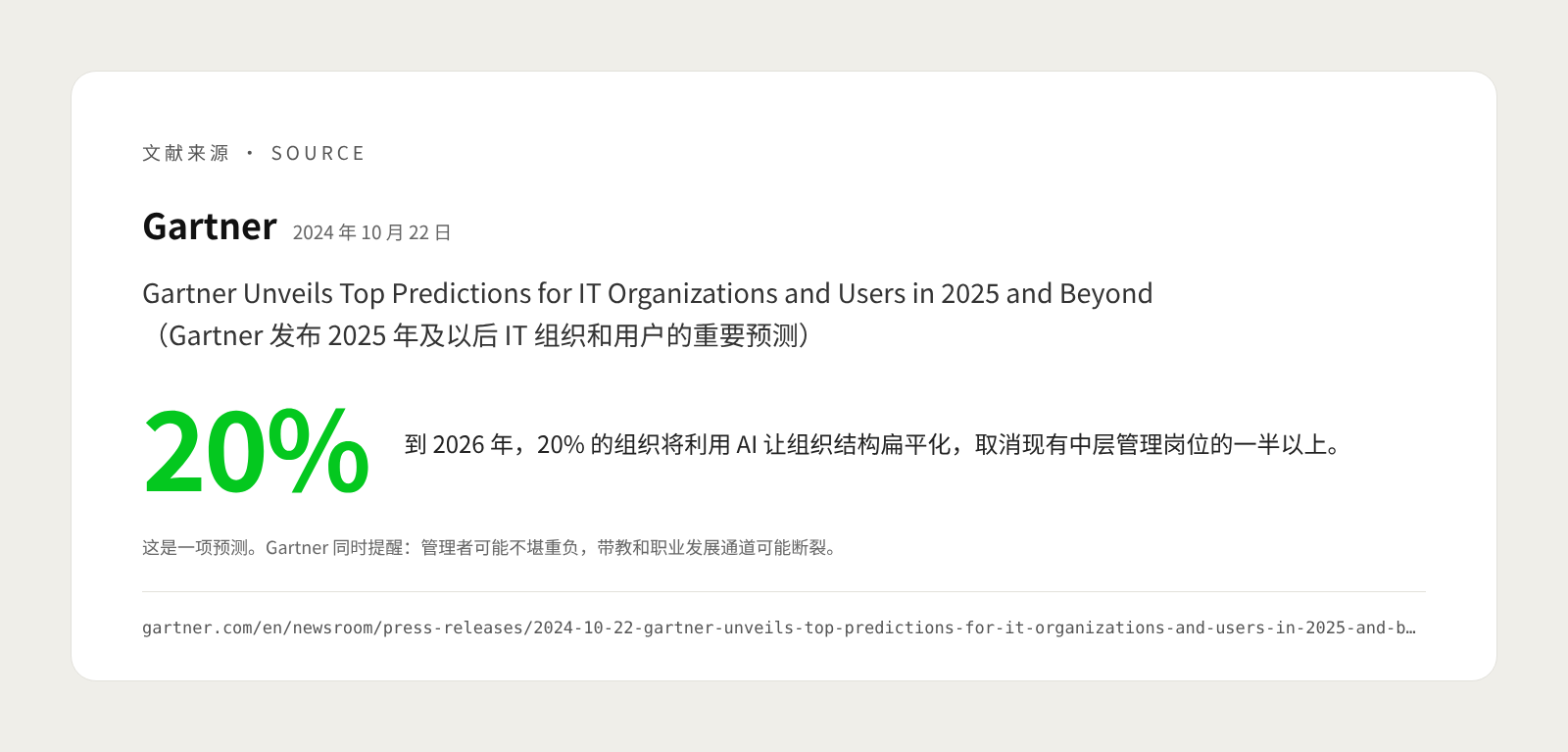
- Analyst forecasts. In its annual predictions published in October 2024, Gartner stated that by 2026, 20% of organizations will use AI to flatten their structures, eliminating more than half of current middle-management positions. Gartner’s reasoning is that AI can automate scheduling, reporting and performance monitoring, allowing the remaining managers to oversee larger teams. But it also flagged the risks: employees will worry about job security, managers may become overstretched, existing mentoring and career-development paths may break down, and younger employees will have fewer opportunities to grow (source).
- What companies are doing. AI aside, cutting layers is already the choice of many large companies. In an internal memo in September 2024, Amazon CEO Andy Jassy asked each business unit to increase the ratio of non-manager employees (individual contributors) to managers by at least 15% by the end of the first quarter of 2025, arguing that added layers had brought extra bureaucracy and that fewer layers would give employees a stronger sense of ownership and bring decisions closer to the front line (source).
- How employees actually feel. A 2025 Korn Ferry survey of more than 15,000 professionals across 10 markets found that 41% of employees said their organization had cut management layers; 37% said having fewer managers had left them feeling directionless (source).
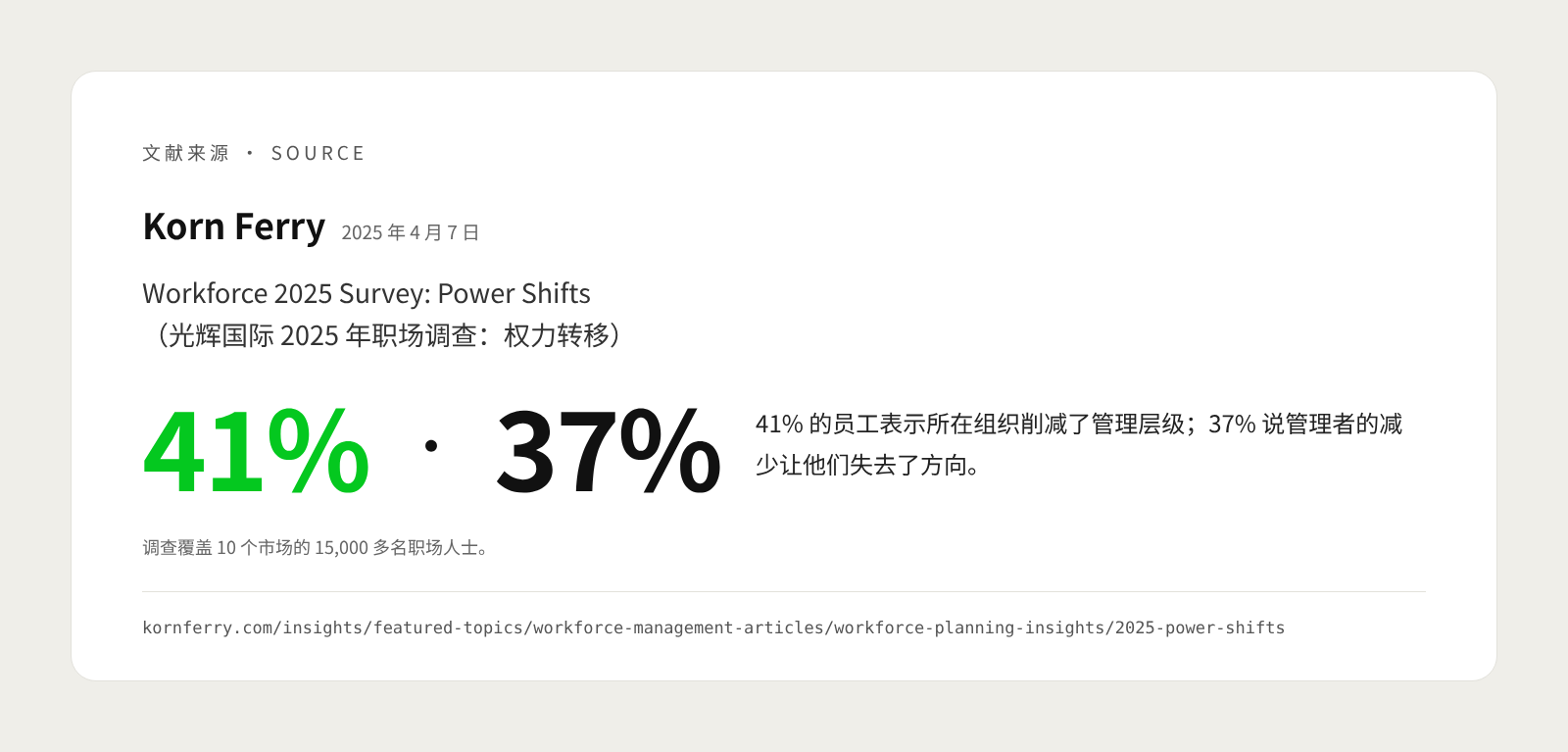
Taken together, these point to a more accurate conclusion than “middle managers are going away”: cutting layers is easy, but the connecting, explaining and caring that middle managers used to provide doesn’t disappear just because the positions do. Either the managers who remain pick it up, or it becomes a gap that no one on the team owns. Korn Ferry’s data shows the cost of the latter.
It’s also worth noting that Gartner’s figure is a prediction, and actual progress varies widely by industry. For most small and mid-sized businesses, which are rarely bloated to begin with, the more practical question is not “how many middle managers should we cut?” but “where should our existing middle managers spend their time?”
Which middle-management tasks will AI take over, and which become more important?
What middle managers have traditionally done falls roughly into a few categories: relaying information up and down, coordinating resources, overseeing execution, compiling reports, and leading the team. AI is best at taking over the parts that follow a fixed format and can be derived from data; the parts that require trust, judgment and accountability for consequences still depend on people.
The table below compares how several typical functions change in the AI era:
| Traditional function | How middle managers did it | What AI can take over | What still needs middle managers — and matters more |
|---|---|---|---|
| Relaying up and down | Holding meetings to communicate goals, then summarizing front-line conditions for leadership | Meeting minutes, key-point summaries, information updates | Explaining the “why” and translating company goals into concrete tasks the team can understand |
| Reporting and data consolidation | Collecting data from different sources by hand to produce weekly and monthly reports | Automatically consolidating sales, inventory and ticket data and generating first-draft reports | Working out the causes behind the data and deciding whether to act |
| Task allocation and progress tracking | Scheduling shifts, assigning work, chasing progress | Automated scheduling, reminders for due tasks, flagging anomalies | Handling exceptions and making trade-offs when resources conflict |
| Oversight and review | Spot-checking work quality, correcting problems when found | Automatically checking documents and flagging deviations | Turning problems into coaching opportunities, not just assigning blame |
| Cross-department coordination | Coordinating resources through meetings and personal relationships | Shared dashboards, fewer repeated confirmations | Negotiating and compromising when interests diverge, and building long-term collaboration |
| Developing the team | Mentoring newcomers, passing on experience | Training materials, Q&A assistants | Targeted coaching and feedback that help employees grow |
The split in the table reflects a general pattern; the specifics depend on a company’s data foundation and process maturity. For example, if a logistics company’s order and shipping data are still scattered across multiple spreadsheets, AI will struggle to generate reliable daily reports.
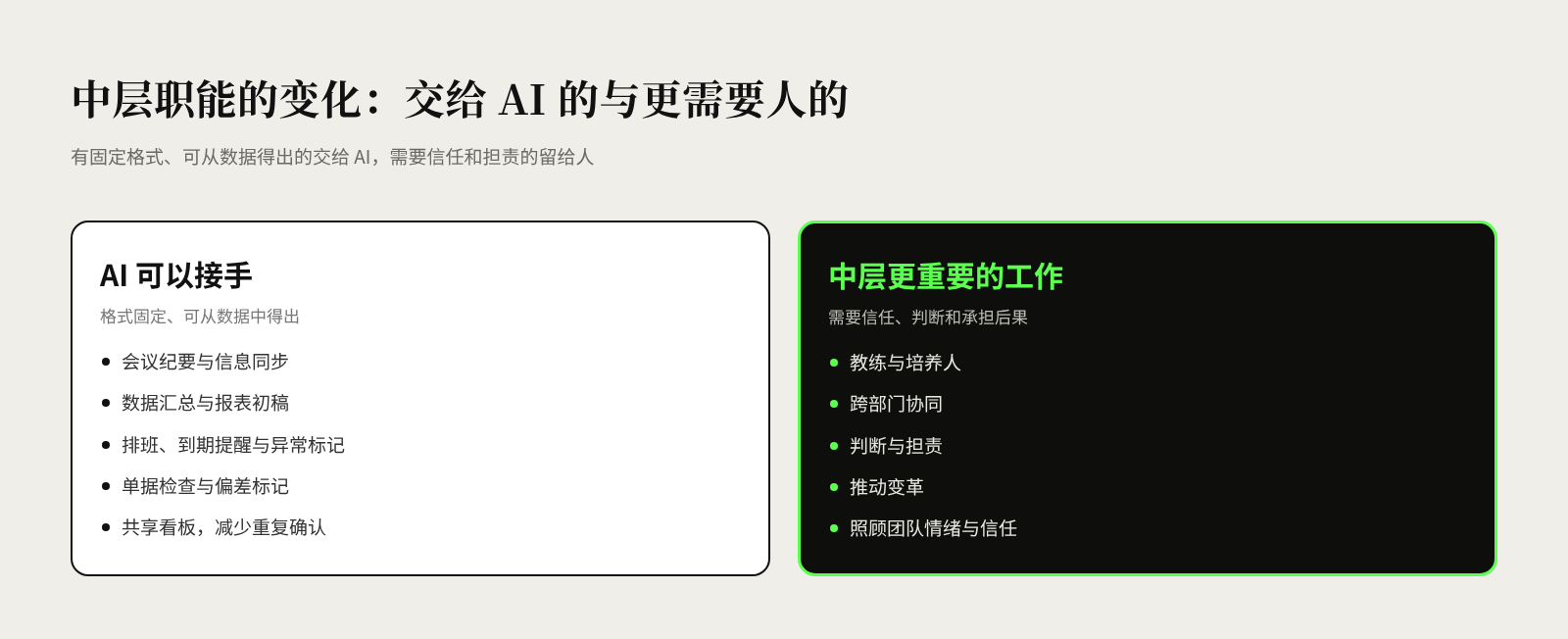
The table points to five main areas where middle managers’ work becomes more important:
- Coaching and developing people. As AI takes over much of the basic work, the path by which newcomers build experience by “doing the simple things” narrows. The broken mentoring path Gartner warns about is exactly what managers need to deliberately repair: assigning stretch tasks, giving timely feedback, and helping employees learn to judge AI output.
- Cross-department collaboration. AI can make information more transparent, but it can’t reconcile interests between departments. Sales, for example, wants to take more rush orders while the warehouse wants stable production schedules; someone has to sit down and work that out.
- Judgment and accountability. AI can make recommendations, but it can’t be accountable for outcomes. In BCG’s 2026 AI at Work survey, 47% of respondents listed accountability issues arising from AI among their top three concerns for the next two to three years; 52% said the time they spend checking and correcting AI output has increased (source). Who makes the call and who takes responsibility will become an increasingly central part of a middle manager’s value.
- Driving change. Whether new tools actually get used depends heavily on the direct manager. Microsoft’s 2026 Work Trend Index, analyzing 20,000 AI users across 10 countries, found that organizational factors such as culture, manager support and talent practices explained more than twice as much of employees’ perceived AI impact as individual factors did (67% vs. 32%). A separate Microsoft-led study of 1,800 people found that when managers personally modeled AI use, employees reported 17 percentage points more value from AI (source). These are correlations within self-reported employee data, not proof of causation, but the direction is clear.
- Caring for team morale and trust. The faster things change, the more employees need someone they can trust and speak candidly with. Korn Ferry’s survey found that 80% of employees said they would stay in a job because of a boss they trust (source).
How do managers view AI, and what are they worried about?
Overall, middle managers are fairly receptive to AI — often more so than other employees. Their concerns are less about whether they can use it and more about being asked to drive change without the methods or support to do so.
Several surveys capture this from different angles:
- They use it more than employees do. A Gartner survey from July 2025 found that 46% of managers were trying to use AI to improve their work, compared with only 26% of employees; 45% of managers said AI had lived up to their expectations in improving their teams’ work, but only 14% said they had faced no difficulties in getting their teams to use AI effectively (source). The survey covered 1,973 managers and 2,986 employees.
- They expect big changes. In BCG’s 2026 survey, regular AI use among managers had reached 88%. Among frequent AI users, 65% of managers and executives believed AI agents could do more than half of their job within the next three years, compared with 52% of frontline employees (source).
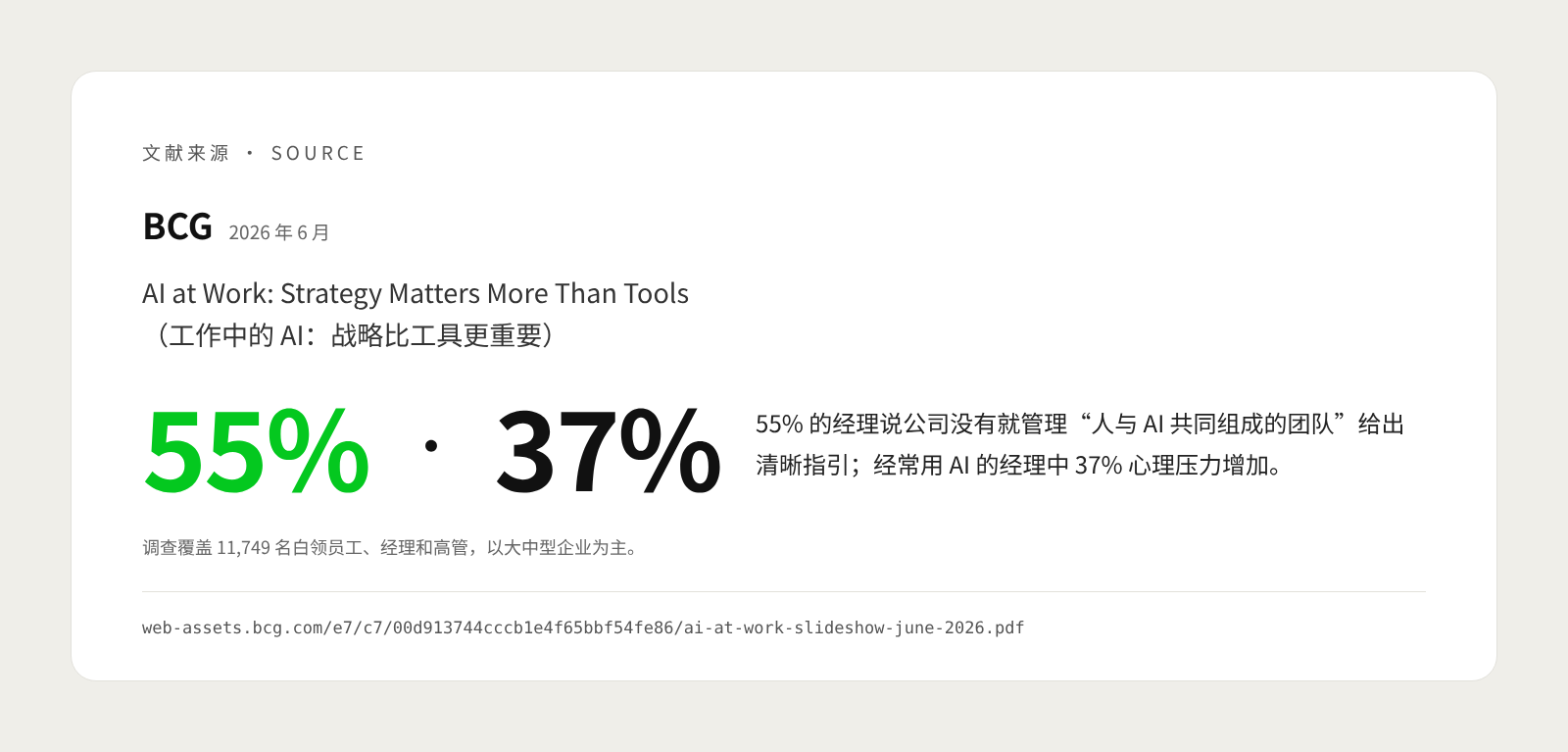
- Pressure, with rules still missing. In the same survey, 37% of managers who use AI frequently reported increased psychological stress, and 55% of managers said their company had not yet provided clear guidance on how to manage teams made up of both people and AI (source).
Respondents to these surveys come mainly from large and mid-sized companies, and managers at smaller businesses may be in a different position. But one common thread stands out: middle managers occupy a dual role. They are AI’s champions, expected to persuade their teams to try new approaches, and they are also the people AI changes most, as their own ways of working and the criteria they are judged by shift. If a company simply hands middle managers a “drive AI adoption” target without giving them methods, time and a sense of security, they can easily pass that pressure straight on to their teams.
Microsoft’s report also points to a structural contradiction: only 13% of AI users said their attempts to redesign work with AI would be recognized even if the results fell short (source). For middle managers, this means the room they have to let their teams experiment depends largely on whether their own bosses allow experimentation.
How can middle managers make the transition? A step-by-step guide
For individual middle managers, the key to the transition is not learning more tools but reallocating their time. Put the time AI saves you into the things only people can do well.
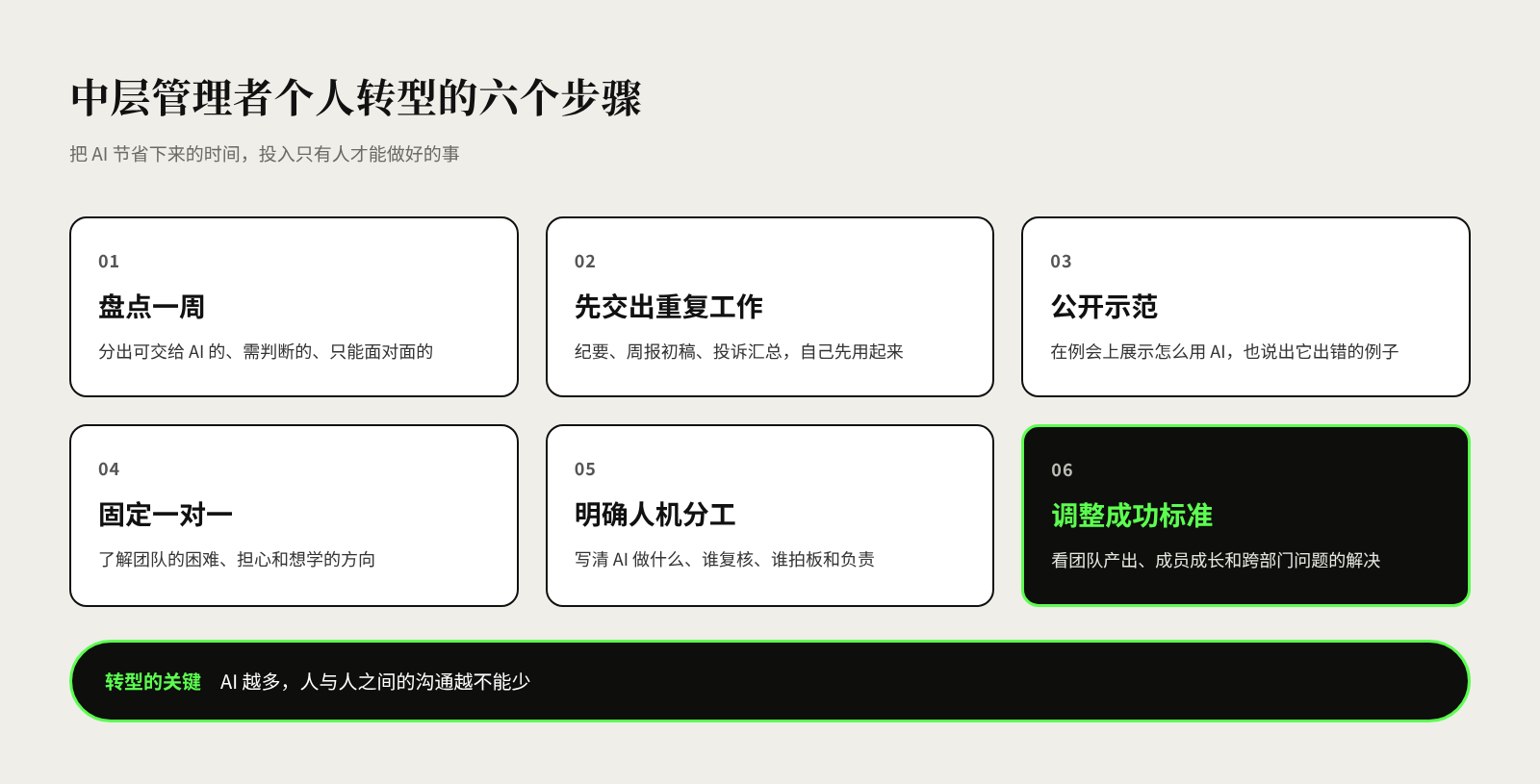
Step 1: Audit your week. Spend a week or two logging your work and sort it into three categories: what can go to AI or systems (such as compiling weekly reports or consolidating data), what requires your own judgment (such as approving exceptions or allocating resources), and what can only be done face to face (such as coaching team members or resolving conflict). Many managers find the first category is larger than they expected.
Step 2: Hand your own repetitive work to AI first. Start with the tasks you know best — for example, using AI to write up meeting notes, draft the weekly sales report, or summarize the main issues in customer complaints. Using it yourself first is how you come to understand AI’s strengths and weaknesses, and it gives you the confidence to guide your team.
Step 3: Use and discuss AI openly in front of your team. Show how you use AI in team meetings, and be candid about examples where it got things wrong. A manager’s example sends a clear signal: using AI is encouraged, and spotting its mistakes is valuable too.
Step 4: Make one-to-ones a regular fixture. Use the time you save first and foremost for one-to-one conversations with team members: find out what difficulties they face using AI, what worries them about changes to their roles, and what they want to learn. The more AI there is, the more human conversation matters.
Step 5: Define the split between people and AI on your team. Work with your team to spell out which tasks AI can handle, who reviews the output, and who decides and takes responsibility when something goes wrong. For example, AI can generate purchasing recommendations, but a buyer checks them before an order is placed, and orders above a set amount require a supervisor’s approval.
Step 6: Redefine your measures of success. Stop measuring yourself by how many people you manage, how many meetings you hold or how many reports you submit. Look instead at your team’s output, your team members’ growth, and whether cross-department problems actually get solved.
How should companies support middle managers?
Middle managers can’t make this transition without organizational support. If a company simply cuts layers without redesigning middle-management responsibilities, the managers who remain will only become busier and more exhausted.
Companies can start with the following:
- Redefine middle-management responsibilities and performance reviews. Be clear about which reporting and data work will be handled by systems, and build team development, cross-department collaboration and driving change into middle managers’ responsibilities and reviews, rather than looking only at business metrics.
- Give middle managers dedicated AI training and tools. Training should cover not just how to operate tools but how to evaluate AI output, how to roll it out across a team, and how to address employees’ concerns. Gartner likewise recommends equipping managers with methods and tools for integrating AI into their teams’ work, and helping them guide employees on how to use the time AI frees up (source).
- Set rules for collaboration between people and AI. Define the scope of AI use, review requirements and accountability at company level, so that individual middle managers aren’t left to figure it out on their own, each with a different set of rules.
- Keep spans of control reasonable. Span of control is the number of people a manager directly oversees. If flattening widens a manager’s span, their administrative workload needs to shrink at the same time; otherwise coaching and communication are the first things to be squeezed out.
- Allow experimentation and reward improvement. Recognize attempts to redesign processes with AI, even when the results aren’t yet where you want them. Only when middle managers feel free to experiment will their teams feel free to try.
FAQs about middle managers in the AI era
Will AI eliminate middle-management roles? Some roles centered on compiling and relaying information may be merged or eliminated, but the work of leading teams, coordinating resources, exercising judgment and taking responsibility will not disappear. The more likely outcome is fewer middle managers, each carrying heavier responsibilities, or a shift in where their focus lies.
Do middle managers need to learn to code or build AI tools? Generally not. What matters more is understanding what AI can do and where it goes wrong, knowing how to apply it to the team’s specific processes, and being able to judge whether its output is reliable.
When team members become more productive with AI, how should managers allocate the time saved? Discuss it with the team first rather than simply adding more work. Some of the time can go toward learning new skills, improving processes or serving customers. Involving employees in the decision keeps productivity gains from turning into new pressure.
Do middle managers at small and mid-sized businesses need to pay attention to these changes? Yes. Middle managers at smaller businesses often wear many hats and are more likely to be swamped by administrative work. Using AI to cut repetitive reporting and coordination frees them to lead people and improve the business.
References
- Gartner Unveils Top Predictions for IT Organizations and Users in 2025 and Beyond, Gartner, October 2024
- Update from Amazon CEO Andy Jassy on return-to-office plans and manager team ratio, Amazon, September 2024
- Workforce 2025 Survey: Power Shifts, Korn Ferry, April 2025
- Agents, human agency, and the opportunity for every organization, Microsoft, May 2026
- AI at Work: Strategy Matters More Than Tools (survey slides), BCG, June 2026
- Gartner HR Survey Reveals 45% of Managers Report AI Has Lived Up to Their Expectations in Improving Their Teams' Work, Gartner, March 2026