Almost every discussion about AI ends up in the same debate: is it another industrial revolution, following the steam engine, electricity and the computer, or a technology that merely replaces people without genuinely raising productivity? The first view rests on the dramatic collapse in the cost of capability and large gains in task efficiency; the second rests on growth that has yet to show up in macroeconomic statistics, and on a growing number of displaced jobs.
The two views are less opposed than they appear: every industrial revolution in history began with “substitution.” Whether a technology deserves to be called a “revolution” depends not on how many people it replaces, but on whether that substitution gives rise to enough new tasks, new organizations and new demand, and on who ultimately captures the gains.
To judge which side is closer to the truth, we first need to return to a more basic question: by what criteria does economic history actually define an “industrial revolution”?
What actually qualifies as an industrial revolution?
An “industrial revolution” is not a title that can be declared at the moment of invention; it is recognized after the fact, from the data. Economists typically use the term “General Purpose Technology” to describe technologies such as the steam engine, electricity and the computer, and rely on it to judge whether a technology can bring about revolutionary change. Such technologies generally share three characteristics:
- Pervasiveness: it is not confined to one industry but enters almost every stage of production;
- Continuous improvement: performance keeps rising and costs keep falling, steadily widening its range of applications;
- Complementary innovation: new equipment, ways of organizing, business models and even occupations grow up around it.
Meeting these three conditions is only a prerequisite for a revolution. What truly leads later generations to call it a “revolution” is a long, sustained rise in productivity: the same inputs yielding markedly more output.
There is a historical detail here that is often overlooked. The first decades of the British Industrial Revolution were not a period in which “everyone benefited.” Research by economic historian Robert Allen shows that in the first half of the 19th century, output per person in Britain grew steadily while real wages stagnated for a long time; the profit rate doubled, the share of profits in national income rose, and the shares going to workers and landowners fell accordingly. Only after the mid-19th century did wages begin to rise in step with productivity (source). This phenomenon later became known as “Engels' pause.”
In other words, “rising productivity” and “workers being replaced without sharing in the gains” have, historically, been true at the same time. After the power loom spread, for example, the incomes of Britain's handloom weavers fell sharply and the entire occupation disappeared, even as total output in the cotton textile industry expanded rapidly. From where a weaver stood at the time, this “revolution” looked like nothing more than substitution.
It follows that today's debate about AI actually conflates two questions. One is efficiency: can AI produce more from the same inputs? The other is distribution: once output rises, who gets the benefits? Many seemingly opposing views are simply each answering one of the two.
What do those who see a revolution see?
Those who support the “new industrial revolution” view are not relying merely on optimism about technology, but on several sets of fairly hard facts.
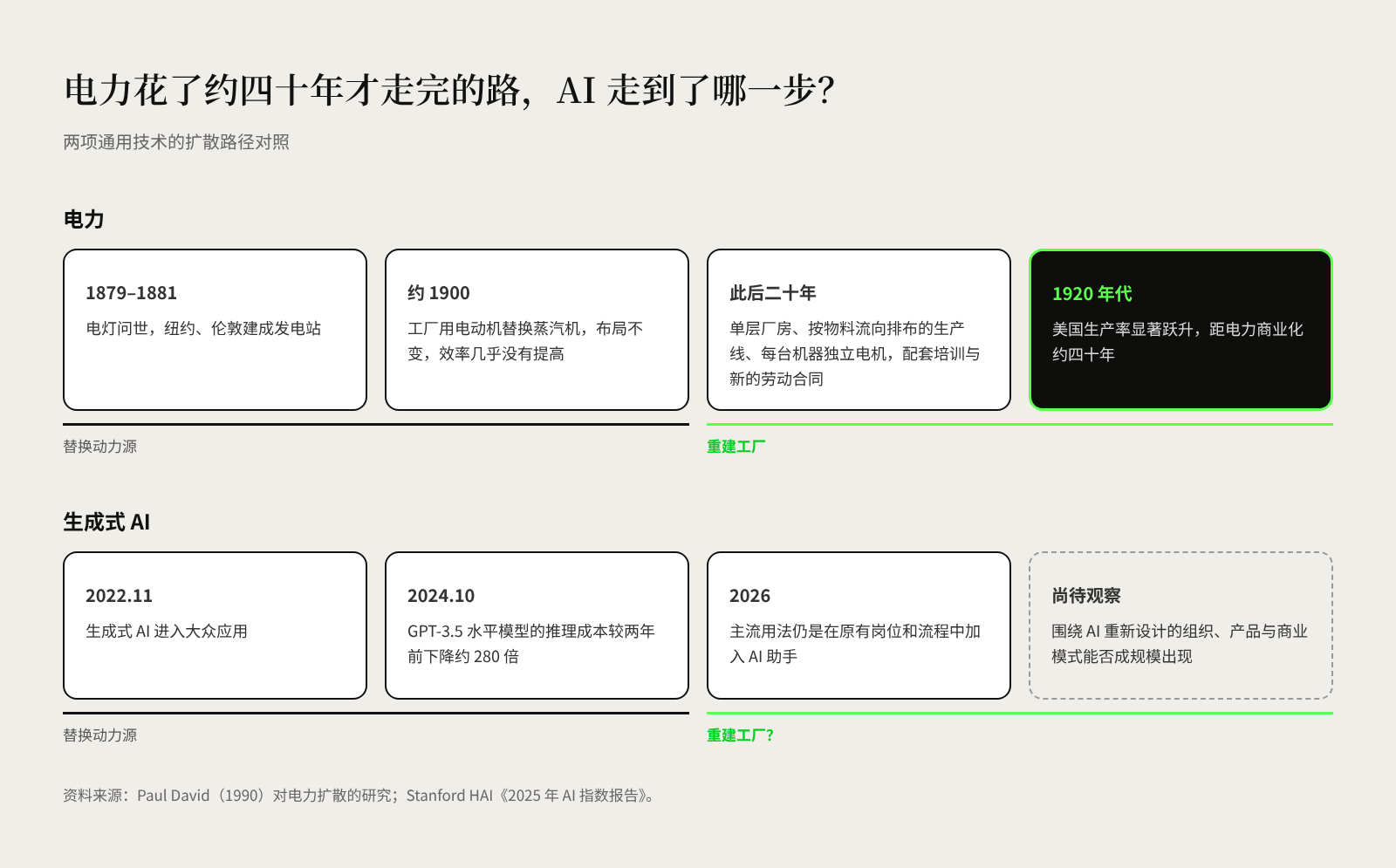
First, the cost of capability is falling at an unusual pace. Stanford University's 2025 AI Index Report found that the inference cost of a model performing at GPT-3.5 level fell roughly 280-fold between November 2022 and October 2024 (source). The spread of steam power, electricity and computing power was in each case premised on steep falls in unit cost. Once a capability becomes cheap enough to use everywhere, it gets embedded in steps that were previously not worth automating, and this is precisely where “pervasiveness” comes from.
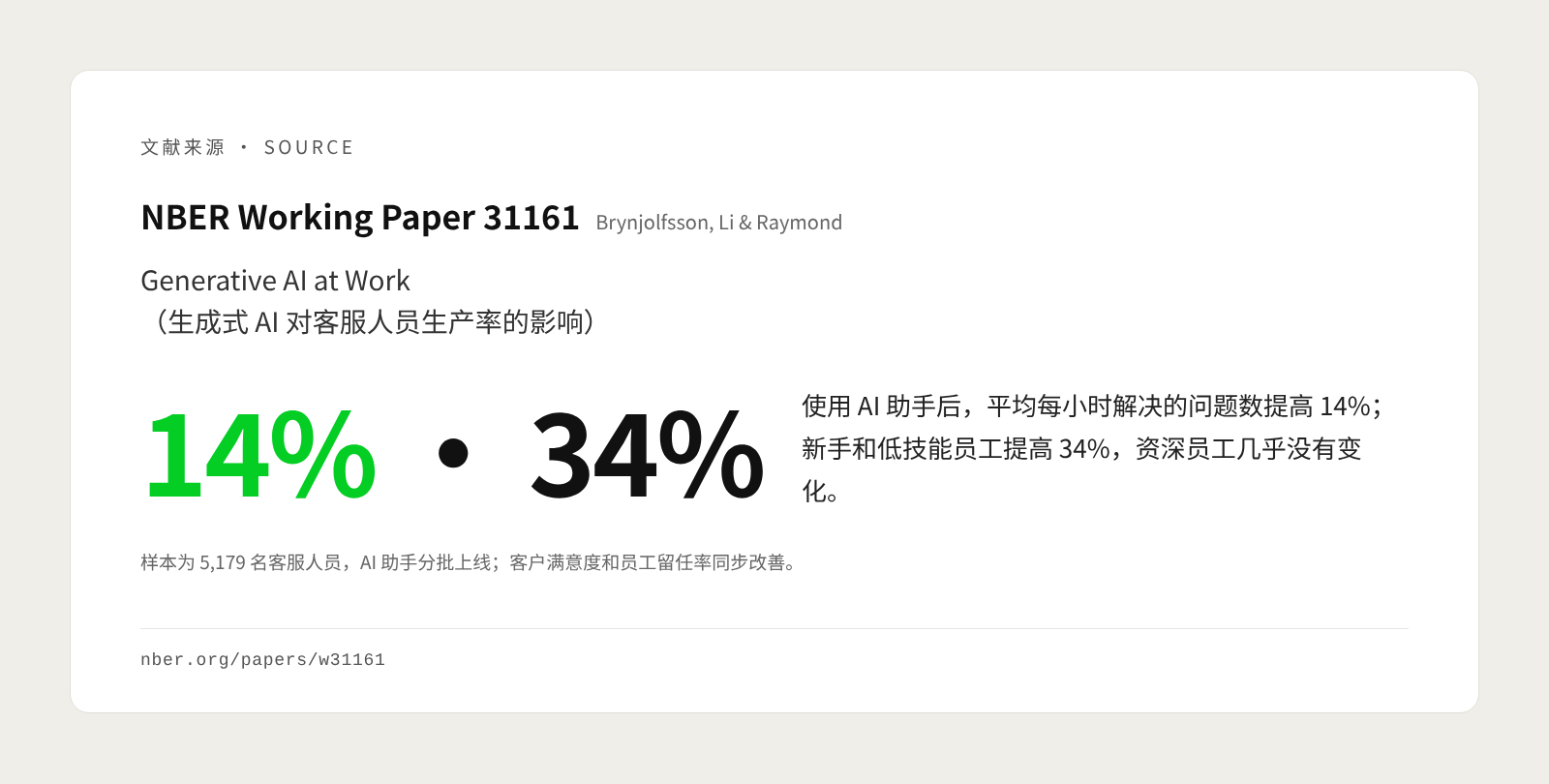
Second, in controlled experiments, efficiency gains are measurable. Erik Brynjolfsson and colleagues tracked 5,179 customer support agents as a generative AI assistant was rolled out in stages: the average number of issues resolved per hour rose 14%, with novice and low-skilled workers improving by 34% and experienced staff seeing almost no change; customer satisfaction and employee retention also improved (source).
One detail in this data deserves a closer look. That AI helps novices most means it is effectively “packaging” the tacit knowledge of experienced employees and handing it to newcomers. Most information technology of the past few decades has favored the highly skilled, but in this setting generative AI works in the opposite direction, narrowing the skills gap. Supporters argue this is what “freeing people” concretely means: ordinary workers reaching, in far less time, a level that once took years of experience.
Third, macro estimates are on a scale comparable to the great technologies of history. In 2023, Goldman Sachs Research estimated that generative AI could raise global GDP by about 7% (nearly $7 trillion) over ten years and lift annual productivity growth by 1.5 percentage points; roughly two-thirds of US occupations are exposed to AI automation to some degree, and 25% to 50% of their workload could be replaced (source).

Fourth, this is the first time automation has entered cognitive work at scale. The steam engine and electricity mainly replaced physical effort, and the computer mainly handled information tasks with clear rules. Generative AI is the first technology to reach, at scale, work that requires understanding context, such as writing, analysis, coding and design. A first-pass contract review, a draft of marketing copy or a data-cleaning script, for example, used to be priced in “person-days”; today its marginal cost is close to that of a single model call. The supporters' logic is this: knowledge work accounts for the largest share of labor in advanced economies, so a technology that affects it naturally has a potential reach no smaller than that of its predecessors.
Why do some argue AI doesn't deserve to be called a revolution?
Skeptics do not deny that AI can do a great deal of work. What they question is whether doing that work amounts to a significant increase in productivity.
Run the macro numbers, and the figures may be far smaller. MIT economist Daron Acemoglu used task-level evidence to infer the macroeconomic impact and concluded that AI will raise total factor productivity by no more than 0.66% over the next decade; once hard-to-learn tasks are taken into account, the figure falls below 0.53% (source). That is an order of magnitude below Goldman Sachs's estimate of a 1.5-percentage-point boost to annual productivity growth.
The difference comes mainly from one assumption. Acemoglu points out that most current experimental evidence comes from “easy-to-learn” tasks, where outcomes can be judged objectively, such as whether a support ticket was resolved. Yet much high-value work depends on contextual judgment and lacks a “right answer” that can be checked directly. Extrapolating gains on easy tasks straight to the entire economy is likely to overstate the overall effect.
“So-so automation” replaces without raising efficiency. Acemoglu and Pascual Restrepo coined the term “so-so automation”: some technologies are just efficient enough to replace workers, but not efficient enough to lower costs significantly or drive product expansion. The result is a falling labor share with almost no improvement in productivity (source). Supermarket self-checkouts, for instance, shift the cashier's work onto customers: the retailer saves on labor, yet the shopping process as a whole is no faster. Skeptics worry that many “AI replaces a job” deployments are of the same type.
Feeling faster is not the same as being faster. In 2025 the nonprofit research organization METR ran a randomized controlled trial in which 16 experienced open-source developers completed 246 real tasks in large codebases they knew well. When using AI tools, they took on average 19% longer. Beforehand they had expected AI to make them 24% faster, and afterward they still believed it had made them about 20% faster (source). The sample was small and the setting unusual, so the results cannot be generalized to all work. But the study exposes an important measurement problem: many companies' judgments about “AI efficiency gains” are based on employees' self-assessments, and there may be a systematic gap between self-assessment and objective results.
The creation of new tasks is slowing. Research by MIT economist David Autor and colleagues found that about 60% of jobs in the US today are in new types of work that emerged only after 1940, strong evidence that “technology creates jobs.” But the same study also found that the negative impact of automation on employment between 1980 and 2018 was more than twice that of 1940 to 1980, while the “augmentation” effect that creates new tasks grew more slowly (source). If this trend continues into the AI era, “substitution” will outpace “creation.”
On distribution, Acemoglu also argues that AI affects different groups more evenly than earlier automation did; it may not greatly widen income inequality among workers, but it is likely to widen the gap between capital income and labor income. This is the more precise economic formulation behind the intuition that “AI is replacing people”: productivity may well rise, but the additional output turns mainly into returns to capital.
If task-level gains are so clear, why don't they show up in the macro data?
This puzzle is not unique to AI. In 1987, Nobel laureate economist Robert Solow made a remark that has been quoted ever since: “You can see the computer age everywhere but in the productivity statistics.” This became known as the “productivity paradox.” Only in the mid-to-late 1990s did the productivity acceleration brought by information technology become clearly visible in US data.
In 1990, economic historian Paul David used the history of electricity to explain this lag. The electric light bulb appeared in 1879, and New York and London had power stations by around 1881, yet by 1900 there was still little visible change in business efficiency. The reason was that factories initially just replaced their steam engines with electric motors, leaving the existing layout, drive shafts and processes unchanged, so productivity barely improved. The real change came from later redesign: single-story buildings, production lines arranged along the flow of materials, a small dedicated motor for each machine, and the worker training and employment contracts that went with them. The leap in US productivity did not come until the 1920s, roughly forty years after electricity was commercialized (source).
Brynjolfsson and his co-authors later summarized this phenomenon as the “productivity J-curve”: for a general purpose technology to take effect, it requires large complementary intangible investments, including process redesign, data preparation, employee training and new management practices. Because these investments are hard to count as capital in the statistics, they depress measured productivity in the early stages, and the gains are released in a concentrated burst only once the complements are in place (source).
Bringing this history back to today's debate yields an important inference: what the skeptics are describing may well be the “swap the steam engine for an electric motor” stage, while the revolutionaries are betting on the “rebuild the factory” stage. The dominant way companies use AI today is to add an assistant to existing roles and processes. This closely resembles fitting electric motors into steam-era factories: local efficiency improves, but the system stays the same.
But the analogy has its limits. The spread of electricity was constrained by the renewal cycle of physical assets such as power grids and factory buildings, while AI spreads mainly through software and cloud services, and in theory can move faster. On the other hand, the pace at which organizational structures, roles and regulations adjust does not automatically accelerate just because the technology is software. Whether AI can travel the J-curve faster than electricity did depends on whether the bottleneck lies on the technology side or the organizational side, and this is the root of the two camps' disagreement over timescales.
Where exactly do the two views diverge?
Break down each side's arguments and there is actually little conflict at the level of facts. The real disagreements lie along the following dimensions.
| Dimension | Revolution camp's view | Skeptic camp's view | What current evidence suggests |
|---|---|---|---|
| Unit of measurement | Efficiency at task and firm level | Macro total factor productivity, wages and labor share | Task-level gains confirmed; not yet visible at macro level |
| Timescale | Benchmarked against the decades-long diffusion of general purpose technologies | Focused on the next five to ten years | Electricity's gains took about forty years to appear |
| Substitution vs. new tasks | Substitution will be followed by many new tasks | New task creation cannot keep pace with substitution | Since 1980, automation has accelerated while augmentation has slowed |
| Extrapolation | Gains on easy tasks will gradually extend to hard ones | Gains on hard tasks will be markedly smaller | Customer support up 14%; experienced developers 19% slower |
| Who benefits | Novices and low-skilled workers benefit most | Capital income grows relative to labor income | Both effects may coexist |
| Easily underestimated | The difficulty and duration of organizational restructuring | The speed at which the cost of capability falls | Both are changing quickly |
As the table shows, the most fundamental disagreement between the two sides concerns “new tasks.” If AI is used mainly to make existing work cheaper, it is closer to the “so-so automation” the skeptics describe; if it gives rise to products, services and occupations that could not previously have existed, it is closer to the industrial revolution the revolutionaries envision.
This means that “substitution or productivity gain” is not determined entirely by the technology itself. The same large model can be used to cut a customer service team, or to let that same team offer personalized service it could never provide before. Both Acemoglu and Autor have stressed that the direction of technological development is shaped by corporate incentives, tax systems and institutional arrangements. For example, when investing in capital is more tax-advantaged than hiring employees, companies are more inclined to use AI to “save headcount” rather than to “add capability.”
What signals will show which way the balance is tipping?
Since the crux of the debate lies in the future rather than the present, the more useful question is not “who is right” but “what evidence would make one side more convincing.” The following five types of signal can help gauge the trend.
- Whether macro productivity reaches a sustained turning point. Growth in any single year may reflect the business cycle; only labor productivity growth that stays above trend for several consecutive years would bear comparison with the 1920s and the late 1990s.
- The direction of labor's share of income. If the labor share keeps falling while productivity rises, the additional output is flowing mainly to capital, a situation resembling “Engels' pause.”
- The pace at which new occupations emerge. Autor's method tracks new occupational titles in census data. Whether the occupations that emerge around AI over the next decade reach meaningful scale, rather than being limited to a handful of highly paid technical roles, will directly test the concern that “substitution is outpacing creation.”
- Whether companies are “swapping the power source” or “rebuilding the factory”. If companies mainly treat AI as a plug-in for existing roles, macro gains are likely to be limited; only when organizational structures, products and business models start being redesigned around AI can the upswing of the J-curve arrive.
- Experimental evidence on hard-to-learn tasks. The most reliable data so far comes mostly from settings with clearly measurable outcomes, such as customer support, writing and coding. Only as randomized controlled evidence accumulates for tasks like medical diagnosis, scientific discovery and complex decision-making will the order-of-magnitude gap between Acemoglu and Goldman Sachs begin to narrow.
Of these signals, the first two are outcomes and the last three are causes. Outcome indicators usually lag by several years, whereas causal indicators can already be observed at company and industry level. For anyone who wants to form a view before the statistics arrive, the last three are the ones worth tracking.
Conclusion
Those who see AI as a new industrial revolution and those who see it merely replacing people may well be describing different stages of the same process. Both the steam engine and electricity first appeared in the guise of “substitution”; gains in productivity and in workers' incomes arrived only much later, and not automatically.
Seen this way, “is AI an industrial revolution?” is more a question for the future than a fact that can be settled today. The more important question is a different one: in this period, when substitution is already happening and new tasks have yet to take shape, in which direction will the technology be steered, and how will the gains be distributed? The title of industrial revolution is conferred by later generations, and what will shape how they judge this era is precisely the choices made during this transition.
References
- Allen, R. C. Engels' pause: Technical change, capital accumulation, and inequality in the British industrial revolution. Explorations in Economic History, 2009
- Stanford HAI. The 2025 AI Index Report
- Brynjolfsson, E., Li, D., Raymond, L. Generative AI at Work. NBER Working Paper 31161
- Goldman Sachs. Generative AI could raise global GDP by 7%, 2023
- Acemoglu, D. The Simple Macroeconomics of AI. NBER Working Paper 32487
- Acemoglu, D., Restrepo, P. Automation and New Tasks: How Technology Displaces and Reinstates Labor. Journal of Economic Perspectives, 2019
- The Decoder. AI coding can make developers slower even if they feel faster, 2025
- MIT News. Does technology help or hurt employment? 2024
- History News Network. Paul David: It took decades for the economic impact of electricity to be felt
- Brynjolfsson, E., Rock, D., Syverson, C. The Productivity J-Curve. American Economic Journal: Macroeconomics, 2021