Exploring technology and businessAsharedfuturewithhumanprogress.
SHEPHARD is a technology company focused on intelligent business operations. Starting from real business scenarios, we combine business insight, digital technology and artificial intelligence to help companies connect information, understand their operations, identify problems, drive action and ultimately solve those problems, building operations that are more efficient, more intelligent and able to keep evolving.
The value of technology goes beyond technology itself.
Technology is changing the business world at an unprecedented pace.
From digital systems to artificial intelligence, from connected information to intelligent collaboration, every technological advance redefines how companies create value, run their organizations and compete.
Yet the real value of technology has never been about how advanced it is, but about the change it can bring to a business.
In the age of AI, technology should start from real business needs: understanding how a company works, unlocking the value of its data and information, improving collaboration between people and systems and between teams, and helping it make better decisions in a constantly changing environment.
SHEPHARD is committed to connecting technology, business and people, so that innovation does not stop at the technical level but becomes part of how a company grows, a force for business progress, organizational evolution and long-term value.
From understanding the business to creating real value.
We believe that building intelligent operations should start with the business, not with technology. Every project has its own context, needs and constraints. That is why SHEPHARD does not rely on a single technical template, but uses a structured method to design solutions around each company's actual situation.
010203040506
01
Understand
Understand the business
Understand the company's business model, organizational structure and needs
02
Analyze
Analyze processes
Map existing processes and identify problems and opportunities for improvement
03
Design
Design the solution
Define the solution, system architecture and implementation plan
04
Implement
Implement
Develop, configure, integrate and deploy the relevant systems and applications
05
Validate
Validate results
Test and validate the results in real business scenarios
06
Evolve
Keep evolving
Keep optimizing and expanding as the business grows
We don't design projects around a technology. The company's problems decide which technology we use.
Some problems can be solved by improving existing processes; some require reconfiguring systems; some need data integration; only some truly need AI.
Our end-to-end servicesFrom understanding the business to intelligent operations in practice.
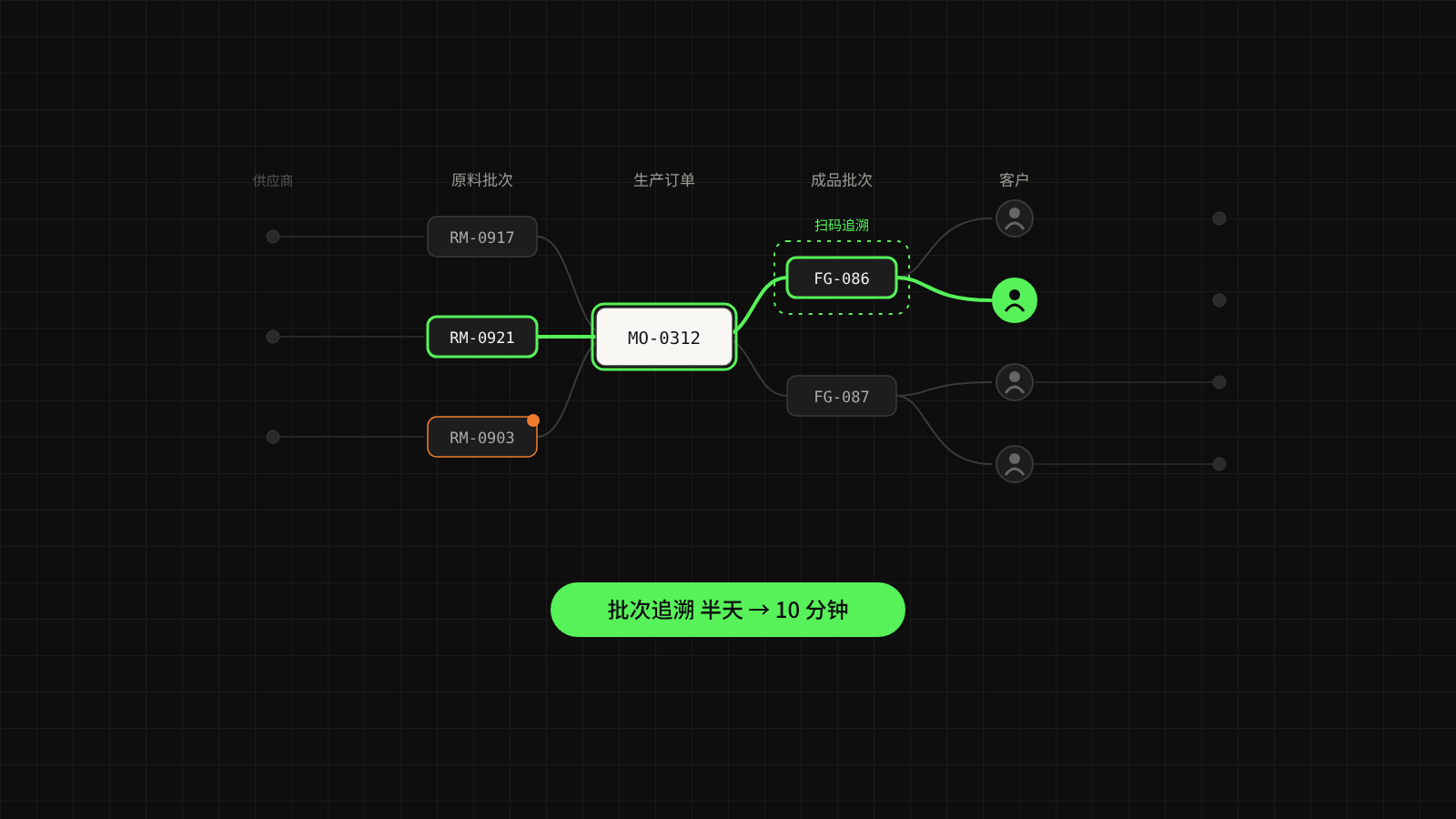
Batch Traceability Cut from Half a Day to 10 Minutes, with Every Batch Accounted For
A multi-category food manufacturer linked purchasing, production, warehousing and sales delivery into a single data chain. Any finished-goods batch can now be traced back to its raw material sources and forward to its customers, and batch traceability has dropped from about half a day to under 10 minutes.
Three-Temperature Inventory Tracked to the Bin, Average Picking Time Down About 40%
A wholesaler of ambient, chilled and frozen food tracked inventory down to bin location and batch, used PDAs for receiving, replenishment and picking, and dispatched stock on a first-expired, first-out basis. Average picking time fell by about 40%, and the value of stock nearing expiry dropped significantly.
Sales Orders Drive the Production Plan Directly, Lifting On-Time Delivery to About 92%
A high-mix, low-volume machining company let sales orders drive material requirements and capacity checks directly, with shop-floor terminals reporting progress in real time. Delivery promises are now grounded in data, on-time delivery rose from about 75% to about 92%, and stoppages due to material shortages fell markedly.
Quality issues traced to process step and supplier batch, with repeat issues down about 50%
A manufacturer of electronic assemblies and control modules linked inspection data to batches and serial numbers, tracked quality incidents through NCRs and launched CAPA for recurring and high-risk issues. Customer complaints can now be traced by serial number, and recurring quality issues have fallen by about 50%.
Specialty chemicals and advanced materials manufacturer
Controlled recipe versions and visible dosing deviations cut quality release time by about 40%
A producer of industrial cleaning agents and functional additives connected recipe versions, raw material batches, actual dosing and quality release into one controlled process. Every batch can be traced back to the recipe and raw materials used, and unreleased stock cannot be shipped.
A digital record for every machine lifts first-time fix rate to around 85%
An industrial equipment manufacturer built its after-sales operation around the serial number, linking customers, warranties, service orders, spare parts and repair costs. Technicians now see a machine's full history before they arrive on site, and after-sales has moved from reactive firefighting to ongoing management.
Styles, colours, sizes and materials calculated in one pass, with material shortages down about 60%
A contract manufacturer producing for several fashion brands standardised styles, colours and sizes into product variants. When an order changes, fabric, trim and packaging requirements are recalculated automatically: planners no longer rework Excel by hand, and purchasing and production work from the same data.
Credit checks at order entry and automatic payment matching cut DSO by about 20%
A wholesaler supplying restaurants, retailers and distributors connected customer credit, contract pricing, shipping, invoicing and bank receipts into a single order-to-cash process. Risks are now flagged as soon as an order is entered, and most incoming payments are matched to invoices by the system.
Is AI the Next Industrial Revolution, or an Overrated Substitute?
Some see AI as a new industrial revolution; others argue it merely replaces people without raising productivity. From the criteria used to define an industrial revolution, to the gap between task-level experiments and macro forecasts, to the historical lessons of electrification, we unpack where the two camps really disagree.
AI Agents in Production: How Companies Can Expand Autonomy While Staying in Control
AI agents are moving from pilots into real business operations, but most projects struggle to scale. The obstacle is rarely model capability; it is reliability, monitoring and risk control. This article covers the four areas you must address before an agent goes live, a phased approach to deployment, and how to expand autonomy step by step according to risk.
Middle Managers in the AI Era: What AI Will Take Over and What Matters More
AI and flatter organizations are prompting a fresh look at the value of middle managers. Compiling and relaying information will increasingly be handed to AI, while leading people, coordinating, exercising judgment and owning outcomes are becoming more important. This article examines how middle-management roles are changing, how managers view AI and what concerns them, and offers concrete advice for managers’ own transitions and for how companies can support their middle managers.
Choosing an LLM: Closed-Source APIs, Open-Weight Models or On-Premises Deployment
When companies adopt large language models, choosing the right way to use them matters more than finding “the most powerful model”. This article compares closed-source APIs, open-weight models and on-premises deployment in terms of capability, cost, data control and operations, outlines key compliance points such as GDPR and cross-border data transfers, introduces multi-model routing, and offers a step-by-step selection guide.
Customer Service in the AI Era: Balancing Efficiency and Experience
AI customer service is moving from rule-based bots to large language models and AI agents, yet customers worry about not being able to reach a human or getting wrong answers, and companies can be held liable for what their bots promise. Drawing on Gartner research and the Air Canada chatbot case, this article explains which issues are suited to AI, key design principles, a step-by-step rollout approach, and the metrics that matter more than containment rate.
Career and Identity: Answering “Who Am I?” in the Age of AI
When AI starts doing the things many people take pride in, can a career still represent who we are? This article looks at how professional identity forms, the real reason AI unsettles it, which kinds of value still belong to people, and how individuals and companies can respond to this shift.
ByteDance Tightens Access for External AI Tools: What Companies Should Take from It
ByteDance is reportedly restricting external AI tools such as Claude and Codex from accessing sensitive internal code and documents from November, including personal accounts employees have paid for themselves. This isn’t a ban on AI. It is an answer to a question every company will face sooner or later: which data can the AI in employees’ hands touch?
Before AI Goes Live: The Data Your Business Needs to Get in Order First
Many AI projects stall not because the model falls short, but because the data is inaccurate, incomplete, hard to find or has no owner. This article explains why AI projects so often get stuck on data, the five most common data problems in companies, six conditions for AI-ready data, and seven steps to prepare data starting from a single business use case.