Today, almost every company uses AI, but not every company has become more competitive as a result. When anyone can buy the models and tools, technology alone rarely sets a company apart. A genuine AI competitive advantage comes from aligning strategy, technology and organizational culture, and from the ability to keep generating value within regulatory requirements.
So how does a company move from “using AI” to “having an AI advantage”? This article covers, in turn, what makes up an AI competitive advantage, how to build governance under regulations such as the EU AI Act, how to turn AI results into measurable business value, and how to make AI an everyday capability of the organization.
Why doesn’t using AI mean having an AI competitive advantage?
A competitive advantage requires something others find hard to copy. General-purpose AI tools, by contrast, are available to everyone. If a company simply gives its employees the same tools as its competitors, what it gains is “not falling behind,” not “getting ahead.”
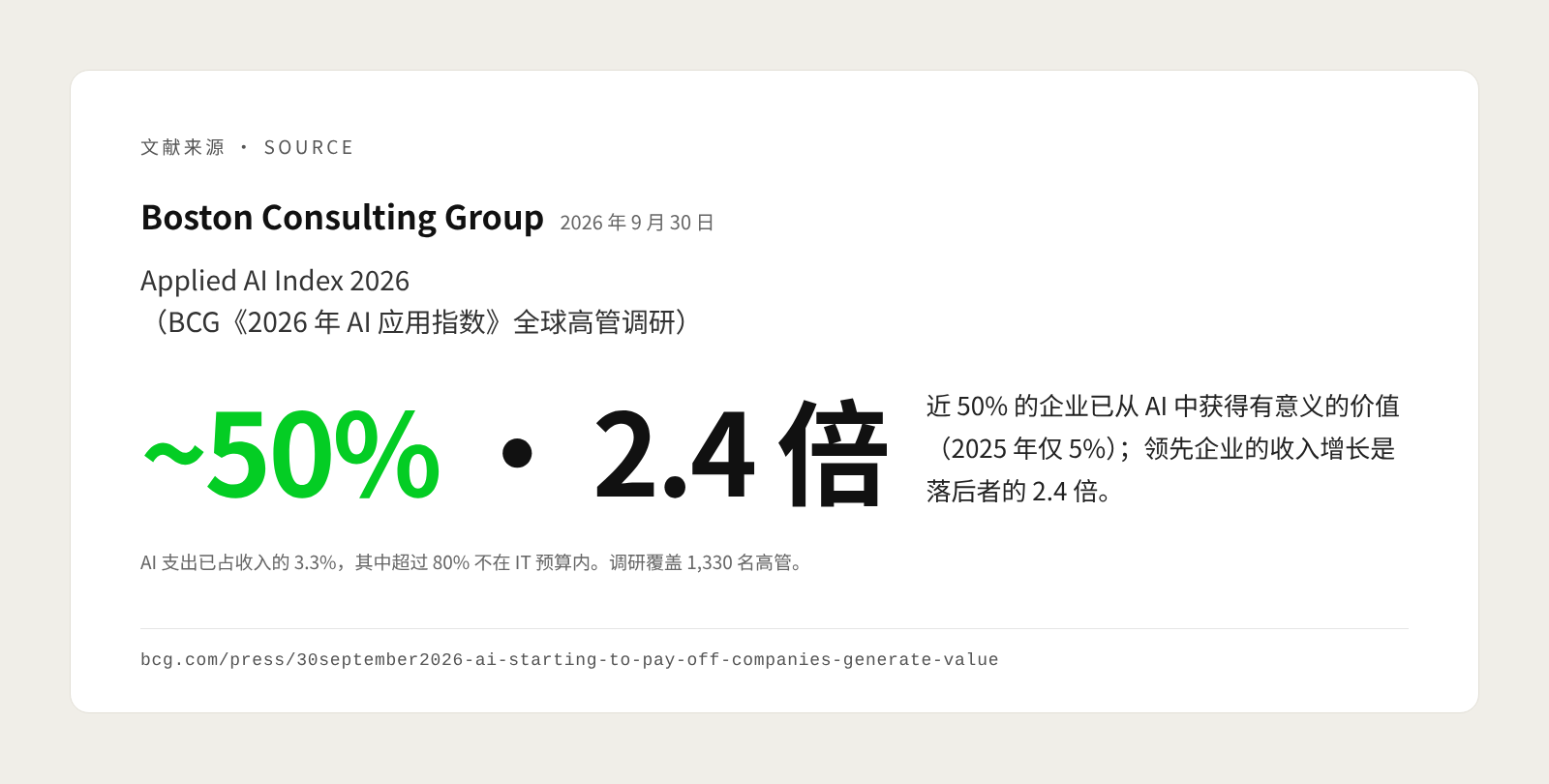
BCG’s Applied AI Index 2026, published in September 2026, surveyed 1,330 executives and found that the gap is widening fast (source):
- Many more companies are creating value. Nearly 50% of companies are now getting meaningful value from AI, compared with just 5% in BCG’s 2025 research.
- Leaders’ advantage is already showing up in the financials. The 7.5% of companies classed as “future-built” achieve total shareholder return, revenue growth and EBITDA growth 2.3, 2.4 and 2.8 times that of laggards, respectively.
- Investment is accelerating. AI spending as a share of revenue has risen from about 1.7% at the end of 2025 to 3.3%, and more than 80% of that spending sits outside the IT budget.
The last point deserves particular attention: AI has moved from being a technology project in the IT department to a business investment made by operating units. This means the measure of AI success should also shift from “Has the system gone live?” to “Has the business improved?”
Consider two competing distributors that adopt the same AI customer service tool. One uses it only to answer common questions; the other connects it to its own inventory, pricing and customer history data and redesigns its quoting process so customers get an accurate quote within minutes. The tool is the same; the difference comes from each company’s own data and processes.
What makes up an AI competitive advantage?
An AI competitive advantage doesn’t come from a single tool or project, but from a combination of three layers: strategy decides where AI is used, technology decides how well it performs, and culture decides whether it is actually used. All three are essential, and the harder a component is for competitors to copy, the more lasting the advantage it creates.
Strategy: apply AI to the core business. Using AI only for emails and meeting notes brings efficiency; using it for pricing, the supply chain, products and customer experience is what brings competitiveness. BCG found that leading companies all start with a clear view of where AI creates value and concentrate AI on high-value areas. For guidance on assessing and selecting use cases, see Enterprise AI strategy: how to escape the pilot trap.
Technology: build a moat with your own data and processes. Models can be bought, but the customer data, transaction records, product knowledge and experience a company has accumulated cannot be bought or stolen. Cleaning up this data, connecting it to AI and redesigning end-to-end processes around AI is what competitors find hard to copy.
Culture: make employees willing, able and confident to use AI. Even the best system cannot deliver value if employees don’t trust it or don’t know how to use it. BCG’s survey shows that seven in ten leading and scaling companies are already reskilling their employees.
The table below compares “using AI” with “having an AI advantage” across these layers:
| Layer | Just using AI | Having an AI advantage |
|---|---|---|
| Strategy | Departments experiment on their own, on peripheral tasks | Focused on a few core business areas, directly tied to corporate strategy |
| Technology | General-purpose tools; data copied and pasted as needed | Connected to proprietary data, with processes redesigned around AI |
| Culture | A few people know how to use it; know-how stays with individuals | Everyone has baseline skills; effective practices are captured in processes and templates |
| Measurement | How many tools have gone live | Changes on the P&L |
| Governance | Rules added after problems arise | Rules set up front, so innovation has boundaries and is sustainable |
This table can serve as a starting point for self-assessment: any row still in the left-hand column is where the next investment will pay off most.
How should AI be governed as regulation tightens?
For companies operating in Europe, regulation is no longer a future concern. Treating governance as a brake on innovation is a misconception; clear rules actually let teams expand their use of AI with more confidence.
The EU AI Act is the most prominent example. In July 2026, its amendment, the AI Omnibus, was formally published, adjusting when some obligations take effect (source):
- February 2, 2025: Provisions on prohibited AI practices and AI literacy began to apply.
- August 2, 2025: Rules for general-purpose AI models, the governance framework and penalty provisions began to apply.
- August 2, 2026: The Act applies in full, including the transparency obligations in Article 50, such as informing users that they are interacting with AI.
- December 2, 2027: Obligations for high-risk AI systems listed in Annex III begin to apply, originally scheduled for August 2026. Use cases such as recruitment and credit assessment fall into this category.
- August 2, 2028: Obligations for high-risk AI systems listed in Annex I (linked to product safety legislation) begin to apply.
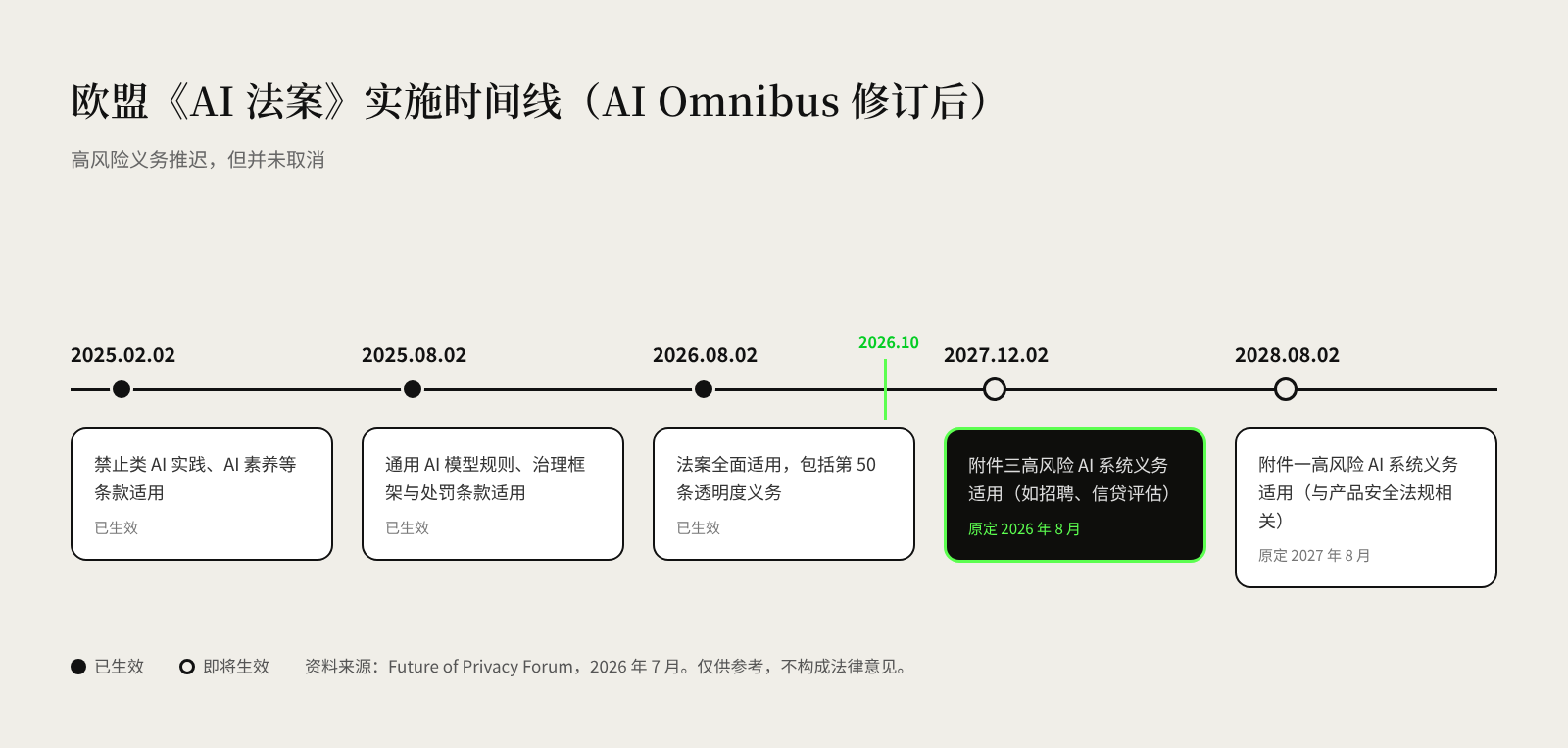
The high-risk obligations have been postponed, not canceled. Meanwhile, the authority companies give AI keeps growing. BCG’s survey shows that 42% of companies expect to give AI agents real decision-making authority by 2030, yet only 5% currently have full control mechanisms in place.
In practice, you can build baseline governance in five areas:
- Build an AI inventory. Establish which AI tools and systems are in use across the company, for what purposes and who is responsible for them — including tools employees use on their own.
- Classify by risk. Assess use cases against the regulation and their business impact, identify those that may be high-risk and address them first.
- Define data boundaries. Specify which data may go into which tools; customers’ personal data and trade secrets must not enter unauthorized external services. This is also a GDPR requirement.
- Keep human oversight. For decisions that affect customers, employees or money, make sure someone can review, intervene and take responsibility.
- Keep records. Retain records of model versions, data sources, test results and key decisions — useful both for internal reviews and for external inspections.
For example, if a company uses AI to screen résumés, this is a high-risk use case listed in the Act. Rather than scrambling to fix things in 2027, build human review, bias checks and record-keeping into the process now. The above is general information; please consult your legal advisers on specific compliance requirements.
How can you prove AI is really paying off?
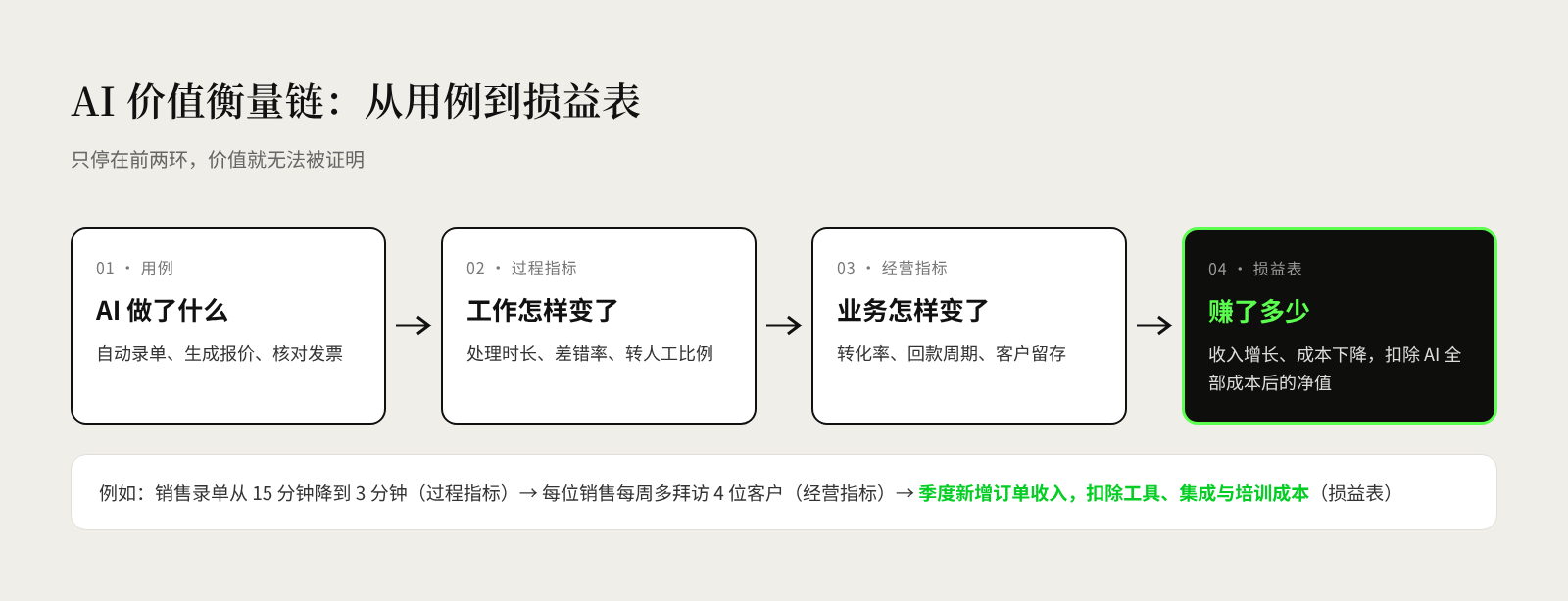
If AI’s impact stops at “employees feel faster,” it is hard to secure sustained investment. BCG found that leading companies measure AI’s impact directly on the P&L. Getting the numbers right on AI’s value is the passport from pilot to scale.
Set business metrics first, then work back to process metrics. First decide which business metric the AI use case should ultimately affect — gross margin, collection cycle or customer retention, for example — then work back to intermediate metrics such as processing time, error rate and conversion rate.
Record a baseline before going live. Without a baseline, there is nothing to compare against. Before introducing AI, record at least several weeks of real data for the relevant metrics.
Keep a control group. Have some teams, stores or customer segments use AI while others carry on as before, so you can separate AI’s impact from seasonality, market conditions and other factors.
Count the full cost. Besides software and usage fees, include the effort spent on data preparation, system integration, training, human review and compliance. Counting the benefits but not the costs overstates AI’s return.
Put the time saved to use. Time employees save only turns into revenue or profit when it is reallocated to higher-value work. For example, the time the sales team no longer spends entering orders should be explicitly redirected to visiting more customers.
Review quarterly and let resources follow results. Each quarter, review how each use case’s metrics have changed, and shift resources from underperforming projects to proven ones.
How do you turn AI from a project into an everyday organizational capability?
Projects have a beginning and an end, but competitive advantage has to accumulate continuously. Only when AI no longer depends on a particular project team or a few enthusiastic employees, and becomes the way every department works, does the advantage grow year after year.
To get there, focus on four areas:
- Assign business owners. Every AI use case should have a business owner who is accountable for results, rather than leaving the technical team to deliver it and move on.
- Build shared platform capabilities. Build data integration, access management, evaluation processes and governance rules centrally, so each department can quickly build its own applications on top. That way, every new project starts from a higher baseline than the last.
- Turn effective practices into standards. Prompts, templates and processes that employees have proven should be captured in shared knowledge bases and systems, not left in individual chat histories.
- Keep building team capabilities. Design role-specific AI training so that management knows how to evaluate investments, business teams know how to work with AI, and technical teams know how to build and maintain systems securely. BCG expects dedicated AI roles to grow from 7% of the total workforce in 2026 to 22% in 2030.
Suppose a company successfully launches an AI application for invoice matching in its finance department. If the data integration and review mechanisms belong only to finance, purchasing has to start from scratch when it wants to run similar contract checks; if they are built as shared capabilities, purchasing can be up and running within weeks. This kind of reuse is how competitive advantage builds up, step by step.
Four questions managers ask most
Can small and medium-sized businesses build an AI competitive advantage too? Yes. SMEs have short decision chains and processes that are easier to adjust. By applying AI to one or two core areas and combining it with their own customer and business data, they can build advantages that large companies cannot quickly replicate.
Which companies does the EU AI Act apply to? It applies not only to companies that develop AI but also to companies that use AI systems within the EU, including non-EU companies doing business in the EU. The specific obligations depend on a company’s role and the risk level of the use case; we recommend consulting your legal advisers.
The high-risk obligations have been postponed — can we leave them for now? We don’t recommend it. The postponement simply gives more time to prepare. Building an AI inventory, risk classification and record-keeping takes time, and the earlier you start, the lower the cost of fixing things later.
How soon will AI show a return on investment? It depends on the use case. Process automation use cases usually show efficiency gains within a few months; use cases involving business model or product innovation take longer. The key is to set a baseline and interim targets before you start.
References
- Applied AI Index 2026 (press release), BCG, September 2026
- The AI Act Implementation Timeline: What Changes Under the AI Omnibus?, Future of Privacy Forum, July 2026