Customer service was one of the first areas where companies adopted AI, and one where they have done so most eagerly. From auto-replies to AI agents that can look up orders and process refunds, AI customer service genuinely lets companies handle more inquiries with fewer people. But customers aren’t always convinced: irrelevant answers and endless loops with no way to reach a human make for a poor experience and can even expose a company to legal liability. The goal of AI customer service shouldn’t be “fewer calls answered” but “customer problems solved faster and more accurately.” Efficiency and experience have to be weighed together.
So how can companies strike the right balance? In this article, we cover how AI customer service has evolved from rule-based bots to large language models and AI agents, how customers really feel about AI support, the lessons of the Air Canada chatbot case, which issues are suited to AI, and the design principles, step-by-step rollout approach and metrics that truly matter.
How has AI customer service evolved?
AI customer service has gone through roughly three stages: rule-based bots, LLM assistants and customer service agents. Each stage has brought greater capability, but the way things go wrong has changed too: from “not understanding” to “sounding entirely convincing while being wrong.”
- Rule-based bots. Early customer service bots relied on keywords and predefined question-and-answer trees. If a customer typed “return,” the bot sent a link to the returns policy. It rarely said anything wrong, but as soon as a question strayed slightly outside the predefined scope, all it could say was “Sorry, I didn’t understand. Please rephrase.”
- LLM assistants. Customer service built on large language models (LLMs) can understand natural language and compose answers from a knowledge base, which noticeably improves the conversation. But it may improvise where the knowledge base has gaps, producing answers that sound reasonable but contradict company policy.
- Customer service agents. AI agents don’t just answer questions; they can also call business systems to complete tasks, such as tracking a shipment, changing a delivery address or initiating a refund. They can resolve far more issues, but when they get something wrong, the consequences land directly on orders and money.
This shift is happening fast. Salesforce’s State of Service: AI Agents Edition, published in May 2026, surveyed 3,075 service professionals and found that the share of service organizations using AI agents rose from 39% in 2025 to 66% in 2026; among teams already using agents, 70% said they saw measurable value within 60 days of deployment (source). Note that this survey was commissioned by a customer service software vendor and that respondents were service professionals rather than end customers, so the findings reflect the company side of the picture.
How do customers view AI customer service?
Companies are enthusiastic about AI customer service; customers are noticeably more cautious. What customers really fear is not AI itself but being shut out by it, unable to reach someone who can solve their problem.
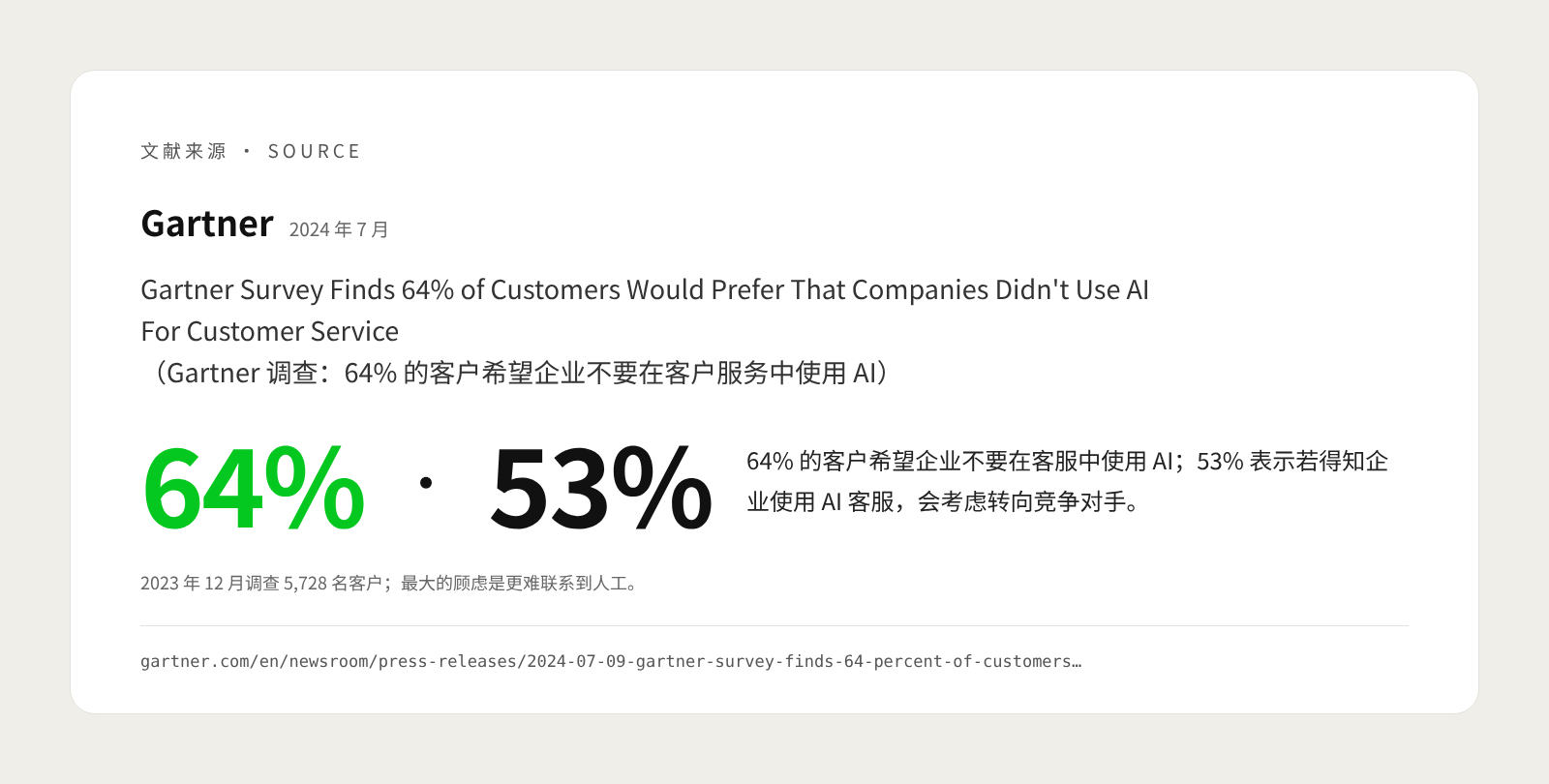
Gartner surveyed 5,728 customers in December 2023, and the results, published in July 2024, showed that 64% of customers would prefer that companies didn’t use AI in customer service, and 53% said they would consider switching to a competitor if they found out a company was going to use AI for customer service. Customers’ biggest concern was that it would become harder to reach a human agent, followed by AI displacing jobs and AI giving wrong answers (source). The survey was completed at the end of 2023, and AI customer service has changed considerably in both capability and adoption since then, so today’s figures may differ — but the categories of concern remain instructive.
There is also a clear perception gap between companies and customers. The Salesforce report cited above found that 65% of service professionals believe their customers fully trust AI, while a Metrigy consumer survey cited in the same report found that only 44% of consumers trust AI to handle their customer service needs (source).
Gartner’s own outlook is restrained as well. In September 2025, it predicted that by 2028, none of the Fortune 500 companies will have fully eliminated human customer service, and that by 2027, half of the companies that had planned to significantly reduce their customer service workforce because of AI will abandon those plans after failing to achieve “agent-less” operations (source). Gartner analysts argue that AI still struggles with exceptions and high-stakes situations, and that the more realistic direction is a hybrid model of people plus AI, not a fully unstaffed contact center.
What does the Air Canada chatbot case show?
The 2024 case of Moffatt v. Air Canada is the most frequently cited lesson in AI customer service. It illustrates a simple principle: what a customer service bot says, the company says.
According to the decision issued on 14 February 2024 by the Civil Resolution Tribunal of British Columbia, Canada, the facts were broadly as follows (source):
- In November 2022, passenger Jake Moffatt’s grandmother died. He asked the customer service chatbot on Air Canada’s website about bereavement fares.
- The chatbot told him he could buy tickets at the regular price and then apply, within 90 days of the ticket being issued, for a refund of the difference at the reduced bereavement rate. Yet the official page linked in the chatbot’s answer actually stated that bereavement fares did not apply to requests made after travel had been completed.
- Moffatt bought return tickets as the chatbot had described, and his later request for a refund of the difference was refused. Air Canada acknowledged that the chatbot’s wording was misleading, but argued that it could not be held liable for information provided by its agents or representatives, including a chatbot.
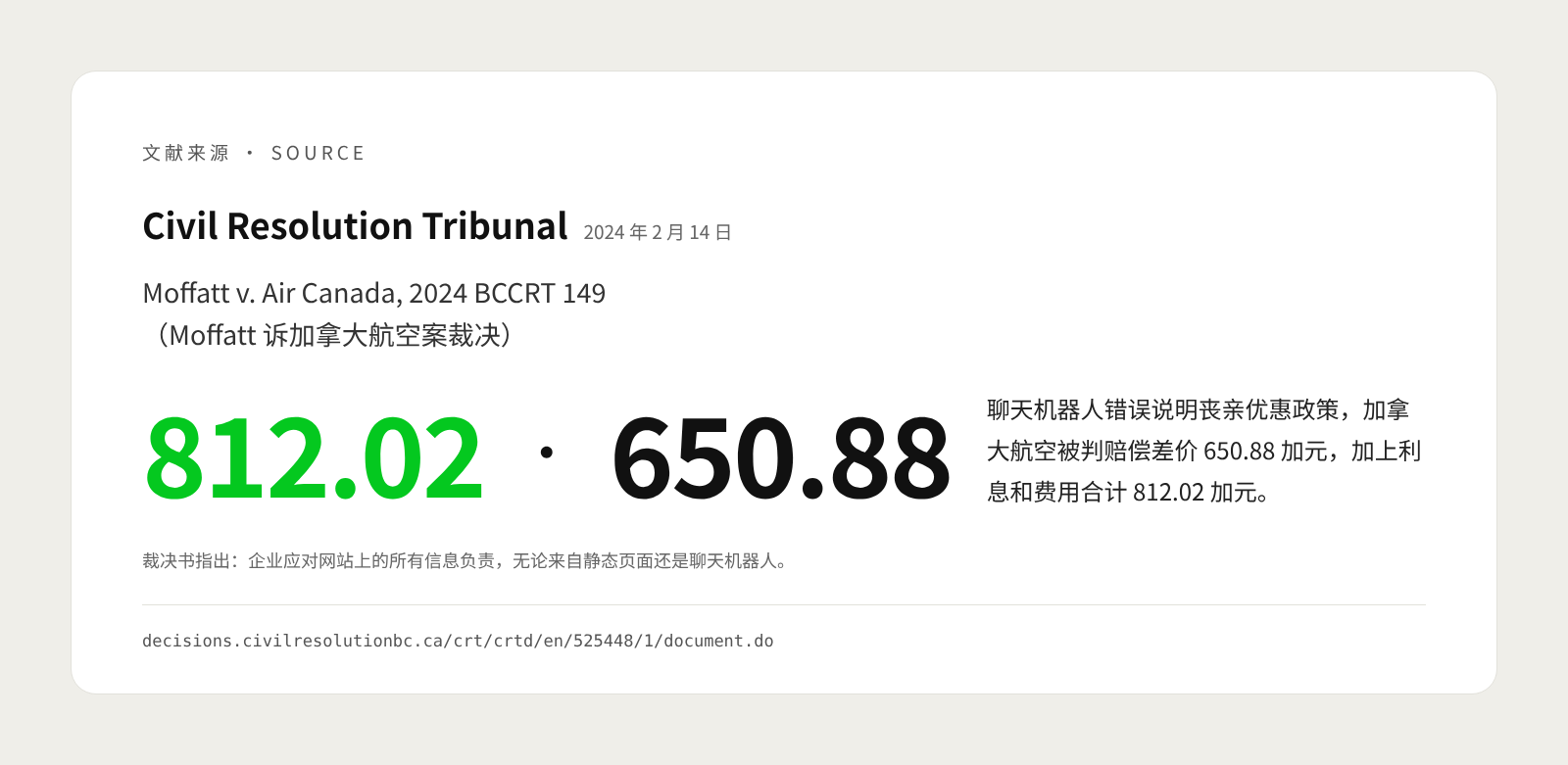
- The tribunal found that this amounted to suggesting the chatbot was a separate legal entity responsible for its own actions, calling it a “remarkable submission,” and ultimately held Air Canada liable for negligent misrepresentation. The decision stated that although a chatbot has an interactive component, it is still just part of Air Canada’s website, and the company is responsible for all the information on its website, whether it comes from a static page or a chatbot.
- Air Canada was ultimately ordered to pay CA$650.88 in damages for the fare difference, plus interest and tribunal fees, for a total of CA$812.02.
The amount was small, but the implications are far-reaching. For companies, the case offers at least three lessons. First, “the bot said it” is no defense. Second, the policy details in a bot’s answers must match official policy; where the two conflict, a company can hardly expect customers to check for themselves. Third, commitments involving refunds, compensation and pricing exceptions are the most likely to go wrong and need the strictest boundaries.
Which issues are suited to AI, and which must go to a human?
Deciding who should handle an issue comes down to two things: how clear-cut the answer is, and how costly a mistake would be. Issues with clear, verifiable answers, where errors are easy to correct, are well suited to AI. Issues involving judgment, emotion, money or legal consequences should go to a person, or at least be confirmed by one.
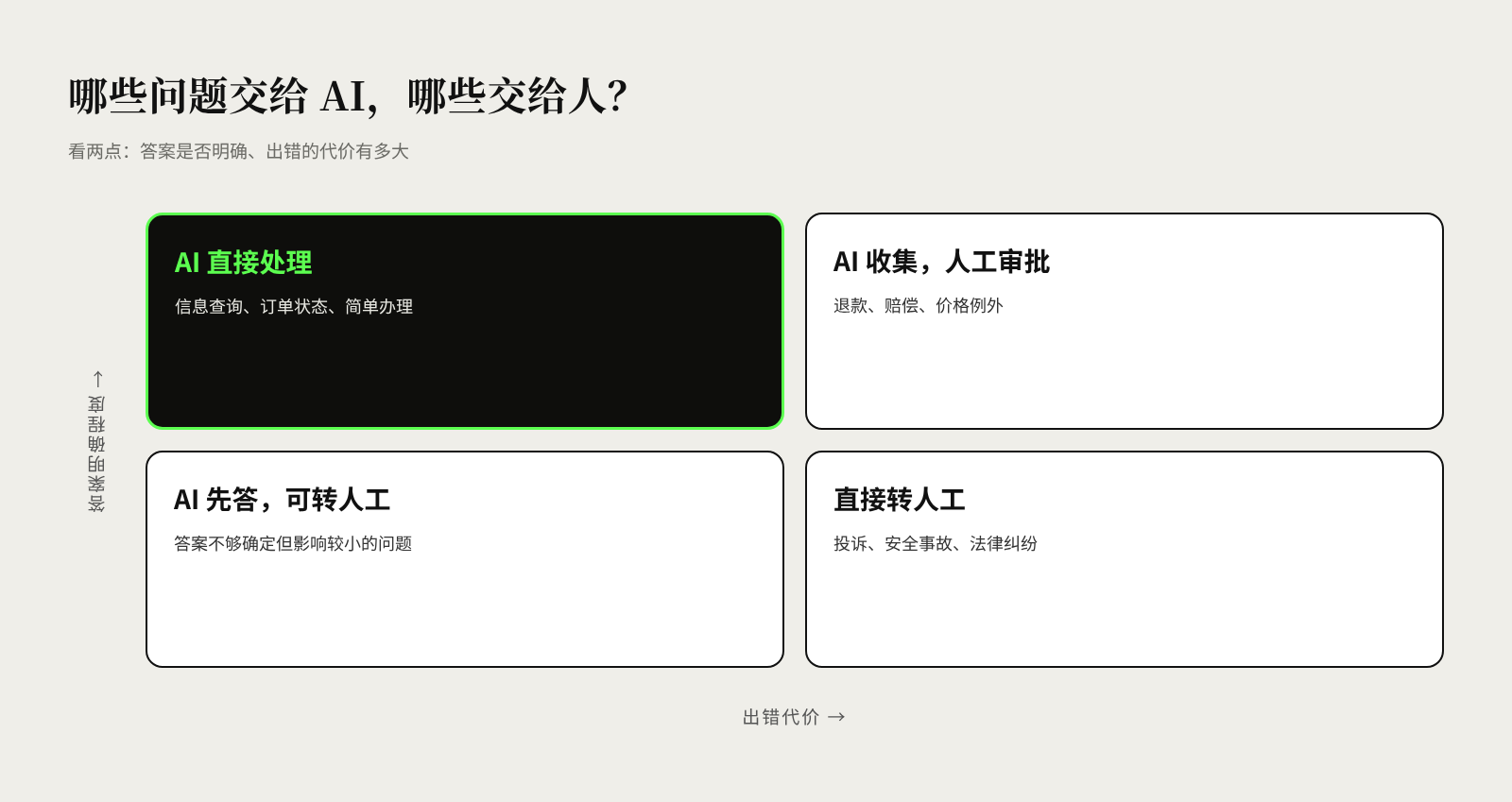
The table below offers a common reference for dividing the work:
| Issue type | Typical examples | Recommended handling | Why |
|---|---|---|---|
| Information requests | Opening hours, store addresses, delivery areas | AI answers directly | Standard answers that can be drawn straight from the knowledge base |
| Status inquiries | Where an order is, ticket progress, whether an invoice has been issued | AI checks the system, then answers | Data can be verified, and errors are easy to spot |
| Simple transactions | Changing a delivery address, booking an installation slot, resending an e-invoice | AI handles it within defined rules | Clear rules, and actions can be reversed |
| Money and exceptions | Refunds, compensation, pricing exceptions, special handling beyond policy | AI gathers information, a person approves | High cost of error, and easily read as a commitment |
| Complaints and strong emotions | Repeated unresolved complaints, explicit dissatisfaction | Escalate to a human quickly | Requires empathy and flexibility |
| Complex or high-risk | Safety incidents, legal disputes, health-related issues | Escalate straight to a human | Involves judgment and legal liability |
| Customer explicitly asks for a human | “I want to speak to a person” | Escalate to a human immediately | Respects the customer’s choice and avoids escalating frustration |
The table is for reference only; the exact boundaries should be adjusted to your industry, regulatory requirements and your company’s own risk tolerance.
What principles should guide the design of AI customer service?
Good AI customer service isn’t about making it as hard as possible to reach a human; it’s about getting customers to a resolution by the shortest path. The five principles below all come down to one thing: customers should always know who they are dealing with and who is responsible for their issue.
Make a human always reachable. The route to a human agent should be visible and easy to find, not buried several turns into a conversation. In the survey cited above, Gartner recommends that when a bot cannot resolve an issue, it should proactively tell the customer it will transfer them to a human (source).
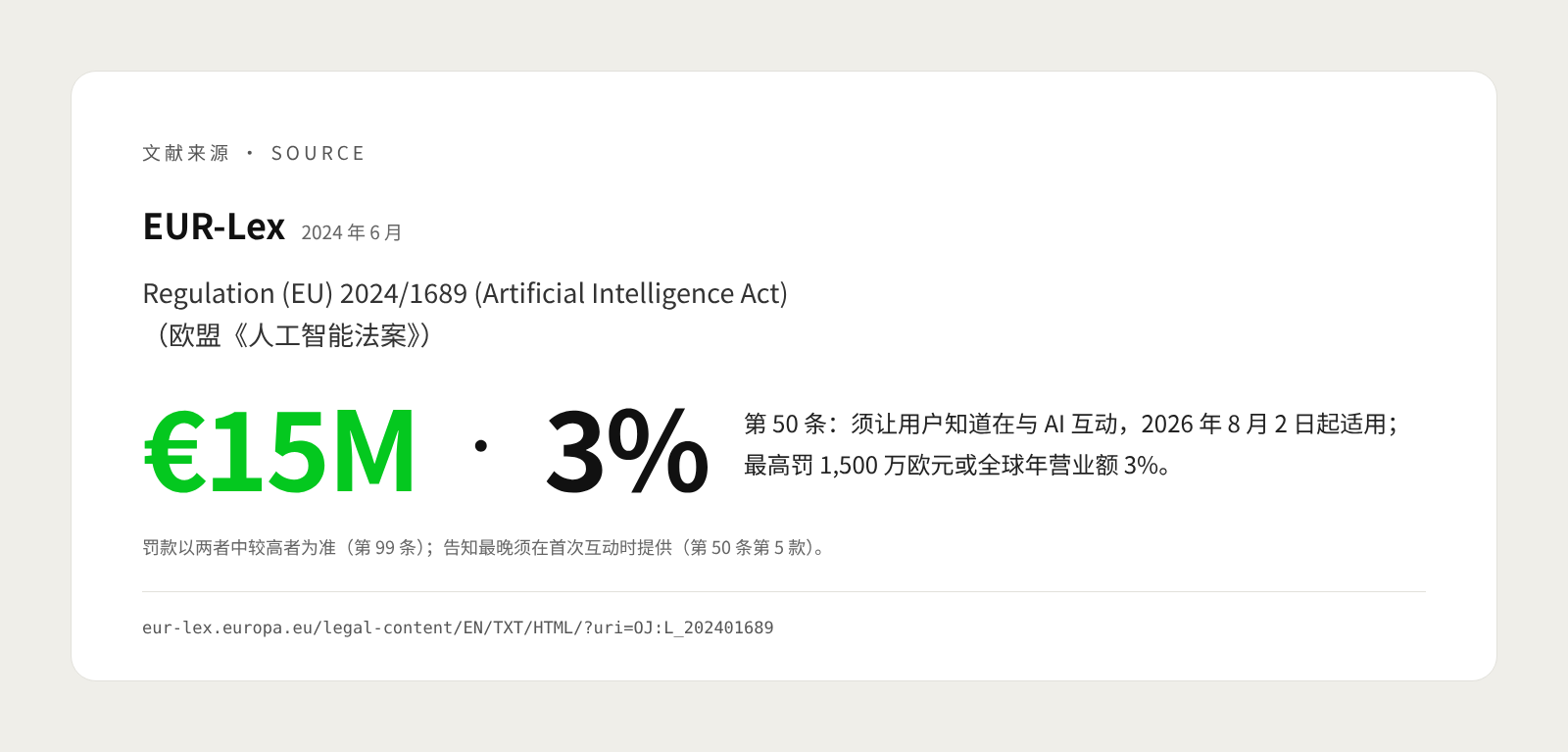
Disclose that it’s AI. Letting customers know from the start that they are talking to AI is a matter of respect and also helps manage expectations. For companies serving customers in the EU, it is now a legal requirement: Article 50(1) of the EU Artificial Intelligence Act (Regulation (EU) 2024/1689) requires providers to ensure that AI systems intended to interact directly with natural persons are designed so that those persons are informed they are interacting with an AI system, unless this is obvious to a reasonably well-informed, observant and circumspect person. Article 50(5) requires this information to be provided in a clear and distinguishable manner at the latest at the time of the first interaction (source). Under Article 113, these obligations apply from 2 August 2026; under Article 99, breaches of the Article 50 transparency obligations can incur fines of up to €15 million or 3% of total worldwide annual turnover, whichever is higher. A July 2026 analysis by the Irish law firm McCann FitzGerald notes that the EU’s subsequent Digital Omnibus only changes the application date of Article 50(2) (machine-readable marking of AI-generated content) for existing systems; the chatbot disclosure obligation still follows the August 2026 timeline (source). For how specific compliance responsibilities are allocated, we recommend consulting a qualified lawyer.
Pass on the context at handover. What customers dislike most after being transferred is having to explain their problem all over again. The bot should hand over the customer’s identity, the information already confirmed, the steps already tried and the conversation history to the human agent. Gartner also recommends making the handover seamless, with the human agent picking up where the bot left off.
Never promise beyond its authority. As the Air Canada case shows, a bot’s commitments are the company’s commitments. For anything involving refund amounts, compensation or pricing exceptions, the bot should only explain the policy and process, never make promises of its own, and hand over to an authorized human for confirmation when needed.
Answer only from an accurate, up-to-date knowledge base. The bot’s answers should be based on policy documents, product information and business data the company has reviewed, with sources cited wherever possible. When something isn’t in the knowledge base, it is better to reply “this needs to be confirmed by a member of our team” than to let the model guess. Whenever a policy changes, the knowledge base must be updated at the same time.
How should you roll out AI customer service step by step, and which metrics should you track?
The safest way to roll out AI customer service is to start with a narrow scope of low-risk issues and let data decide the next step. First prove it can handle simple issues well, then gradually expand what it can take on.
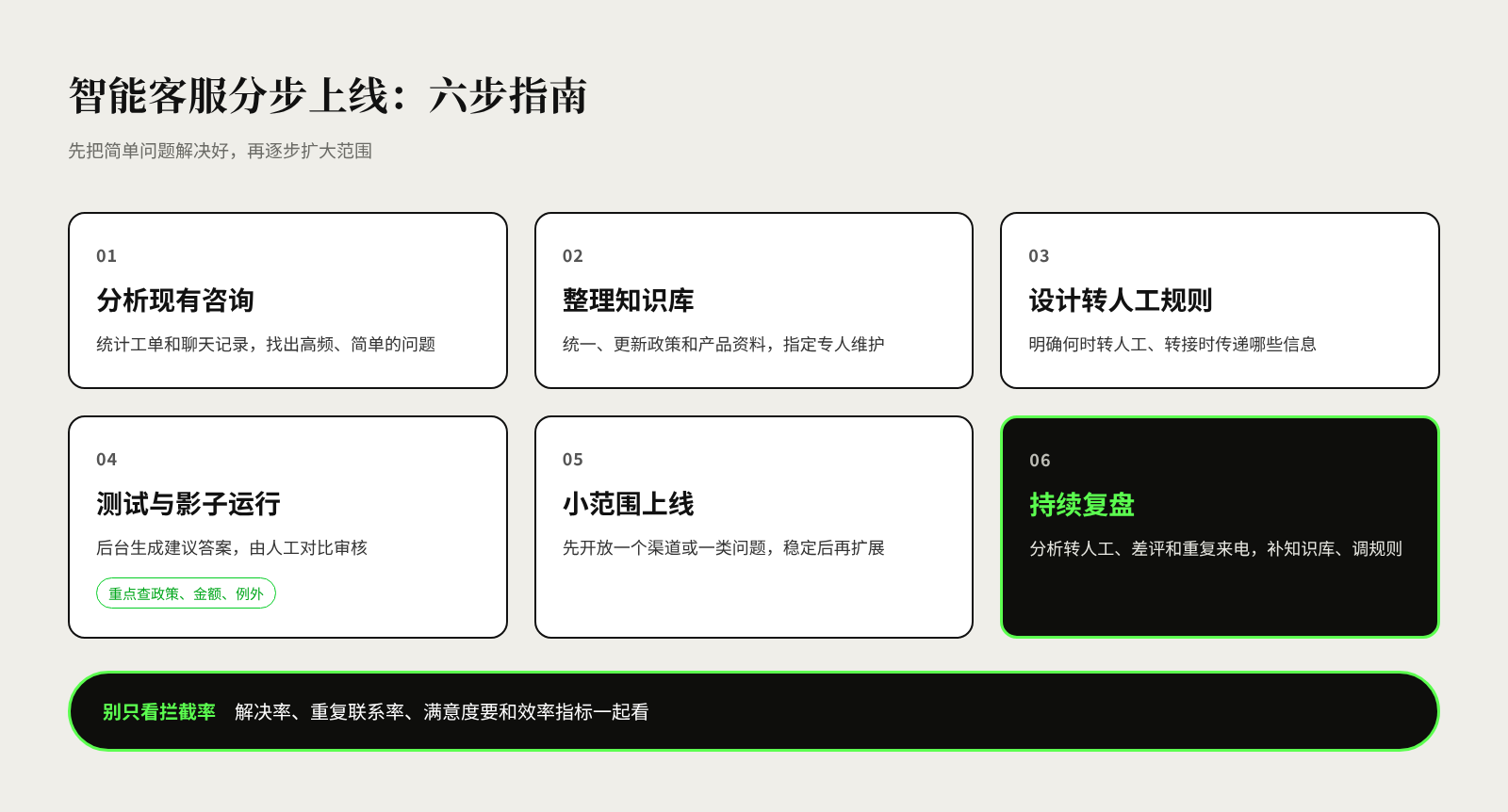
Step 1: Analyze existing inquiries to identify frequent, simple issues. Export the past few months of tickets and chat logs, and tally the volume and handling time by issue type. Typically a handful of issue types (such as order inquiries, invoices and delivery times) account for most of the volume, and these are the best place to start.
Step 2: Organize and review the knowledge base. Consolidate policies, product information and FAQs into a single, up-to-date version, and assign a named owner to maintain it. The quality of the knowledge base sets the ceiling on the quality of the bot’s answers.
Step 3: Design escalation rules and the handover process. Define which issues go straight to a human, in which situations the bot must stop, and what information is passed on at transfer. At the same time, make sure human agents are scheduled to absorb the escalated inquiries.
Step 4: Test internally and run in shadow mode. First have employees play the role of customers, then let the bot process real inquiries in the background, generating suggested answers only, which staff compare and review. Focus on whether it gets policy details, amounts and exceptions wrong.
Step 5: Launch on a small scale, then expand gradually. Start with one channel or one type of issue — for example, handling only order inquiries on your website. Once performance is stable, extend it to more channels and to transactional requests.
Step 6: Review continuously and close the improvement loop. Sample conversation logs every week, focusing on cases that were escalated, received negative feedback or led to repeat contacts, and use them to fill gaps in the knowledge base and adjust the rules.
The most common mistake in measuring AI customer service is looking only at containment rate — the share of inquiries that never reach a human. A high containment rate may mean issues were resolved, or it may mean customers couldn’t find a human and gave up. A more reliable approach is to look at efficiency and experience metrics together:
- Resolution rate. Whether the customer’s issue was actually resolved, which can be gauged through confirmation at the end of the conversation or a follow-up.
- Repeat contact rate. A customer getting in touch again about the same issue within a short period usually means it wasn’t resolved the first time.
- Escalation rate and reasons for escalation. A lower escalation rate isn’t automatically better; what matters is analyzing why: the bot’s limited capability, gaps in the knowledge base, or issues that should have gone to a person in the first place.
- Customer satisfaction. Track satisfaction separately for AI-handled and human-handled interactions, paying particular attention to how satisfaction changes after a transfer from bot to human.
- Errors and complaints. Track complaints triggered by the bot giving incorrect information or making inappropriate commitments. Even if there are very few, each one deserves a review.
FAQs about AI customer service
Do small and mid-sized businesses need AI customer service? It’s worth considering if you handle a high volume of inquiries with many repeat questions. If volume is modest and your customers value the personal touch, start by organizing your knowledge base and setting up auto-replies. The key is first to work out which issues consume the most staff time.
Should you tell customers they are talking to AI? Yes, we recommend it. It helps build trust and manage expectations, and for services aimed at EU users, it is also required under Article 50 of the AI Act from 2 August 2026.
If the bot gives a wrong answer, is the company liable? Judging by the Air Canada case, companies will struggle to escape liability by claiming “the bot said it.” That is why you should limit the bot’s ability to make commitments on matters such as refunds and compensation, and regularly check that its answers are consistent with official policy.
Once AI customer service is in place, can you drastically cut customer service staff? Proceed with caution. Gartner predicts that half of the companies planning to significantly reduce their customer service workforce with AI will abandon those plans by 2027. A more prudent approach is to let AI handle simple, repetitive issues and focus your human agents on complex problems and customer relationships.
References
- State of Service: AI Agents Edition (press release: AI service agents improve customer satisfaction), Salesforce, May 2026
- Gartner Survey Finds 64% of Customers Would Prefer That Companies Didn't Use AI For Customer Service, Gartner, July 2024
- Gartner Predicts None of the Fortune 500 Companies Will Have Fully Eliminated Human Customer Service by 2028, Gartner, September 2025
- Moffatt v. Air Canada, 2024 BCCRT 149, Civil Resolution Tribunal (British Columbia, Canada), February 2024
- Regulation (EU) 2024/1689 (Artificial Intelligence Act), EUR-Lex, June 2024
- One Month to Go: EU AI Act Transparency Compliance, McCann FitzGerald, July 2026