Over the past four decades, enterprise digital transformation has gone through two major leaps: first moving information from paper onto computers, then building business processes into systems. The third leap is under way. The role of systems is shifting from “recording the business” to “helping run it”: AI agents are beginning to make judgements, take action and coordinate within the limits of their authorization, and companies are entering the stage of “intelligent operations”.
What problems did each stage solve, and what problems did it leave behind? How does intelligent operations differ fundamentally from the previous generation of “reports + automation”? This article sets out the characteristics and limits of each stage, how intelligent operations works, how companies can tell where they stand, and which foundations need to be in place before moving to the third stage.
What did each of the three stages change?
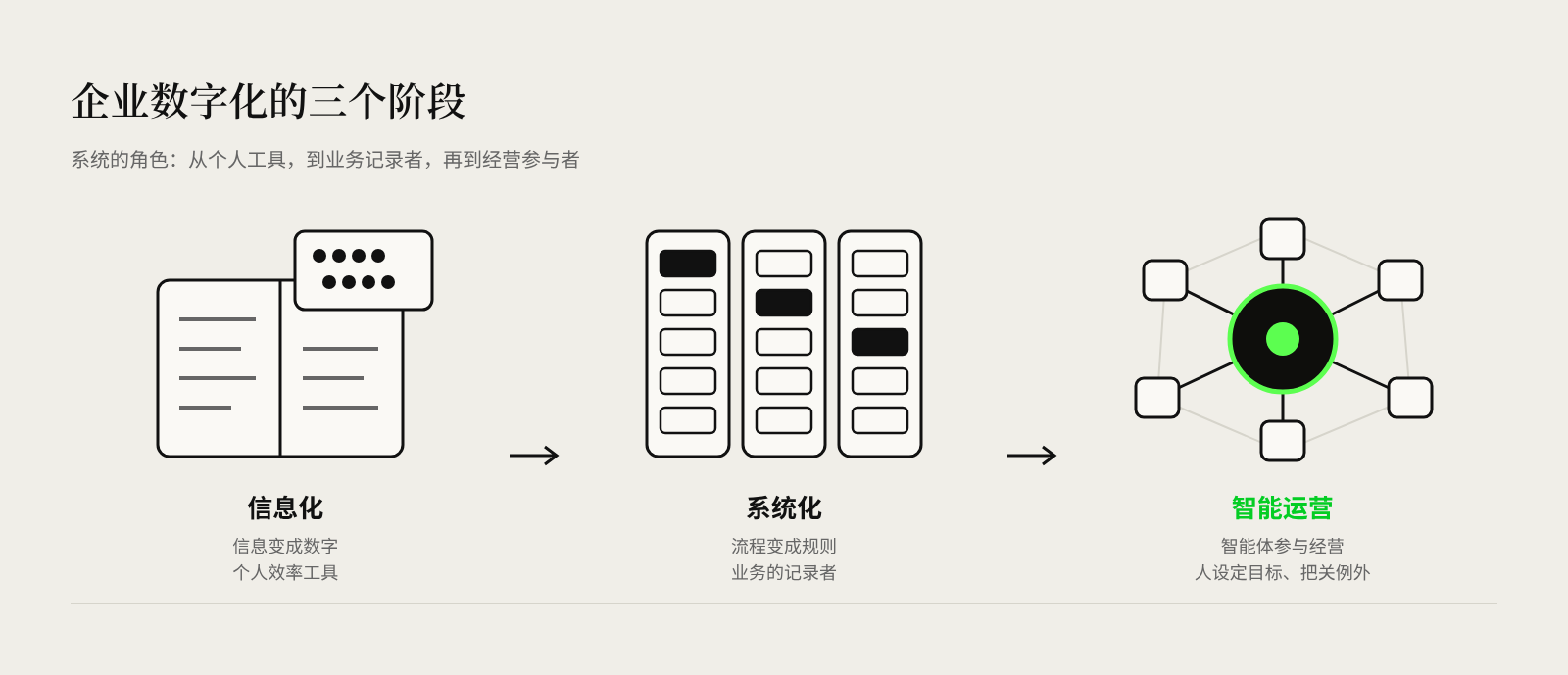
Enterprise digital transformation can be divided into three stages: digitization turned information into data, systematization turned processes into rules, and intelligent operations turns systems from record-keepers into doers. With each leap, what changes is not just the technology but the division of labor between people and systems.
| Dimension | Digitization | Systematization | Intelligent operations |
|---|---|---|---|
| Approximate timing | From the 1980s | From the 1990s | From around 2023 |
| Key technologies | PCs, office software, email | ERP, CRM, OA, SaaS | Large models, AI agents, data platforms |
| Role of systems | Personal productivity tools | Record-keepers of the business | Participants in running the business |
| State of data | Scattered across personal files | Locked in separate systems | Connected and accessible to agents |
| Role of people | Data entry, calculation, collation | Following processes, approving | Setting goals, overseeing, handling exceptions |
| Problems left behind | Data follows people and can’t be shared | System silos: plenty of data, little use | Governance and trust, still being built |
It is worth noting that the three stages do not simply replace one another. Most companies straddle two or even all three at once: finance moved onto systems long ago, sales still works in spreadsheets, and a few departments are already trialling agents. The timing is only approximate; the pace varies widely across industries and regions.
Digitization: information became data for the first time
The core change of the digitization stage was that information existed in digital form for the first time. It greatly boosted individual productivity, but did not change how organizations use information.
This stage began with the personal computer. In 1979, VisiCalc, the first spreadsheet program for personal computers, was released on the Apple II, and the PC became a serious business tool for the first time; with the arrival of the IBM PC in 1981, spreadsheets and word processing quickly became office staples (source). In China, this process accelerated from the late 1980s, with finance departments the first to abandon manual bookkeeping: Yonyou was founded in 1988 and Kingdee in 1993, both starting out in accounting software (source).
Handwritten ledgers became spreadsheets, paper documents became files, and faxes and letters became email. But digitization at this stage happened at the level of the individual, and it lacked three things:
- Unified data standards. The same customer might be written three different ways in the sales, warehouse and finance spreadsheets.
- Shared storage. Data lived on employees’ personal computers rather than on company servers.
- Traceable records. There was no way to tell who changed what, and when.
The biggest legacy of this stage is a habit: data follows people, not the business. For example, when a salesperson responsible for key accounts leaves, the quotes and contact history on their computer “leave” with them. Even today, a great deal of critical information at many companies still exists this way.
Systematization: processes were codified, but data was fragmented
The systematization stage moved business processes into systems. For the first time, companies could turn “how things should be done” into “the only way they can be done”, and began building up their own historical data.
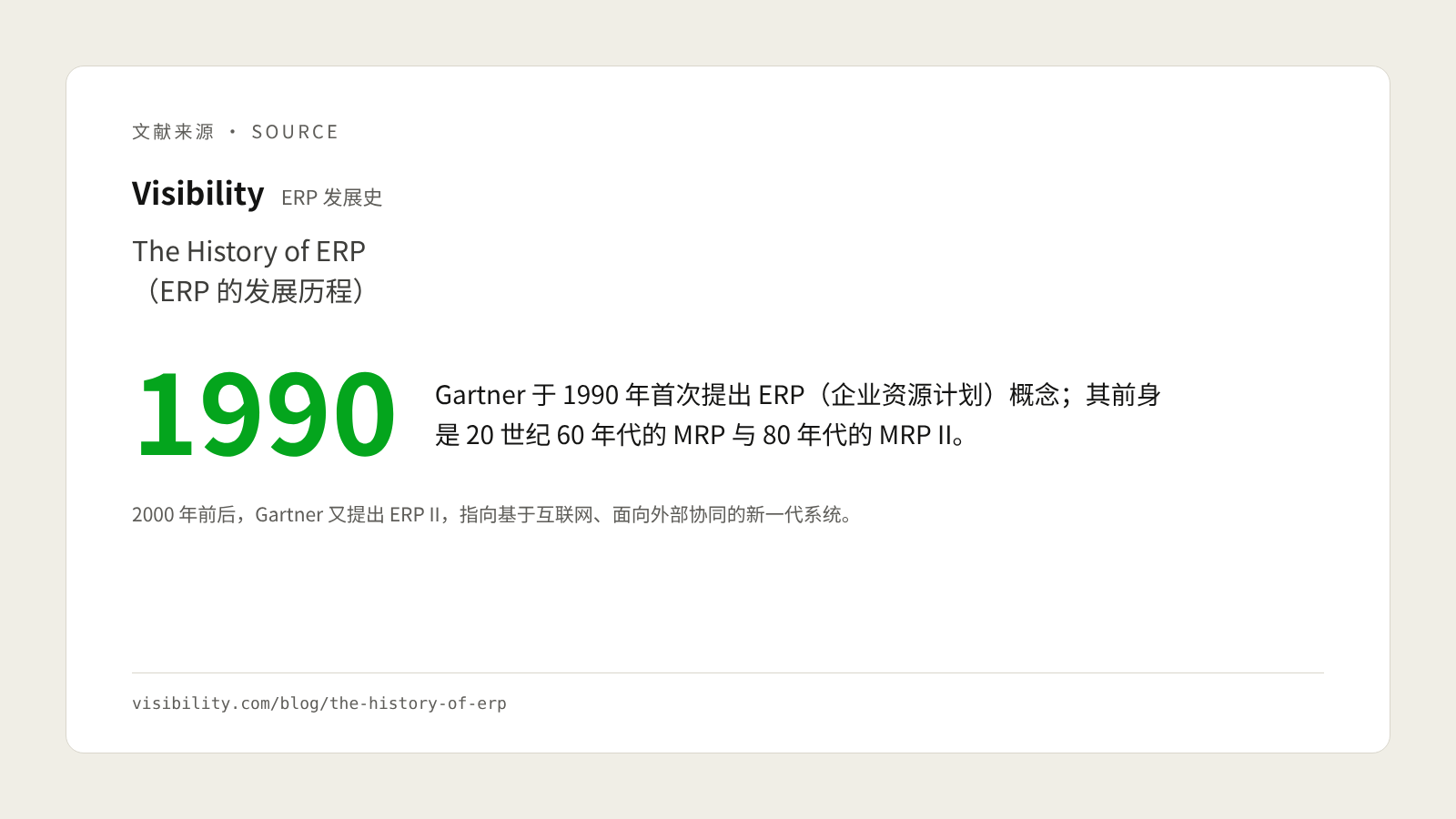
Its roots lie in manufacturing: material requirements planning (MRP) in the 1960s, manufacturing resource planning (MRP II) in the 1980s, and then ERP, a term coined by Gartner in 1990, covering core functions such as finance, production and HR (source). Chinese vendors started with accounting software and entered the enterprise management software market in the late 1990s; in the 2010s, cloud subscriptions (SaaS) brought management systems within reach of small and mid-sized companies at relatively low cost (source).
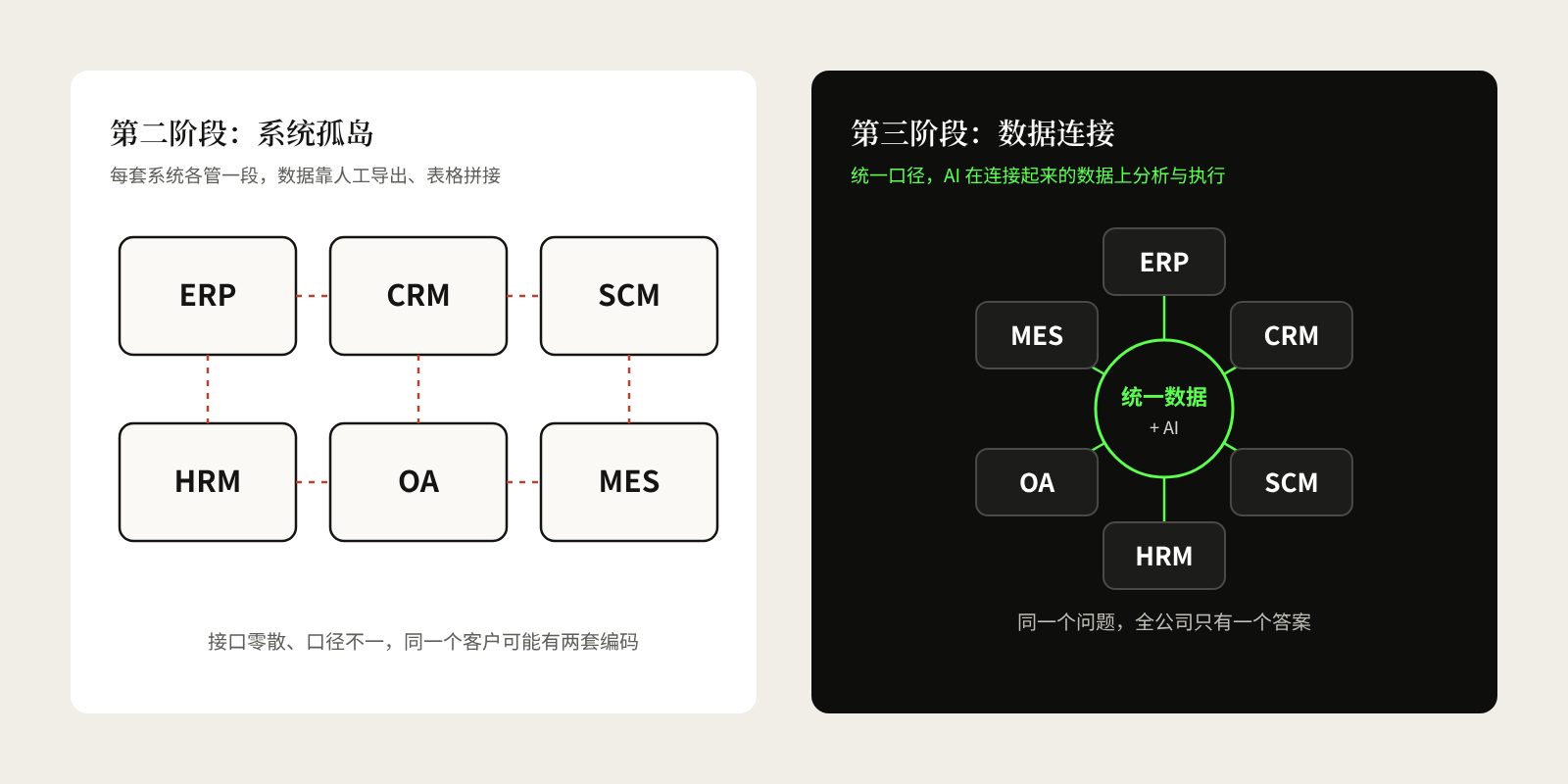
By the later part of this stage, a mid-sized company would typically be running several systems at once — ERP, CRM, SCM, HRM, OA and more — with manufacturers adding MES. Each system was well organized internally, yet the systems often didn’t talk to one another. System silos had three main causes:
- Department-by-department purchasing. Each department chose systems for its own needs, with no unified data architecture.
- Inconsistent master data. The same customer has two different codes in CRM and ERP; the same material goes by different names in purchasing and in production.
- Point-to-point integrations. Systems exchanged data through individually built interfaces. The more systems, the more interfaces, and an upgrade anywhere could ripple through everything.
The more fundamental limitation, however, lay in what these systems were designed to do. This generation of systems was built to “record”: it can tell you precisely what happened last month, but it won’t proactively tell you where things are going wrong, let alone step in to fix them. Even with the later addition of business intelligence (BI) reporting and robotic process automation (RPA), the former still needed people to look and decide, while the latter could only repeat actions according to fixed scripts and would stop at anything outside the rules.
Intelligent operations: when systems start doing the work
Intelligent operations is a way of running a business in which AI agents sit at the core and people and agents work together to keep the business running. What fundamentally sets it apart from the first two stages is that systems no longer just record and display the business; they proactively spot problems, make judgements and drive execution in pursuit of business goals.
Two forces are driving this shift. The first is the maturing of data platforms: data warehouses, data lakes and integration tools have made connecting multiple systems technically feasible and affordable. The second is breakthroughs in large models and agent technology: for the first time, systems can understand unstructured information such as contracts, emails and tickets, and can plan steps, call tools and complete a chain of actions.
An agent that takes part in running the business typically operates in a loop of four steps:
- Sense. Continuously reads data on orders, inventory, collections, customer communications and more, spotting anomalies and opportunities.
- Decide. Analyzes causes and proposes a course of action based on business rules and past experience.
- Act. Takes direct action within its authorization, such as generating documents, sending reminders or creating tickets; anything beyond its permissions is handed to a person to decide.
- Feedback. Records outcomes and human corrections and uses them to improve its next judgement.
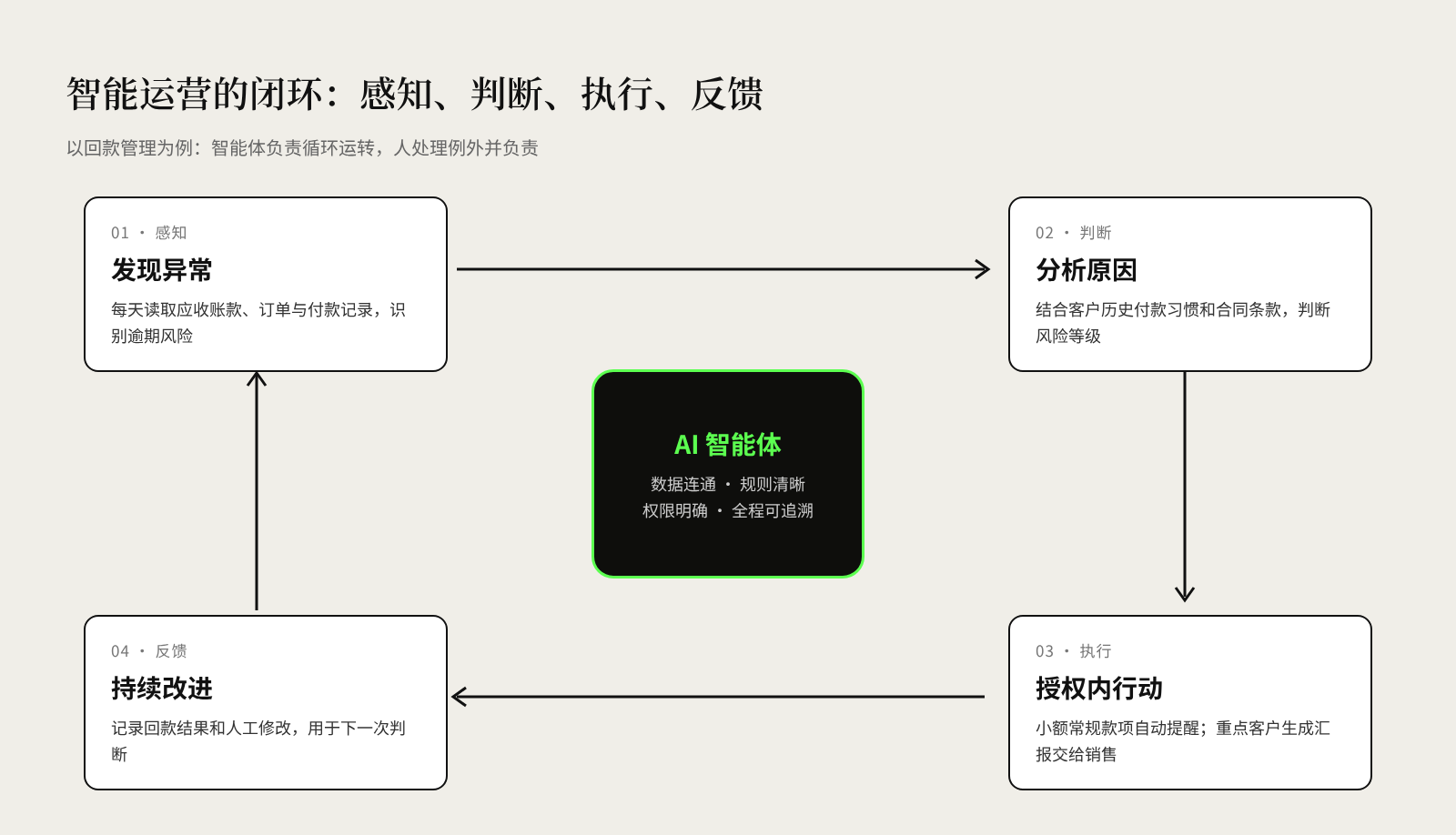
Take collections management as an example. In the systematization stage, the finance team exports an accounts receivable report every week and then chases each payment by email. In the intelligent operations stage, an agent checks due dates every day, assesses risk based on each customer’s payment history, automatically sends reminders for small, routine amounts and, for key accounts, prepares a briefing for the sales lead to follow up. People no longer compile data; they handle the exceptions that genuinely require judgement.
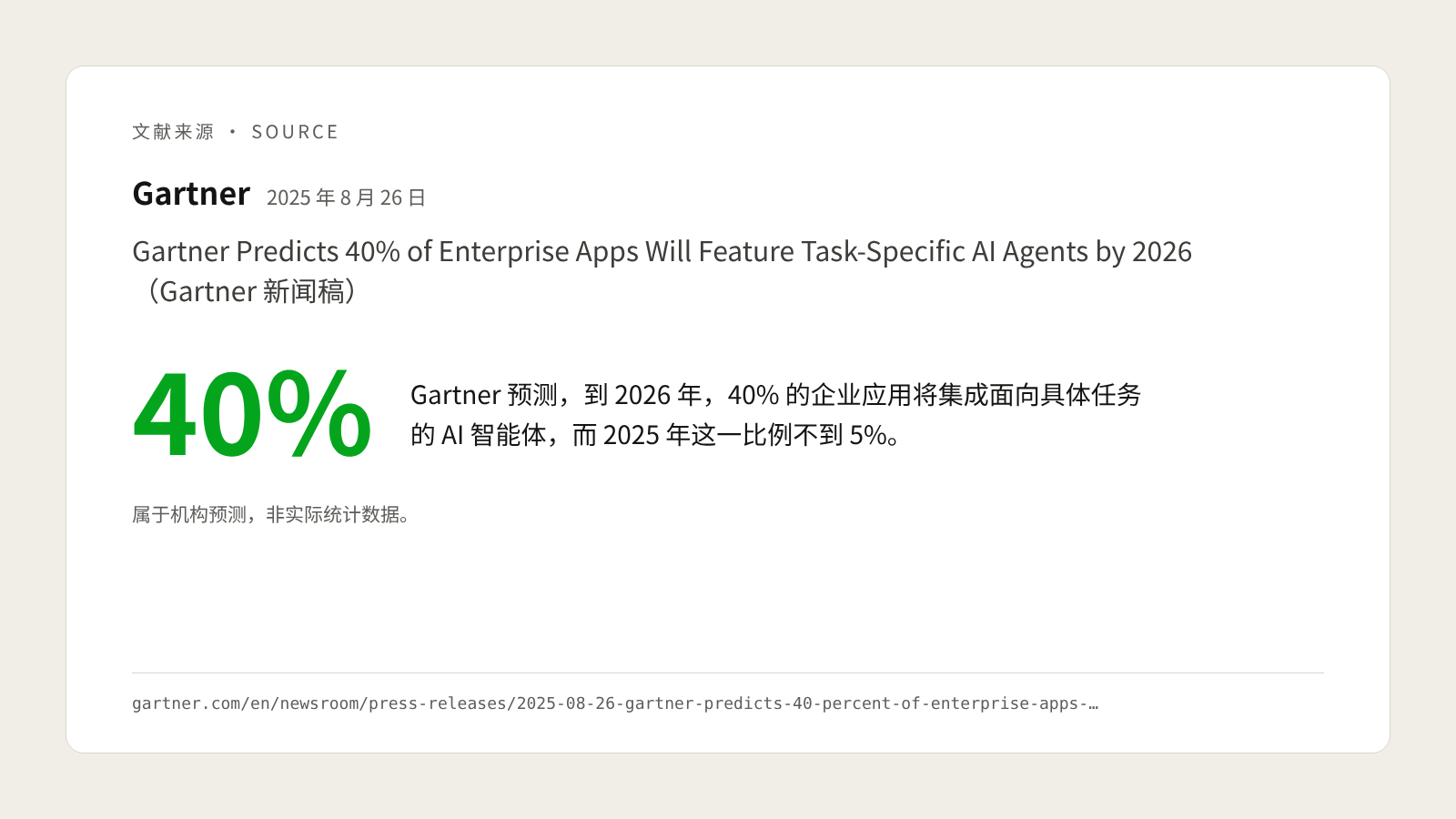
This stage is arriving fast. Gartner predicts that by 2026, 40% of enterprise applications will feature task-specific AI agents, up from less than 5% in 2025 (source), and that by 2028, at least 15% of day-to-day work decisions will be made autonomously by agents (source). McKinsey’s “The state of AI in 2026” also shows that among large companies with annual revenue above US$1 billion, 40% are already scaling agents in at least one function, up from 27% a year earlier (source).
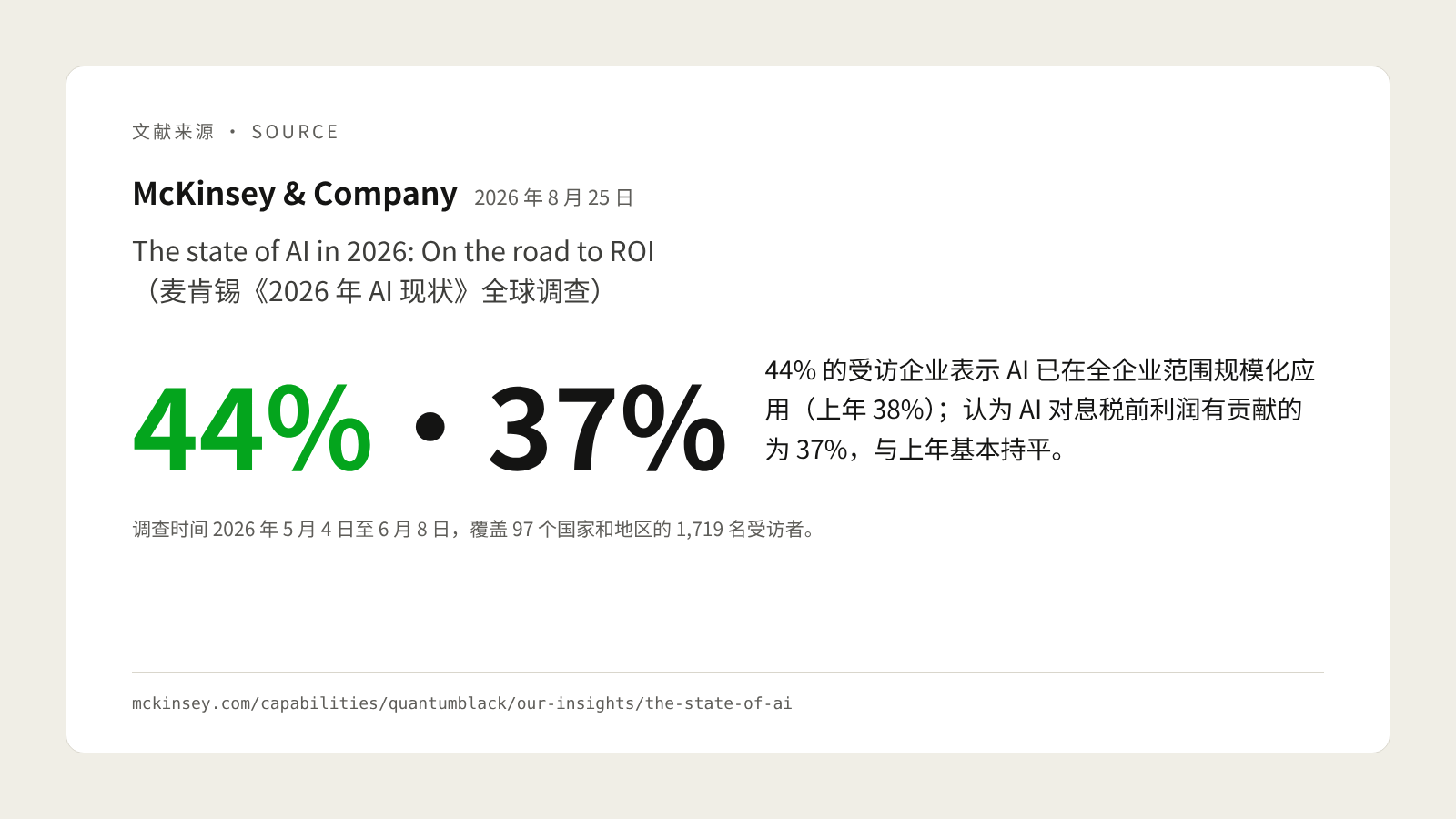
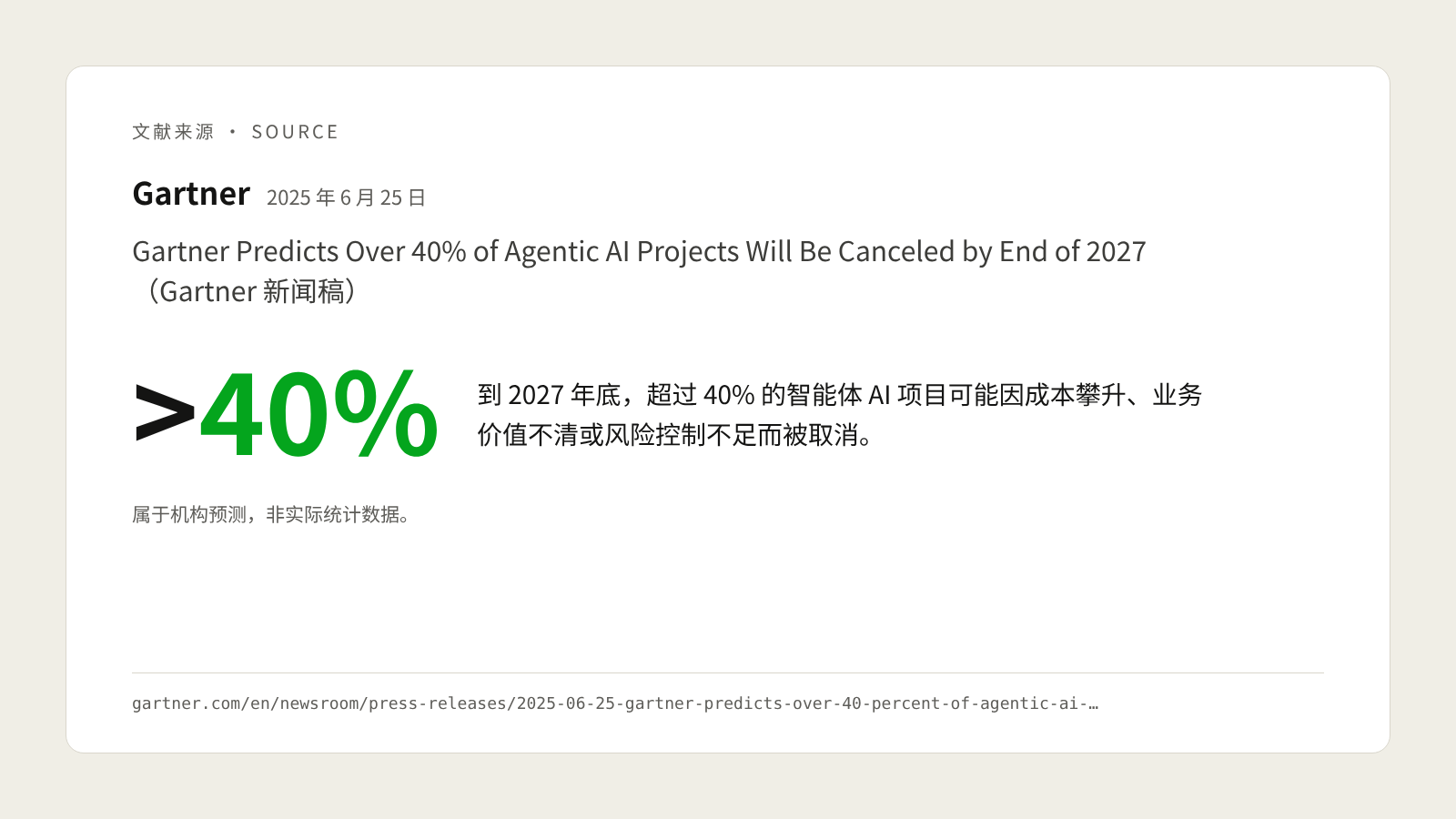
But the shift is far from complete. In the same McKinsey survey, only 37% reported that AI contributes to earnings before interest and taxes (EBIT); Gartner also warns that by the end of 2027, more than 40% of agentic AI projects may be canceled because of cost, value or risk-control issues. The barrier to intelligent operations is not whether you can buy agents, but whether your data is connected, your processes have been redesigned, and permissions and accountability are clearly defined.
Where does your company stand?
Working out which stage a company is in isn’t about which systems it has bought, but about the actual state of its data, processes, decision-making and organization. The same company is often at different stages on different dimensions, and the weakest one determines how far the next step can go.
The table below can serve as a quick self-assessment checklist:
| Dimension | Digitization | Systematization | Intelligent operations |
|---|---|---|---|
| Data | Core data sits in personal spreadsheets | Data spread across systems with inconsistent definitions | Unified master data, accessible to agents within their authorization |
| Processes | Based on experience and verbal handovers | Approvals routed through systems | Repetitive steps executed by agents; people handle exceptions |
| Management reporting | Takes days of manual consolidation | Exported from each system and stitched together | Available on demand, with automatic anomaly alerts |
| Decisions | Based on experience | Based on historical reports | System recommends; people decide and are accountable |
| Governance | Virtually no access control | System permissions by role | Agent permissions, audit logs and human approval rules in place |
If the first two rows are still in the left-hand column, the groundwork of digitization and systematization still needs doing; if data is already connected and reports are available on demand, you have the foundation to introduce agents.
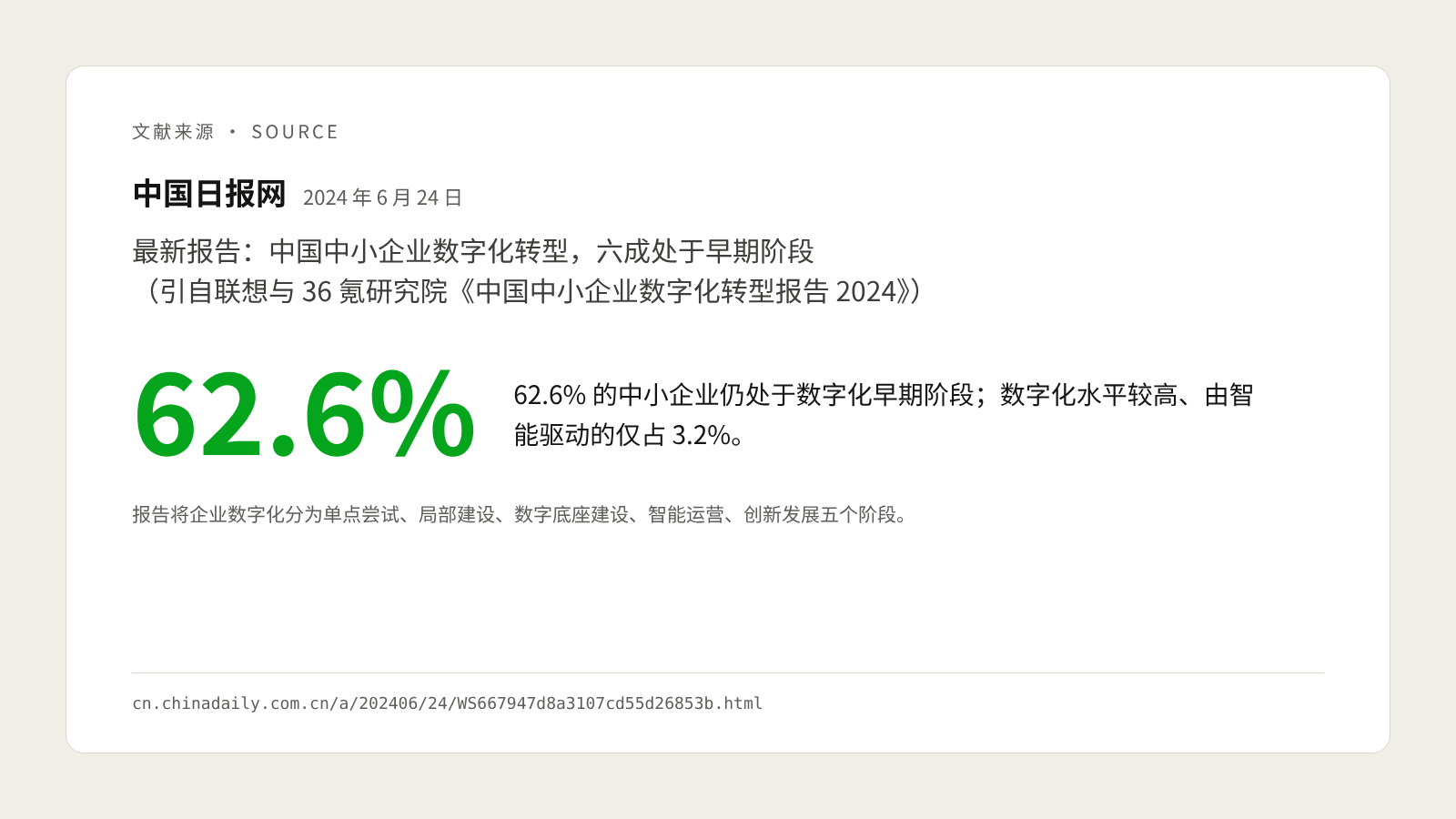
Overall, many companies are still in the first two stages. A 2024 report by Lenovo and 36Kr Research Institute shows that 62.6% of small and mid-sized enterprises in China are still in the early stages of digital transformation, while only 3.2% are highly digitalized and intelligence-driven (source). In other words, many companies are already standing at the threshold of the third stage before finishing the work of the second.
Which foundations come first on the road to intelligent operations?
The most common misconception about intelligent operations is to treat it as “buying a set of agents”. For agents to take part in running the business, the business must already be recorded in systems and the data must be connectable. The stages can be accelerated, but rarely skipped; without solid foundations, agents will simply make wrong judgements faster on top of messy data.
Unify master data so that every question has only one answer. Start by cleaning up core master data such as customers, products and suppliers, and connect the data that most affects business decisions: orders, inventory and collections. This is the precondition for agents to make reliable judgements.
Turn tacit know-how into explicit rules. How discounts are granted, when to expedite, which customers need personal follow-up: if these rules exist only in the heads of long-serving staff, agents have nothing to learn from. Writing them down and organizing them into a knowledge base is the most easily overlooked step.
Redesign processes around agents rather than squeezing them into old ones. McKinsey’s survey shows that nearly three-quarters of AI high performers have fundamentally redesigned their workflows, compared with only about a quarter of other companies. Redesign means redefining the division of labor: which steps go to agents and which stay under human oversight.
Define permissions and accountability before letting agents act. Specify what data each agent can see, what actions it can take and which decisions require human confirmation, and keep a complete log of its actions. The agent may be autonomous, but people remain accountable. For guidance on extending agent autonomy in stages, see AI agents in production: how enterprises can expand autonomy while staying in control.
Start with one closed-loop use case. Choose a process with clear rules and measurable value, such as receivables follow-up, inventory alerts or order entry, and let an agent run the full “sense, decide, act, feedback” loop before replicating the same approach in the next process.
Conclusion: rewriting the division of labor between people and systems
Looking back at the three stages, each leap redrew the boundary between people and systems. Digitization freed people from copying and calculating; systematization freed them from verbal handovers and repetitive approvals; intelligent operations frees them from compiling data and chasing routine tasks, so they can focus on setting goals, handling exceptions and nurturing customer relationships.
Intelligent operations is not a systems project, but a redesign of how the business is run. There is no need to chase every new tool. First, see clearly where you stand on each dimension, shore up your weakest link, and then let agents take on more of the work, step by step.
References
- VisiCalc, Wikipedia
- The History of ERP, Visibility
- After more than 30 years of rivalry, neither Yonyou nor Kingdee has won, PEdaily, April 2025
- The evolution of Yonyou Network’s ERP software business, Qianzhan Industry Research Institute
- Gartner Predicts 40% of Enterprise Apps Will Feature Task-Specific AI Agents by 2026, Gartner, August 2025
- Gartner Predicts Over 40% of Agentic AI Projects Will Be Canceled by End of 2027, Gartner, June 2025
- The state of AI in 2026: On the road to ROI, McKinsey, August 2026
- Latest report: six in ten Chinese SMEs are in the early stages of digital transformation, China Daily, June 2024