Employees use AI to write emails, translate documents and tidy up reports, and their personal productivity has genuinely improved. Yet the company’s business results often fail to follow. Using AI as an individual is a skill; enterprise AI capability is a system built from data, processes, rules and organization. The first does not automatically become the second.
The enthusiasm among employees is already there. The question is whether the company can capture it. Starting from a set of survey findings, this article looks at where the gap between individual and organizational capability comes from, what enterprise AI capability is made of, and how to turn the AI practices scattered among employees into capabilities the organization owns.
Everyone is using AI. Why isn’t the business doing better?
The individual benefits of AI are already clear, but most of them stay with the individual. Employees have moved ahead of management, and companies have not captured what they are doing.
Three surveys illustrate this from different angles:
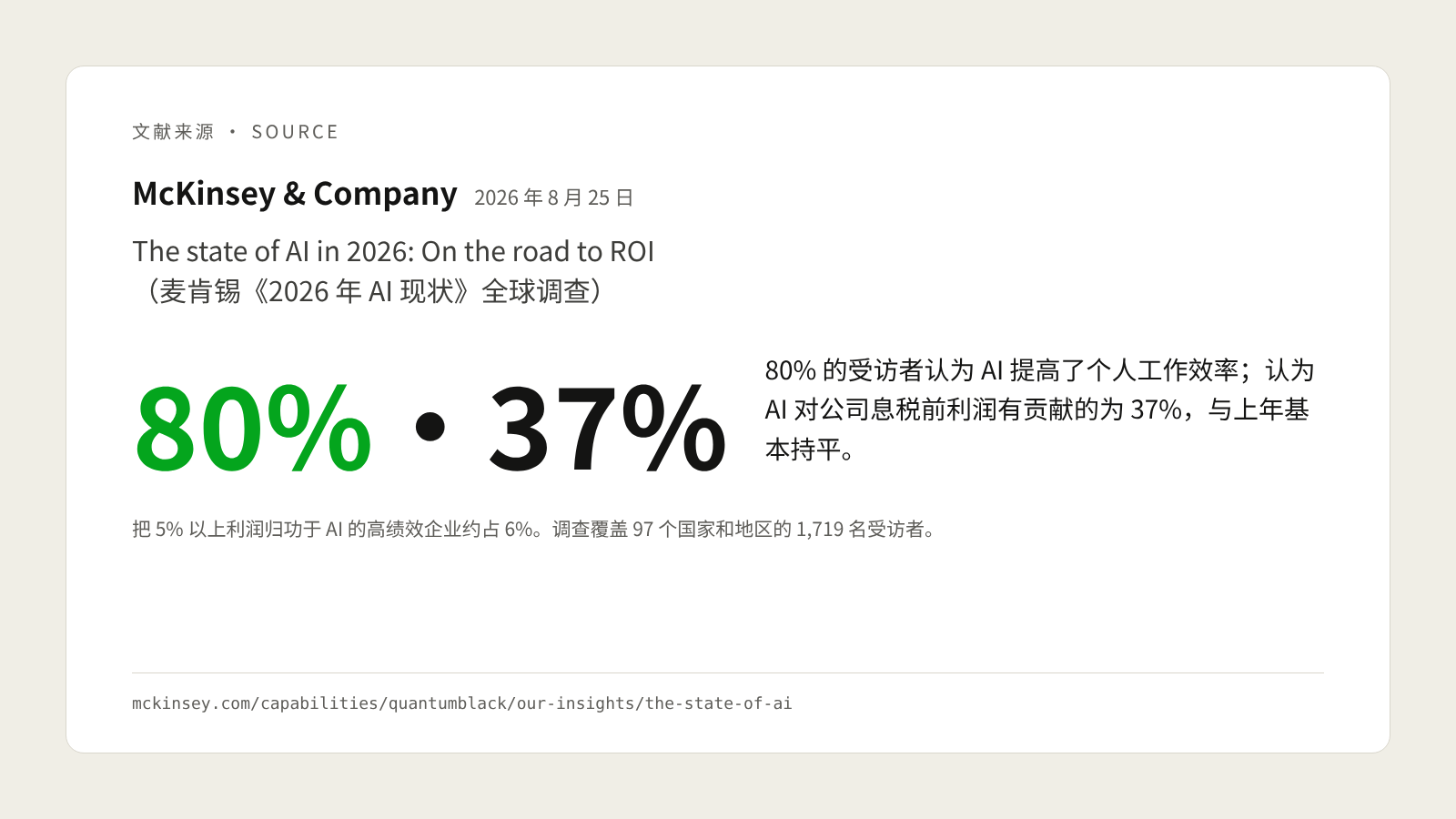
- Individuals are speeding up; companies are standing still. McKinsey’s “The state of AI in 2026” surveyed 1,719 respondents worldwide: 80% said AI had made them more productive, and about half said it had helped them make better decisions. Yet only 37% said AI contributed to their company’s earnings before interest and taxes (EBIT), essentially unchanged from the previous year. The report states plainly that individual-level gains have yet to translate into enterprise-level financial impact (source).
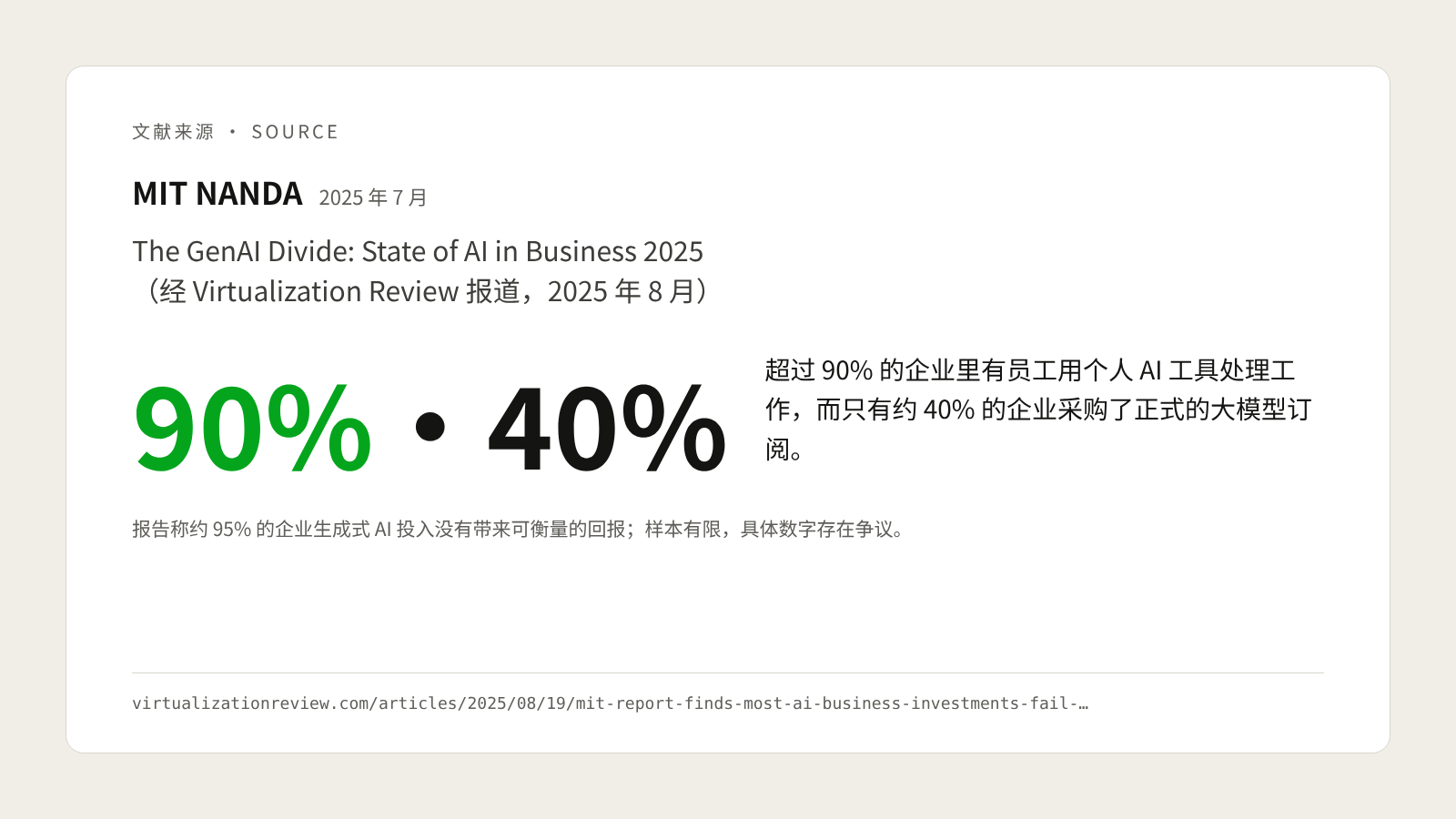
- “Shadow AI” is widespread. The 2025 report “The GenAI Divide” from MIT’s Project NANDA found that only about 40% of companies had purchased an official LLM subscription, yet employees at more than 90% of companies were using personal AI tools for work. At the same time, 95% of companies had seen no measurable business return from generative AI (source). The study’s sample is limited and its specific figures are disputed, but the pattern it describes is common.
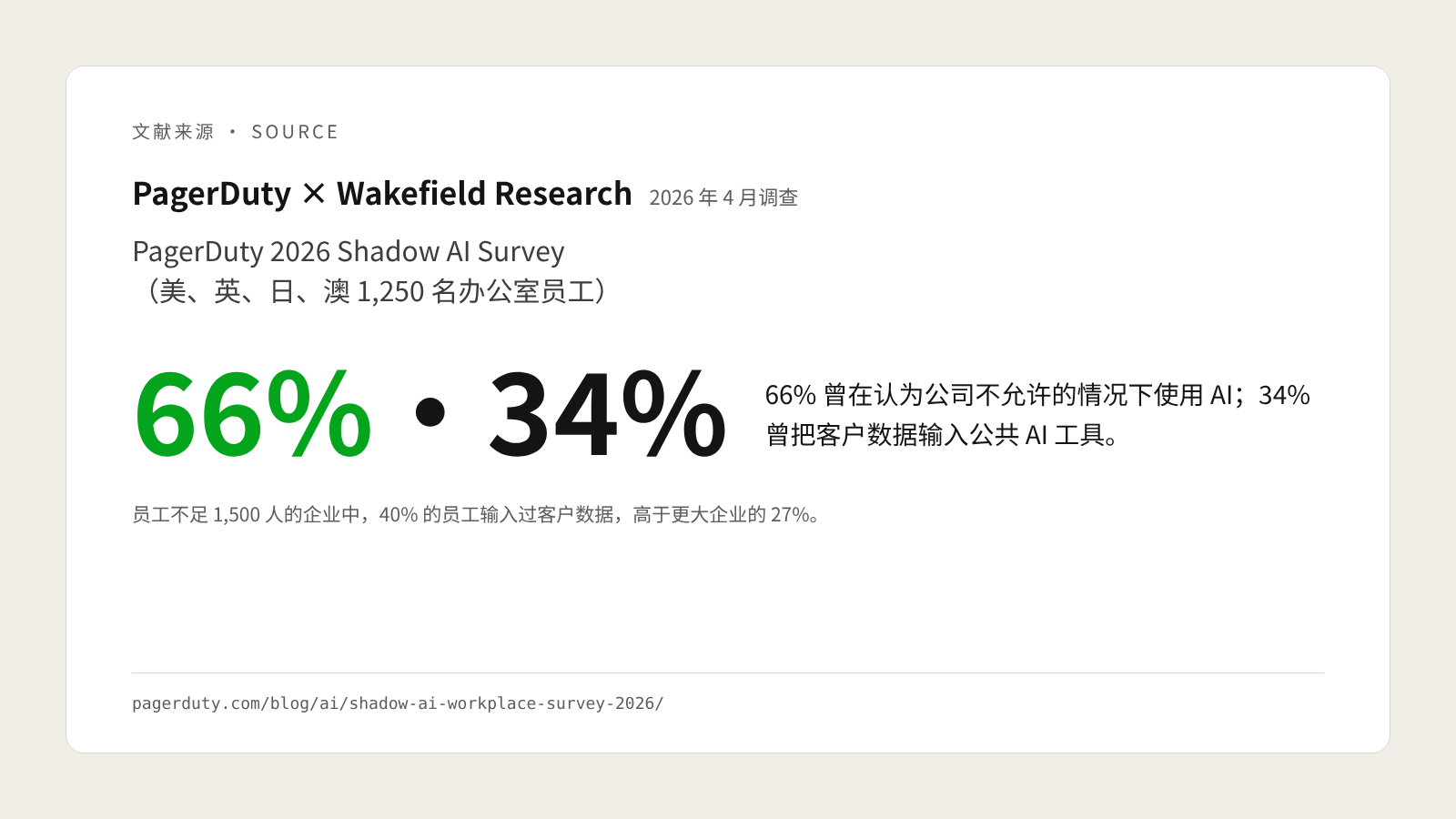
- The risks are already real. A survey commissioned by PagerDuty and conducted by Wakefield Research in April 2026 among 1,250 office workers at large companies in the US, the UK, Japan and Australia found that, among employees who had used AI, 66% had done so in situations where they believed their company did not allow it; 34% had entered customer data into public AI tools, and 31% had entered financial information or confidential company documents (source).
Take a wholesale company of around thirty people where almost every employee now uses AI: purchasing uses it to translate supplier quotes in foreign languages, sales uses it to draft replies to customers, and accounting uses it to read letters from the tax authority. But at the year-end review, excess inventory, collection cycles and customer churn look much the same as the year before. No one can say which tools the company’s quotes and customer records have been pasted into. And a highly effective approach that one salesperson worked out left the company when she did. Everyone can use AI, yet the company has not gained any AI capability as a result.
“I work faster” versus “the company performs better”: where is the gap?
Individual AI capability is a person’s skill in using AI to do their own work faster and better. Enterprise AI capability is a company’s ability to embed AI reliably in its business processes and keep producing business results. The first is the foundation for the second, but they differ entirely in scope, repeatability and risk management.
| Dimension | Individual AI capability | Enterprise AI capability |
|---|---|---|
| Scope | One task for one person | A cross-departmental business process |
| Data used | Snippets pasted into a chat window as needed | Business data connected to systems, with consistent definitions |
| Where know-how lives | In employees’ personal habits and prompts | In processes, templates and systems that keep working when people change roles |
| Repeatability | Varies by person; results are inconsistent | Consistent standards that can be rolled out company-wide |
| Who manages the risk | Often no one | Rules, permissions and clear ownership |
| How it is measured | “It feels faster” | Business metrics such as cycle time, cost, error rate and revenue |
The table also works in reverse: any row where a company is still in the left-hand column points to a capability that has not yet moved from individuals to the organization.
Why don’t individual skills add up to organizational capability?
Thirty employees who can use AI do not make a company with AI capability. Between the individual and the organization lie at least four gaps: know-how, data, process and risk.
Know-how isn’t retained. A set of effective prompts or a proven approach exists only in one employee’s chat history. Others don’t know about it and can’t learn it, and it disappears when that employee leaves. It is the same problem as in the spreadsheet era, when data walked out the door with people — only this time, what walks out is methods and experience.
Data isn’t connected. All employees can give AI is the small piece of information they happen to copy and paste. AI cannot see the full picture of inventory, orders and receivables, so it naturally cannot answer the questions that really affect the business, such as “Which products should we order less of?” or “Which customer should we chase for payment?” The MIT report also notes that most generative AI systems do not retain feedback, adapt to context or improve over time, which is exactly why they are hard to trust with important work.
Processes haven’t been redesigned. Employees use AI to speed up their own step, but nothing upstream or downstream changes. However quickly a quote is written, it still waits for the owner’s approval the next day; however quickly customer service replies, orders still have to be keyed into the system by hand. Efficiency gets stuck at the handoffs. McKinsey’s survey found that nearly three-quarters of AI high performers have fundamentally redesigned their workflows around AI, compared with only about a quarter of other companies.
No one manages the risk. Which tools have customer records, quotes and contracts been pasted into? Does anyone check AI-generated content? Who is accountable when something goes wrong? None of these questions has an answer. For companies operating in the EU, customers’ personal data is subject to the General Data Protection Regulation (GDPR), so this is not only a management issue but also a compliance one.
The four pillars of enterprise AI capability
If employees’ individual AI skills are the foundation, enterprise AI capability needs four pillars built on top of it: data, processes, rules, and people and organization. They correspond directly to the four gaps above.
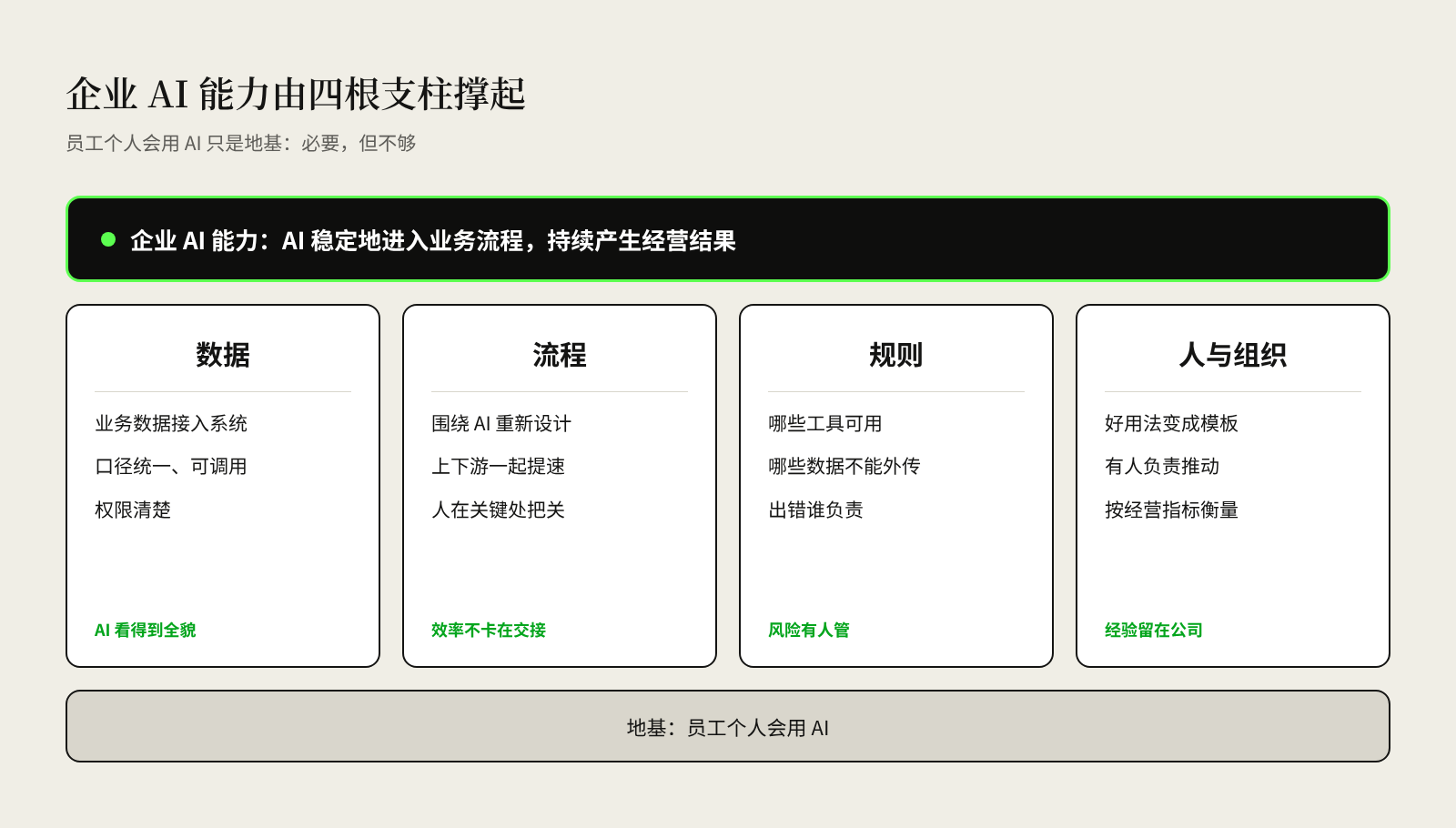
- Data: let AI see the full picture. Business data is connected to systems, uses consistent definitions and can be accessed by AI within authorized limits. If inventory, orders and receivables are still scattered across different spreadsheets and software, even the smartest AI can only guess from fragments.
- Processes: keep efficiency from stalling at the handoffs. Rather than slotting AI into one step of an existing process, redesign the entire process around AI: which steps go to AI, which must be confirmed by a person, and how the handoffs connect.
- Rules: let employees use AI with confidence. Make clear which AI tools are allowed, which data must not be entered into external tools, which scenarios require human review and who is accountable when problems arise. Rules are not there to restrict employees, but so that they no longer need to use AI on the quiet.
- People and organization: keep know-how in the company. Turn the effective approaches employees have discovered into templates and standard processes that new hires can use from day one; appoint someone to drive AI adoption; and measure results with business metrics rather than “it feels faster.”
The four pillars depend on one another. Without rules, for example, a company won’t dare connect its data to AI; without data, a redesigned process cannot run. So they should be built together around a specific business scenario rather than split into four separate projects.
Don’t ban “shadow AI” — capture it
When employees use AI on their own, a blanket ban often just drives it underground. A more effective approach is to treat the practices employees have already proven as a starting point, and move them from individuals into the organization’s data, processes and rules. You can start with five steps.
Take stock: find out how employees are already using AI. Survey which AI tools employees use, at which stages and where the information ends up, while identifying the worst bottlenecks between orders, purchasing, inventory and collections. This step often reveals that the most valuable use cases are hidden in what employees are already doing on their own initiative.
Set rules: give employees an option they can use with confidence. Building on the company’s permission framework, define data boundaries and human review requirements, and provide a safe, easy-to-use company-wide tool. When the official route is more convenient than going it alone, “shadow AI” naturally declines.
Connect: let AI work with the company’s own data and knowledge. Integrate data scattered across systems and spreadsheets and unify metric definitions; organize product information, pricing rules and FAQs into a company knowledge base. AI no longer depends on fragments employees paste into a chat window.
Embed: build effective practices into processes. Pick a scenario with clear rules and measurable results — such as order entry, reconciliation checks or common customer inquiries — and turn the practices employees have proven into templates, intelligent workflows or agents. Let them take on repetitive work such as data entry, checking and routing, with people overseeing the key steps.
Measure: let business metrics decide whether to scale. Before the pilot, set metrics such as processing time, error rate and collection cycle. Once the results are validated, replicate the same approach in the next scenario.
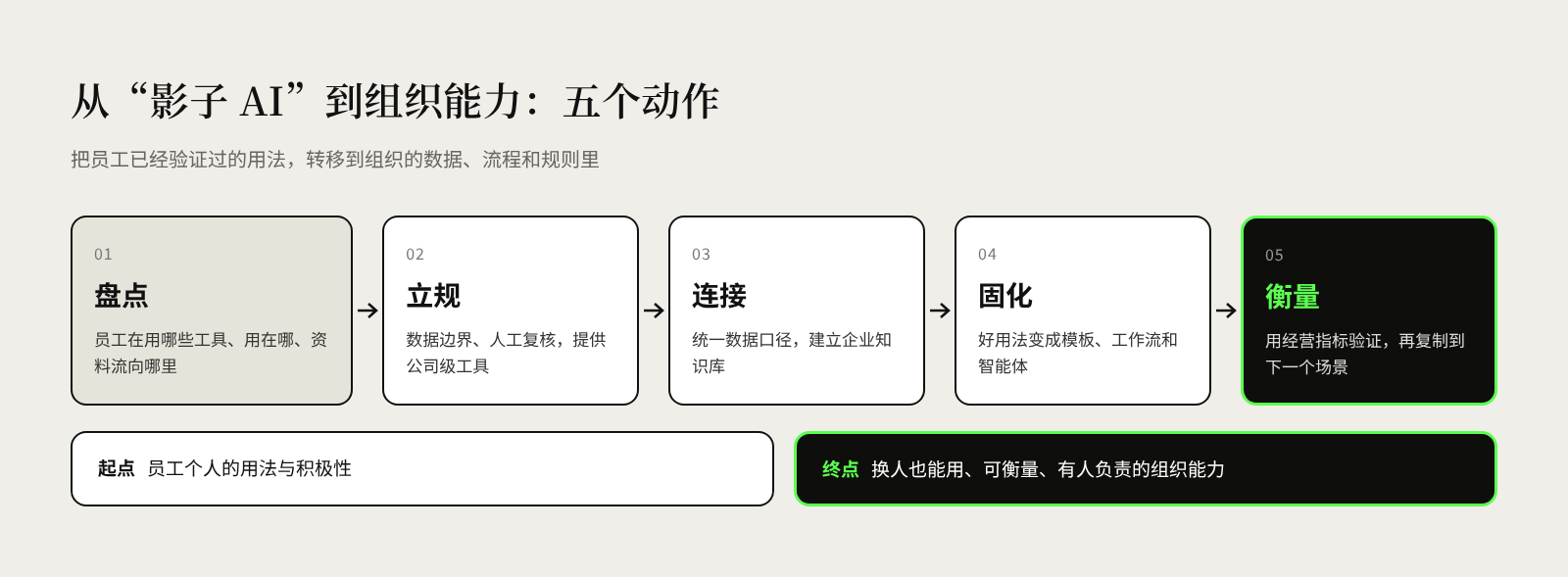
These five steps map directly onto the four gaps described above:
| Why individual skills don’t add up to organizational capability | Corresponding step |
|---|---|
| Know-how isn’t retained | Embed: build effective practices into processes and templates |
| Data isn’t connected | Connect: unify data definitions and build a company knowledge base |
| Processes haven’t been redesigned | Take stock + embed: start from the scenario and redesign the division of work between people and AI |
| No one manages the risk | Set rules: permissions, data boundaries and human review |
One principle runs throughout: people stay in charge. AI helps move work forward within authorized limits, while people make the decisions wherever goals, accountability and key judgments are involved.
Conclusion: from “I can use it” to “the company can use it”
Individual AI skills make one person’s work faster; enterprise AI capability makes the whole company perform better. Between the two lie data, processes, rules and organization — none of which will appear automatically just because employees get better at writing prompts.
Employee enthusiasm is a company’s best starting point, not a risk to be suppressed. The next step is for the company itself to learn to use AI.
References
- The state of AI in 2026: On the road to ROI, McKinsey, August 2026
- MIT report finds most AI business investments fail, reveals "GenAI Divide", Virtualization Review, August 2025 (covering MIT NANDA’s “The GenAI Divide: State of AI in Business 2025”)
- PagerDuty 2026 Shadow AI Survey, PagerDuty, 2026