When companies talk about AI training, their first instinct is often to teach employees “how to use a particular tool”: how to write a prompt, how to generate a weekly report. That is useful, of course, but far from enough. What employees usually lack is not the steps but judgment: when an AI output can be trusted, when it must be checked, and which data must never be entered. The core of AI literacy is not “knowing how to use it” but “using it with understanding and confidence.”
So how should a company systematically build its employees' AI literacy, rather than running a few talks and calling the job done? This article explains what capabilities AI literacy covers, what the EU AI Act requires, the reality that employees are “widely using AI but under-trained”, and how to design role-based training and roll it out step by step.
What is AI literacy, and why is it more than “knowing the tools”?
AI literacy is the set of knowledge and skills that enables employees to understand what AI can and cannot do, and to use it responsibly at work. It is closer to reading and writing than to software skills. Tools keep changing, but the ability to judge AI output and recognize risk carries over for the long term.
The word “literacy” is itself telling. Media literacy was never about whether you could watch TV or scroll through a phone; it was about whether you could ask of a piece of information who produced it, why it says what it says, and what it leaves out. AI literacy follows the same logic. AI-generated content reads fluently and confidently, yet it can fabricate facts, omit key conditions and amplify biases in its training data. What employees need is the ability to keep a clear head when working with such a “very articulate colleague”.
The EU AI Act's definition of AI literacy reflects this too: the skills, knowledge and understanding that allow the people concerned to make an informed deployment of AI systems, and to gain awareness of the opportunities and risks of AI and the possible harm it can cause (source).
Within a company, AI literacy can be broken down into four levels:
- Using it. Knowing what AI is good for, describing tasks clearly, and building AI into your daily work. For example, asking AI to turn meeting notes into a to-do list with owners.
- Understanding its limits. Recognizing that AI can be “confidently wrong” (often called “hallucination”), that it does not know the latest internal developments at the company, and that it cannot take responsibility for outcomes on anyone's behalf.
- Exercising judgment. Checking key facts and figures, spotting bias and omissions in the output, and knowing which conclusions must be confirmed by a person. For example, the prices, discounts and delivery dates in an AI-drafted quotation must be verified against the system before it goes to the customer.
- Respecting boundaries. Being aware of data security: knowing that customer information, contracts, financial data and employees' personal information must not be entered into unapproved tools, and knowing whom to turn to when something goes wrong.
Many training programs cover only the first level. The other three are where a company's real risk and value lie.
What does the EU AI Act require for employee AI literacy?
Article 4 of the EU AI Act sets out a dedicated AI literacy obligation, which has applied since 2 February 2025. Its significance goes beyond compliance: for the first time, it establishes in law that a company that has its employees use AI is responsible for ensuring they understand it.
According to the regulation's text on EUR-Lex, Article 4 requires providers of AI systems (those that develop AI) and deployers (organizations that use AI in their business) to take measures to ensure, to their best extent, that their staff and other persons operating and using AI systems on their behalf have a sufficient level of AI literacy, taking into account their technical knowledge, experience, education and training, the context in which the AI is used, and the persons on whom it will be used. Article 113 provides that Chapter I, which contains Article 4, applies from 2 February 2025 (source).
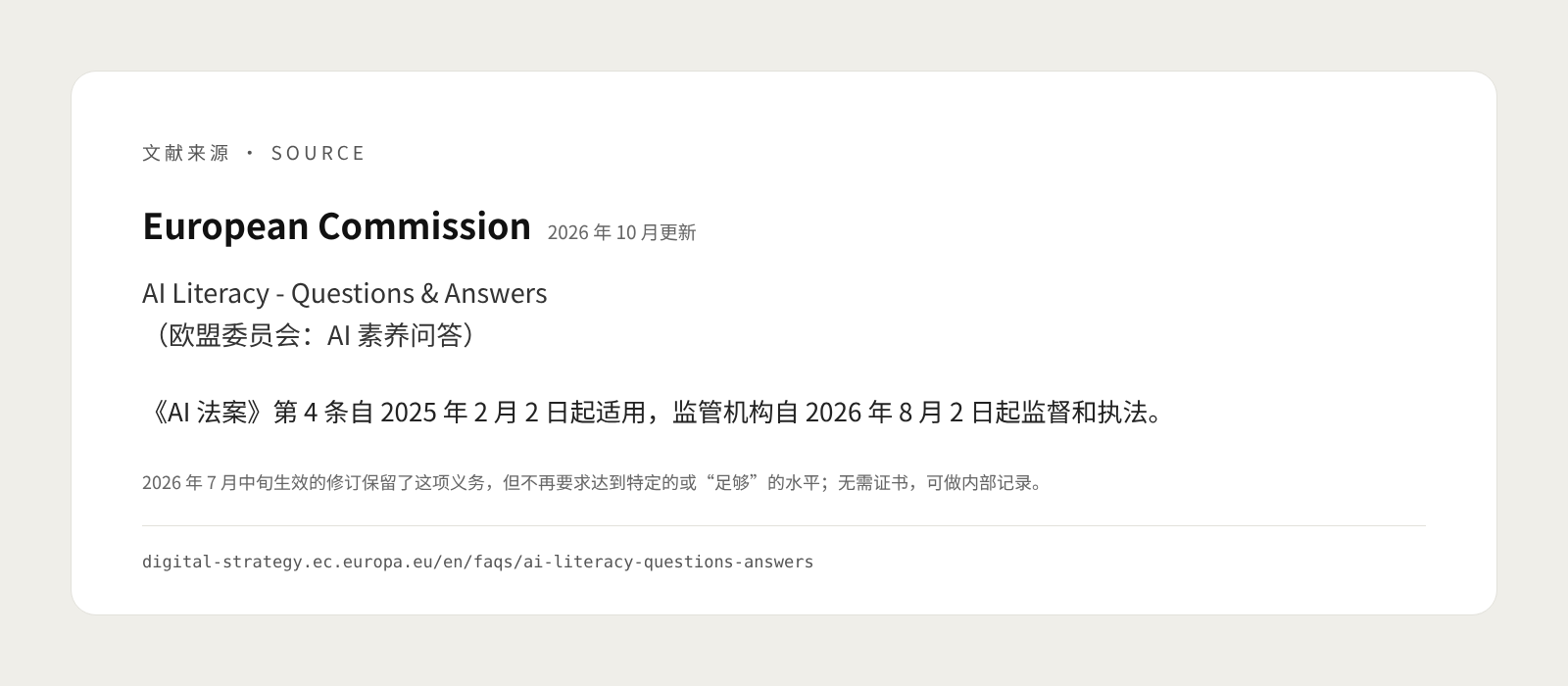
The rules have since been adjusted once. The European Commission's AI Literacy Q&A explains that the Digital Omnibus on AI, which entered into force in mid-July 2026, amended Article 4: AI literacy remains an obligation for providers and deployers, but a specific or “sufficient” level is no longer required, nor must companies guarantee that every employee reaches a certain standard. Supervision and enforcement by the market surveillance authorities of each Member State begin on 2 August 2026 (source).
The same Q&A also clarifies several points that matter most to companies (source):
- No certificate is required. Companies can keep internal records of the training and guidance they have provided.
- There is no prescribed format. The regulation does not mandate specific courses or formats, but simply asking employees to read a tool's instructions is in many cases not enough.
- Everyday use is in scope. For example, employees who use a chatbot to write ad copy or translate text should also be informed of specific risks such as hallucinations.
- Content should be adjusted to risk. The Q&A suggests considering at least four points: giving employees a general understanding of AI; clarifying whether the company is a developer or a user; identifying the risks of the AI systems in use; and then designing specific measures based on employees' backgrounds and the context of use.
- It is not limited to EU companies. The rules also apply whenever an AI system is placed on the EU market, used in the EU, or its use affects people in the EU.
For companies with no EU business, this regulation does not apply directly. But it offers a clear benchmark: AI literacy is not a nice-to-have perk, but a basic responsibility that comes with using AI.
Employees are already using AI widely. Has training kept up?
The reality is that employees are adopting AI far faster than companies are training them. Most employees have taught themselves to use AI, without any structured guidance.
Several large surveys reflect this gap:
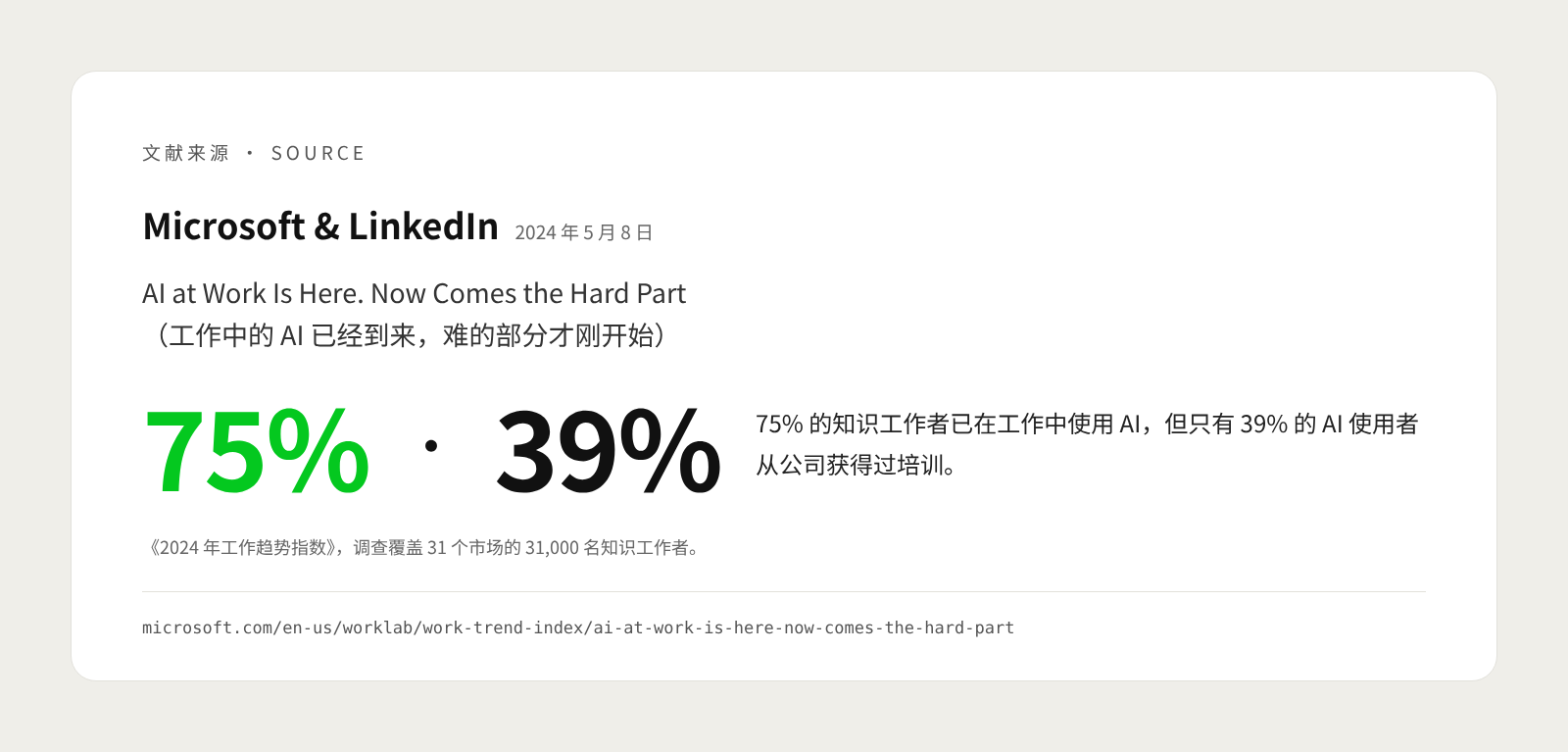
- Widespread use, scarce training. Microsoft and LinkedIn's 2024 Work Trend Index surveyed 31,000 knowledge workers across 31 markets: 75% already use AI at work and 78% of AI users bring their own tools to work, yet only 39% of users have received AI training from their company (source).
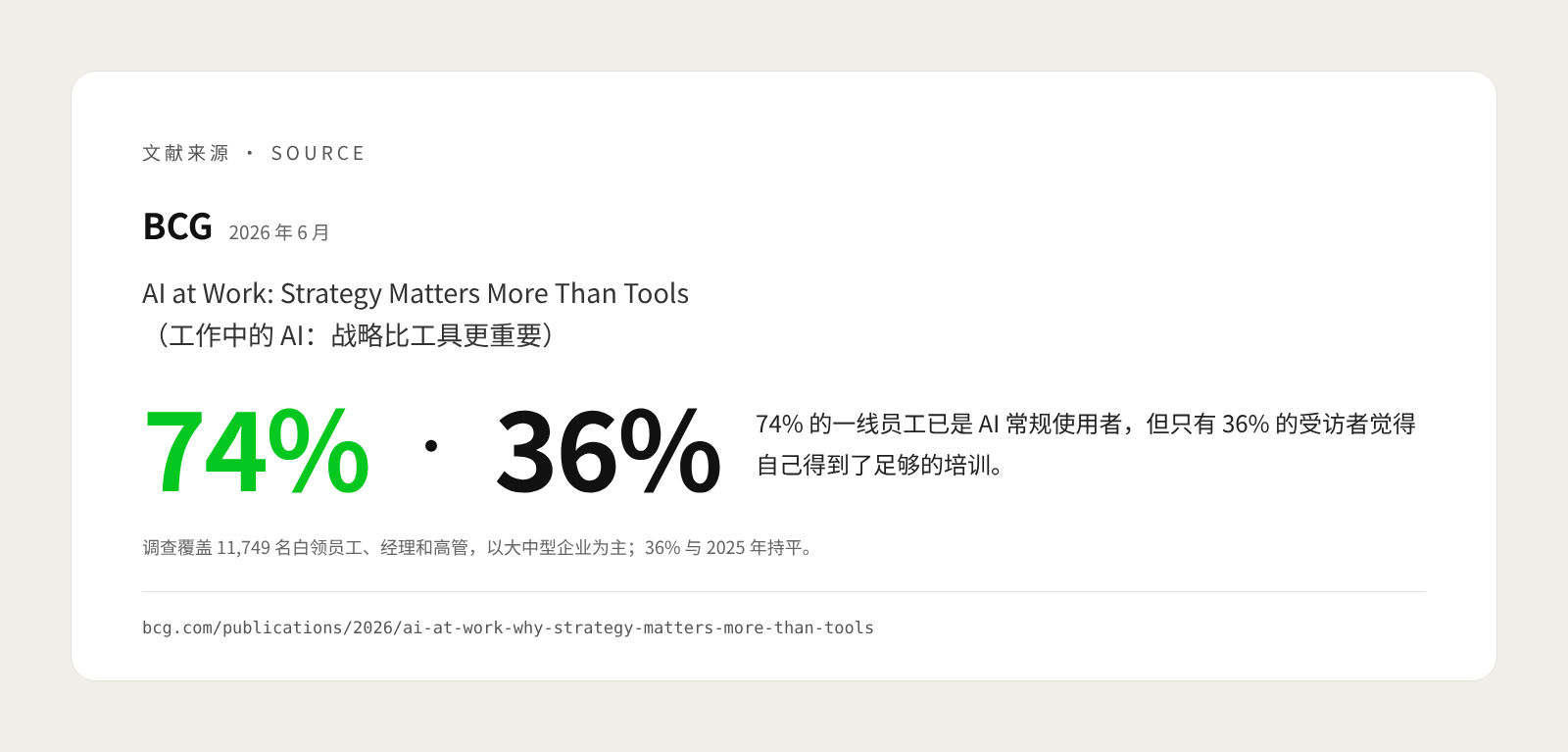
- Strong demand, largely unmet. BCG's AI at Work survey, published in June 2026, polled 11,749 white-collar employees, managers and executives: 74% of frontline employees are now regular AI users, up 23 percentage points on the previous year; 88% of respondents believe they will need significant upskilling over the next five years, but only 36% feel they have been adequately trained, unchanged from 2025; and only 33% of frontline employees believe leadership has communicated clearly about AI (source).
- Without rules, people use AI “on the quiet”. BCG's 2025 survey of more than 10,600 employees in 11 countries found that 54% would use AI tools even without authorization, while employees who had received more than 5 hours of training, especially with in-person coaching and guidance, were significantly more likely to become regular users (source).
- Managers themselves are not ready. A 2025 Gartner survey of 114 HR leaders found that only 8% believe their managers have the skills to use AI effectively, and only 14% of organizations support managers in integrating generative AI into their daily work (source).
It is worth noting that respondents to these surveys are mainly white-collar employees at large and mid-sized companies; the picture at SMEs and on the shop floor may differ. But the trend is consistent: the tools have arrived in the office, but understanding and rules have not caught up.
The cost of this gap is not just lost efficiency. Left to figure things out alone, employees may paste a customer list into a chatbot on a personal account, or put AI-fabricated clauses into a contract; others, worried about being seen as “cutting corners”, simply don't mention that they use it. Silent use is more dangerous than open use, because the company can neither see the risks nor learn from the experience.
What do employees in different roles need to learn?
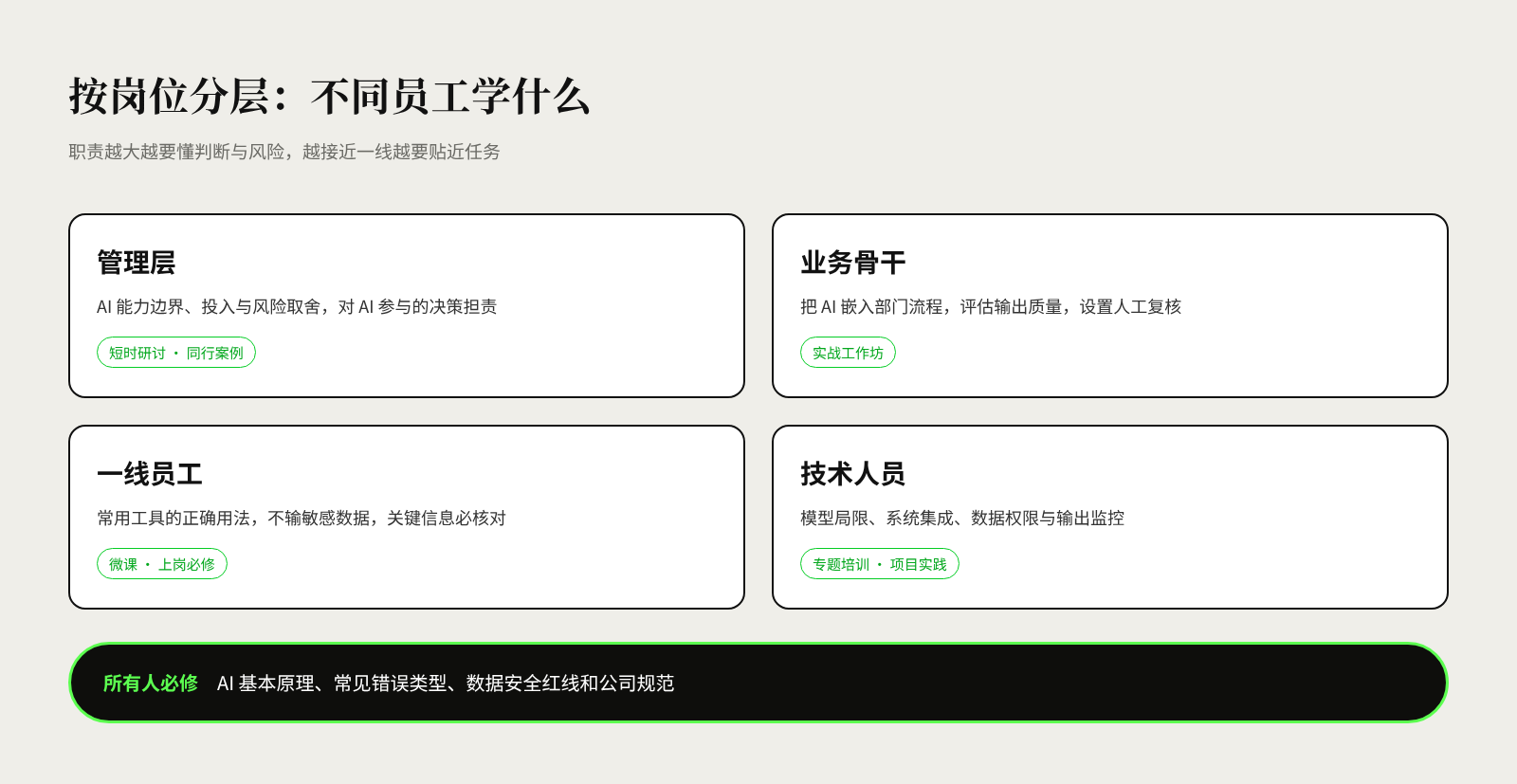
AI literacy training cannot be one slide deck for everyone. Different roles interact with AI differently and carry different responsibilities, so the focus of training should differ too. The principle behind the tiers: the greater the responsibility, the more judgment and risk awareness are needed; the closer to the front line, the more closely training should map to specific tasks.
The table below sets out a tiered framework you can use as a starting point for course design:
| Role level | Learning focus | Typical business scenarios | Judgment and safety focus | Suggested format |
|---|---|---|---|---|
| Management | What AI can and cannot do, trade-offs between investment and risk, leading teams in using AI | Deciding which processes are worth bringing AI into, reviewing AI-assisted business analysis | Bearing final responsibility for decisions involving AI; setting usage policies | Short workshops, peer case exchanges |
| Key business staff | Embedding AI in departmental processes, designing prompt templates, assessing output quality | Sales proposals, supplier price comparison, financial reconciliation, customer complaint analysis | Spotting errors and bias, building in human review checkpoints | Hands-on workshops, bringing real tasks to class |
| Frontline employees | Correct use of common tools, knowing what they can and cannot do | Answering customer inquiries, organizing tickets, store shift scheduling, writing product descriptions | Never entering sensitive data, always checking key information, reporting anomalies promptly | Short video micro-lessons, live demos, mandatory training before starting the job |
| Technical staff | How models work and their limits, system integration, permissions and logging, evaluation methods | Building internal knowledge base Q&A, connecting to ERP and ticketing systems | Data permissions, privacy protection, output monitoring and fallback mechanisms | Specialized technical training, project work |
The table is only a reference; the specifics should be adjusted to the industry, the tools in use and the level of risk. For example, frontline staff at a restaurant chain need a better grasp of AI-based scheduling and ordering suggestions, while key staff at a wholesale distributor need to learn how to use AI to handle large volumes of quote requests and order emails.
One group is often overlooked: management. If managers cannot use AI themselves and do not understand the risks, they will struggle to judge whether their team's AI output is reliable, and to give their team a sense of security. Management training should therefore not just mean “sitting through a trends briefing”; it should include completing several real tasks hands-on.
How to run employee AI literacy training systematically: a step-by-step guide
AI literacy training works best as an ongoing program, not a one-off event. First assess the current situation, then design by tier, practice with real tasks, reinforce with policies and champions, and keep improving with data.
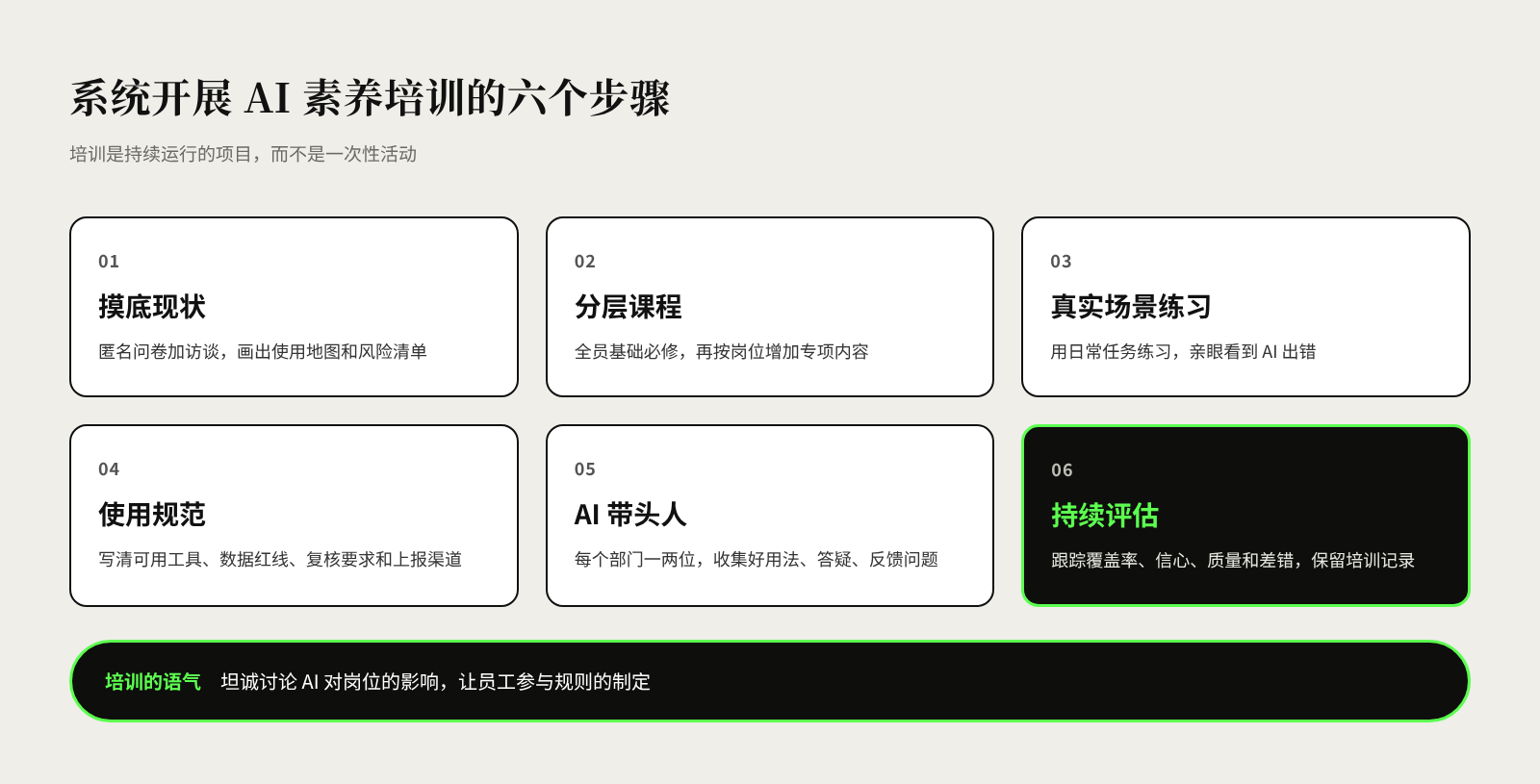
Step 1: Assess the current state. Find out which AI tools employees are using, what for, what problems they have run into, and what concerns they have about AI. An anonymous survey plus a few small-group interviews works well. Anonymity matters: employees will only reveal which tools they use privately if they are not worried about being held accountable. The output of this step is a “usage map” and a “risk list”.
Step 2: Design tiered courses. Following the table above, design different content and durations for different roles. Everyone takes a “core required course” covering how AI basically works, common types of error, data security red lines and company policy; role-specific content is then added on top.
Step 3: Practice with real business scenarios. Training material should come from employees' daily work, not generic examples. For example, have customer service staff use AI to draft replies to ten real complaints, then find the factual errors and tone problems in each other's drafts; have buyers use AI to compare quotes from three suppliers, then verify the results against the original documents. Letting employees see AI make mistakes with their own eyes is more effective than saying “remember to check” ten times.
Step 4: Set clear usage policies. The policy should answer a few specific questions: which tools are approved; which data must not be entered (such as customer identity information, full contracts or unpublished financial data); which outputs must be reviewed by a person before external use; and whom to report problems to. Keep it short and specific, ideally with examples of dos and don'ts, and walk through it point by point in training.
Step 5: Develop internal AI champions. In each department, find one or two employees who use AI well and are willing to share, and make them “AI champions”. They collect good practices from their department, answer colleagues' day-to-day questions and relay problems from the front line to managers. Demonstrations and answers from peers often ease concerns more effectively than external trainers.
Step 6: Evaluate and update continuously. Regularly review a few kinds of metrics: training coverage, changes in employees' confidence with AI, the quality and efficiency of AI-assisted tasks, and records of data security incidents and errors. Keep training records as well, for retrospectives and, when needed, to show what the company has done. We recommend updating course content at least every six months.
As you roll it out, pay attention to the tone of the training. Stress only what “not to do”, and employees go quieter; stress only “how much efficiency improves”, and they start to worry whether “once efficiency improves, jobs will be cut”. A better approach is to discuss openly how AI will change the work of each role, and to involve employees in setting the rules. That is also what makes people willing to use AI openly and share what they learn.
Frequently asked questions about employee AI literacy training
Do companies with no EU business need to pay attention to Article 4 of the AI Act? If an AI system is not placed on the EU market, not used in the EU and does not affect people in the EU, the regulation does not apply directly. But its underlying idea, helping employees understand the AI they use according to their role and the risks involved, is valuable for any company.
How many hours of AI literacy training are needed? Neither the regulation nor the surveys set a single standard. BCG's survey shows that employees who received more than 5 hours of training with in-person guidance are more likely to keep using AI. You can use that as a reference when designing a core course, then add role-specific content.
Employees worry that AI will replace them. How should training address this? Don't avoid the question. Explain candidly why the company is introducing AI and which work will change, and link the time saved to employees' new responsibilities and skills. Employees are more willing to invest in learning when they can see their own growth path.
Where should an SME without a training department start? Start with a short usage policy and a core course, then find one employee who uses AI well to act as a champion. Covering the most frequently used tools and the highest-risk data first is more practical than aiming for a complete curriculum.
References
- Regulation (EU) 2024/1689 (Artificial Intelligence Act), EUR-Lex, June 2024
- AI Literacy - Questions & Answers, European Commission, updated October 2026
- AI at Work Is Here. Now Comes the Hard Part, Microsoft & LinkedIn, May 2024
- AI at Work: Strategy Matters More Than Tools, BCG, June 2026 (survey slides)
- AI at Work 2025: Momentum Builds, But Gaps Remain, BCG, June 2025
- Gartner Research Finds Only 8% of HR Leaders Believe Their Managers Have the Skills to Effectively Use AI, Gartner, October 2025