The impact of AI on working people is not only about “Will I lose my job?” but also “Who am I now?” When a skill someone spent years mastering can be reproduced by a machine in seconds, what is shaken is often not just their income but their sense of self. A career can answer “what do I do,” but it doesn't have to carry “who am I” on its own; separating the two questions is the first step to staying grounded in the age of AI.
So why are career and identity so tightly bound? And why does AI touch this particular nerve? In this article, we look at how professional identity forms, the real reason AI unsettles it, which kinds of value still belong to people, and how individuals and companies can respond to this shift.
Why does a career become the answer to “who am I”?
When two strangers meet for the first time, it does not take long before one asks, “What do you do?” The answer is rarely “I love painting” or “I'm a father of two”; it is “I'm an accountant,” “I work in international trade” or “I'm an engineer.” A career becomes the first line of a self-introduction because it provides income, status, a social circle and a reason to get up every morning, all at once.
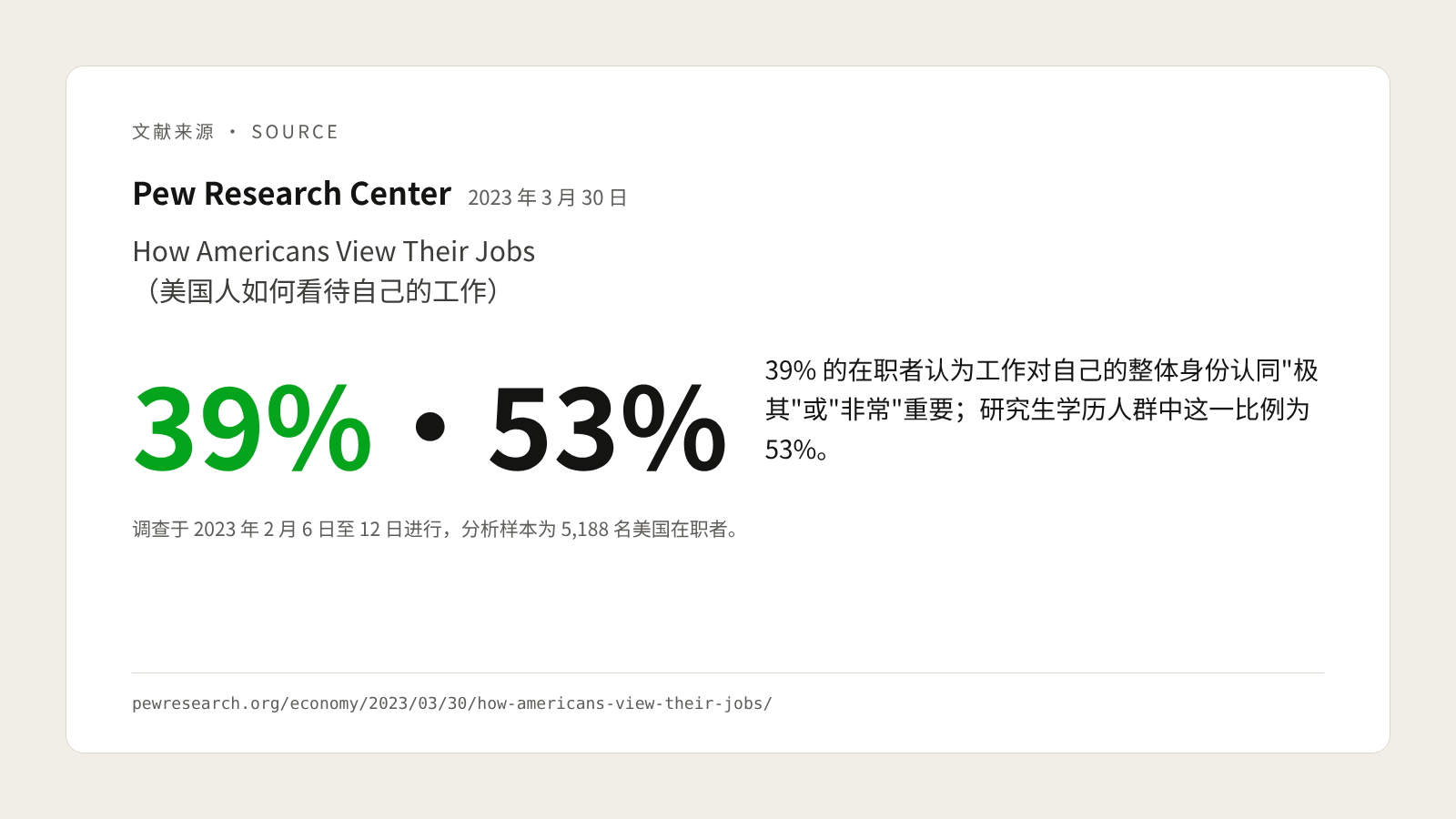
Work takes up more of an adult's waking hours than anything else. A craft someone has spent a decade honing naturally becomes part of how they see themselves. A 2023 Pew Research Center survey of 5,188 U.S. workers found that 39% consider their job “extremely” or “very” important to their overall identity; among those with a postgraduate degree, the figure is 53% (source). In other words, the more you invest in your profession, the more likely you are to tie “what I do” to “who I am.”
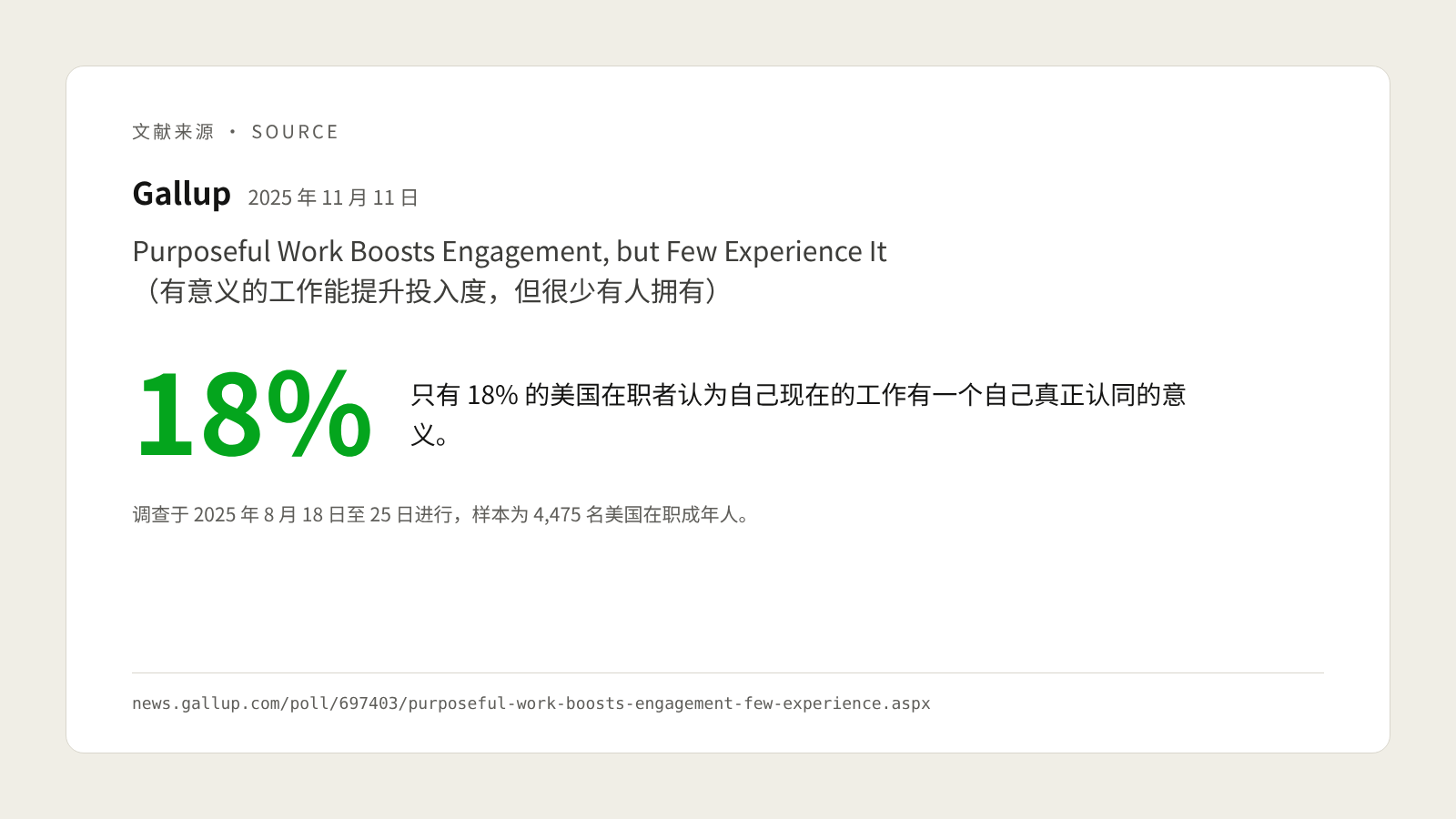
But another figure deserves equal attention. A Gallup survey of 4,475 U.S. workers in August 2025 found that only 18% feel their current job has a purpose they genuinely identify with (source).
Put these two figures side by side and a long-standing tension emerges:
- Many people treat their work as their identity. Their career is the main basis on which they introduce and judge themselves.
- Yet they have not necessarily found meaning in it. Most people do not identify with the purpose of their work.
For example, a translator with ten years in the profession may have long introduced themselves with “I'm a translator,” yet rarely asked why they do the job. In ordinary times, this tension can be ignored; the arrival of AI makes it impossible to avoid.
Why does AI unsettle professional identity?
Earlier waves of automation mainly replaced physical and repetitive labor: the spinning machine replaced hand spinning, the assembly line replaced manual handling, the spreadsheet replaced bookkeeping by hand. This time, AI touches the very “skills” many people take pride in: writing a good article, translating a contract, writing code, drawing an illustration, producing an analysis.
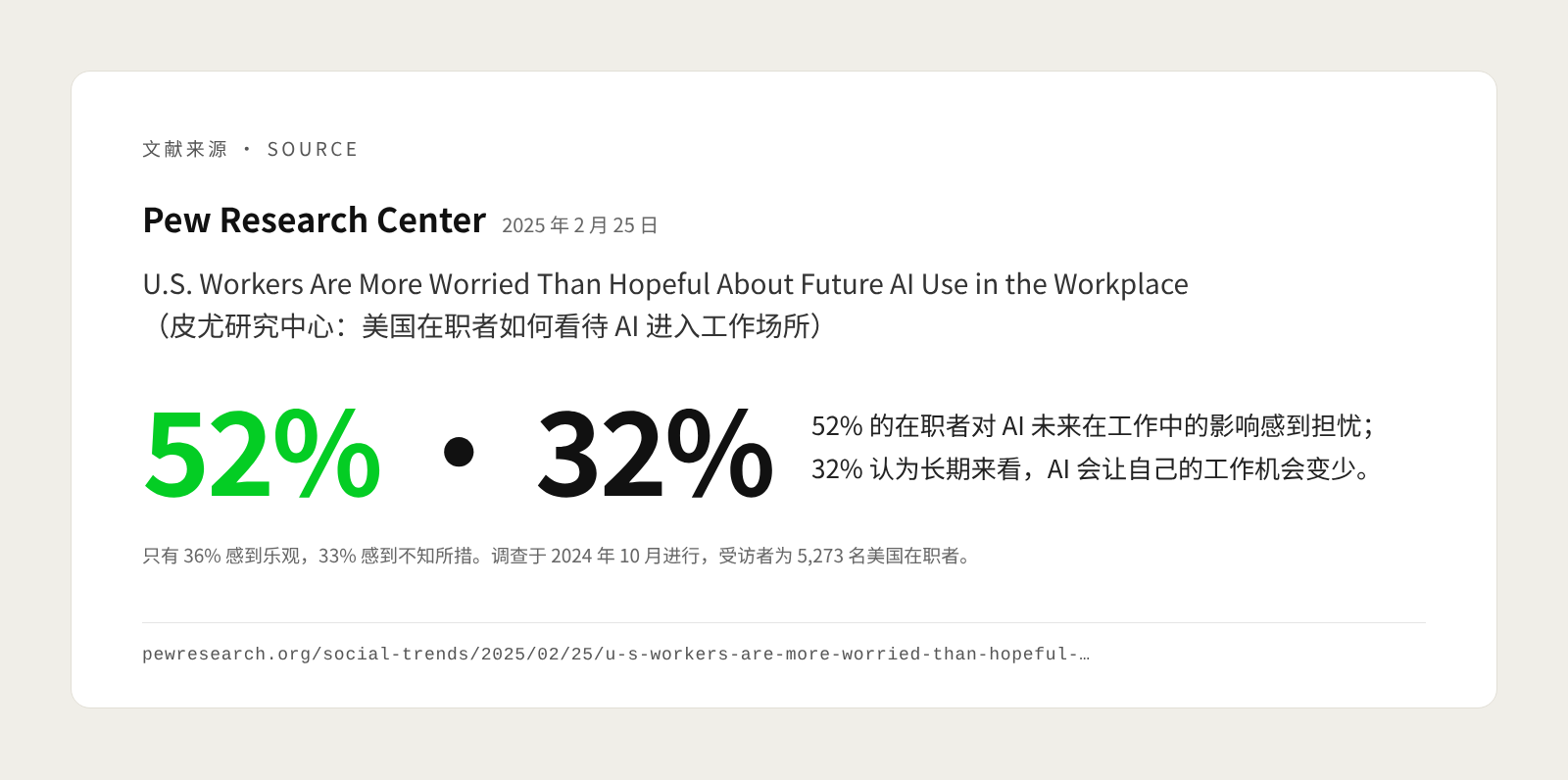
This unease is already widespread. A Pew Research Center survey published in February 2025 (of 5,273 U.S. workers) found that 52% feel worried about AI's future impact in the workplace, only 36% feel hopeful and 33% feel overwhelmed; 32% think that in the long run AI will lead to fewer job opportunities for them (source).
If it were only about income, this anxiety would have plenty of practical remedies: learn new skills, change roles, switch industries. The unease many people struggle to put into words often comes from a deeper layer. Work has never given people just a paycheck:
- The feeling of being needed. Someone is waiting on my results; some things can't get done without me.
- A story about oneself. I went from knowing nothing to standing on my own feet; these ten years were not wasted.
- A simple measure of worth. I do it well, so I am valuable.
That last point is exactly what AI truly touches. Modern society runs on an equation that is rarely said out loud: I am useful, therefore I am valuable. Grades, degrees, job titles and income all keep reinforcing it. As machines become “more useful” than people at more and more things, the conclusion, if the equation holds, becomes brutal.
Some foresaw this question long ago:
- Keynes (1930). In “Economic Possibilities for our Grandchildren,” he imagined that a hundred years on, people might need to work only fifteen hours a week, and argued that humanity would then face its “real, permanent problem”: how to live once freed from the pressure of making a living.
- Hannah Arendt (1958). In “The Human Condition,” she worried that automation would free people from labor, while a society that knows only labor no longer remembers what more meaningful activities might be worth winning that freedom for.
So the real test AI poses may not be “Will I lose my job?” but rather: if being “useful” no longer proves a person's worth, what else can they rely on to affirm who they are? For some, this will feel like a loss; for others, it may be a liberation. The difference lies in whether a person's sense of self rests solely on a single skill that can be replaced.
What can AI take over, and what can't it take away?
The first step in easing this unease is to distinguish two kinds of things in any job. AI excels at output, but what makes a person who they are is their choices, responsibilities, experiences and relationships with others. Output can be copied; the rest cannot.
The table below can help you map your own work:
| Dimension | What AI is better placed to take over | What still belongs to people |
|---|---|---|
| Answers | Quickly generating multiple options | Deciding which one to trust and adopt |
| Output | Drafting, translating, organizing, analyzing | Judging what is worth doing, and to what standard |
| Responsibility | Executing rules that have already been set | Owning the outcome and making decisions beyond the rules |
| Relationships | Writing a well-judged reply | Being the person who is trusted and whose reply people wait for |
| Experience | Simulating, reproducing, copying endlessly | Living through it firsthand and forming your own perspective |
This table is only a framework for thinking. The line between the two columns will shift as technology develops, but the more the left column expands, the more weight the right column carries.
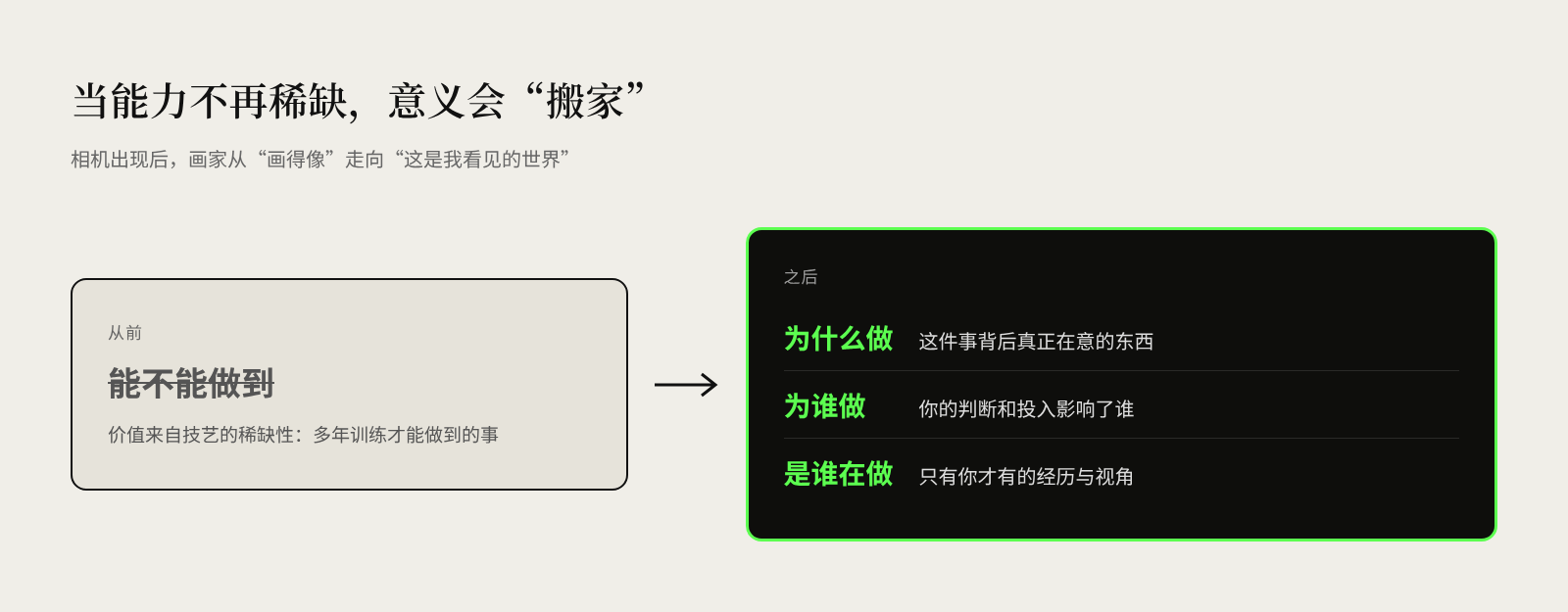
History has seen a similar test before. In 1839, photography was publicly introduced. Until then, accurately capturing a person or a landscape on canvas was a painter's most essential and most prized skill; a camera needed only an instant. One painter is said to have declared at the time: from today, painting is dead.
Painting did not die, but painters were forced to answer a question they had never needed to ask: if “a good likeness” is no longer rare, what is painting for? In the decades that followed, some began painting the fleeting changes of light, some painted the world as they saw and felt it, and some abandoned figurative imagery altogether. A common view is that the camera freed painting from the task of “recording” and turned it toward “expression.”
This story does not mean that everyone will make the transition smoothly, or that the process is painless. But it shows one thing: when a skill is no longer scarce, meaning does not disappear; it moves house, from “can it be done” to “why do it, for whom, and who is doing it.”
How to rebuild meaning in your career in the age of AI: a step-by-step guide
No one can answer “who am I” for someone else. But in the face of the changes AI brings, there are practical steps that can help a person build their sense of self on firmer ground. The core idea: broaden the source of your value from “what skills I have” to “why I do it, for whom, and how I make judgments.”
Step 1: Write down “what I do” and “who I am” separately. Try introducing yourself without mentioning your job title or company: what you care about, how you relate to people, what kind of person you want to become. The more specific this description, the smaller the shock when your career changes.
Step 2: Find the “why” in your work. For example, what a translator truly cares about may not be converting words into another language, but helping two parties genuinely understand each other. Once you find that reason, the meaning of the work does not vanish when the tools change.
Step 3: Treat AI as a tool that takes over repetitive work. Hand drafting, organizing and preliminary analysis to AI, and spend the time saved on review, judgment and communicating with people. Rather than racing the machine, focus your energy on the parts it cannot do.
Step 4: Deliberately develop judgment, responsibility and relationship skills. For example, take on tasks that require decisions, become the contact clients trust, or mentor newcomers. These abilities rarely make it onto a résumé, yet they are the hardest for AI to replace.
Step 5: Build more sources of identity outside work. Family, friends, interests, community and learning can all be part of your answer to “who am I.” The more varied the sources of your identity, the less any change in one of them can shake your foundations.
Step 6: Allow yourself to feel the loss, but don't let it define you. For some, change means real loss: a job, or a pride built over years of hard practice. That loss deserves to be taken seriously, not brushed aside with a glib “embrace change.” A skill becoming less scarce does not mean the person becomes less valuable.
What can companies and managers do?
The erosion of professional identity is not only a personal issue; it directly affects how companies adopt AI. Employees who see AI as a denial of their own worth will find it hard to use it wholeheartedly. Helping employees find their place again is a prerequisite for AI adoption, not an optional act of care.
In practice, you can start in four areas:
- Communicate honestly about AI's real impact on roles. Be clear about which tasks will go to AI, which remain with people and how roles will change. Vagueness and avoidance only drive anxiety underground.
- Redesign roles, don't just cut them. Free employees from repetitive work and move them toward higher-value activities such as review, judgment and customer communication, and write these changes into job descriptions.
- Adjust performance criteria. If evaluations still look only at output volume, employees will naturally feel they are competing with machines. Including quality of judgment, client trust, collaboration and mentoring in evaluations tells employees what really matters.
- Provide upskilling paths. Help employees learn to work with AI rather than be replaced by it. Training should be tailored to their actual work, not a one-off tool demo.
Over a longer horizon, there is a somewhat ironic truth hidden in this shift. For the past one or two hundred years, industrial society has asked people to work like machines: standardized, consistent, efficient, quantifiable. Now real machines have arrived, and they are better at being machines than people are. The equation “useful equals valuable” was never part of human nature; it was a product of its era. The more machines act like machines, the more people are free to be human.
Frequently asked questions about AI and professional identity
Will AI replace my job? AI is more likely to replace some of the tasks within a job than the whole person. Judgment, responsibility and relationships with others remain hard to replace in most roles.
What's wrong with treating your career as your identity? Identifying with your profession is not a problem in itself. The risk lies in building your sense of self solely on one replaceable skill: once that skill becomes less scarce, your view of yourself can be shaken along with it.
Is it normal to feel anxious? Yes. Pew's survey shows that more than half of workers are worried about AI's future impact in the workplace. Turning anxiety into concrete action, such as learning to work with AI and rethinking what your work means to you, helps more than avoiding it.
Where should managers start? With honest communication: explain which tasks AI will take over and how roles will change, then adjust job responsibilities and performance criteria to match.
References
- How Americans View Their Jobs, Pew Research Center, March 2023
- U.S. Workers Are More Worried Than Hopeful About Future AI Use in the Workplace, Pew Research Center, February 2025
- Purposeful Work Boosts Engagement, but Few Experience It, Gallup, November 2025
- John Maynard Keynes, “Economic Possibilities for our Grandchildren,” 1930
- Hannah Arendt, “The Human Condition,” 1958