AI agents are moving from demos and pilots into real business environments. In production, an agent no longer just answers questions; it calls systems, modifies data and completes a chain of actions on someone's behalf. Whether agents can scale depends not on how smart the model is, but on whether a company can make them run reliably, safely and under control.
So what separates a demo that works well from a production system you can trust? In this article, we look at how agents differ from traditional AI tools, why they struggle to reach production, the four areas you must address before going live, and how to expand autonomy step by step while staying in control.
What is an AI agent, and how is it different from a chatbot?
An AI agent is an AI system that can autonomously plan steps toward a goal, call tools and adjust its next action based on the results. A chatbot talks; an agent acts. This also means that when it makes a mistake, the consequences land directly in your business systems.
For example, when a customer asks, “Why hasn't my order shipped yet?”:
- A chatbot gives a generic explanation based on the knowledge base and suggests the customer contact customer service.
- An agent queries the order system, finds the item is out of stock, checks the warehouse's incoming delivery schedule, gives an estimated shipping date and, if necessary, creates a ticket for a human to follow up.
The table below summarizes the main differences:
| Aspect | Chatbot / AI assistant | AI agent |
|---|---|---|
| How it works | Question and answer | Autonomously plans multiple steps toward a goal |
| What it can reach | Text, knowledge base | Business systems, databases, external tools |
| Output | Text suggestions | Real actions, such as creating tickets or updating records |
| Consequence of errors | Inaccurate answers | Wrong actions directly affect the business |
| Management focus | Answer quality | Permissions, monitoring, approvals and rollback |
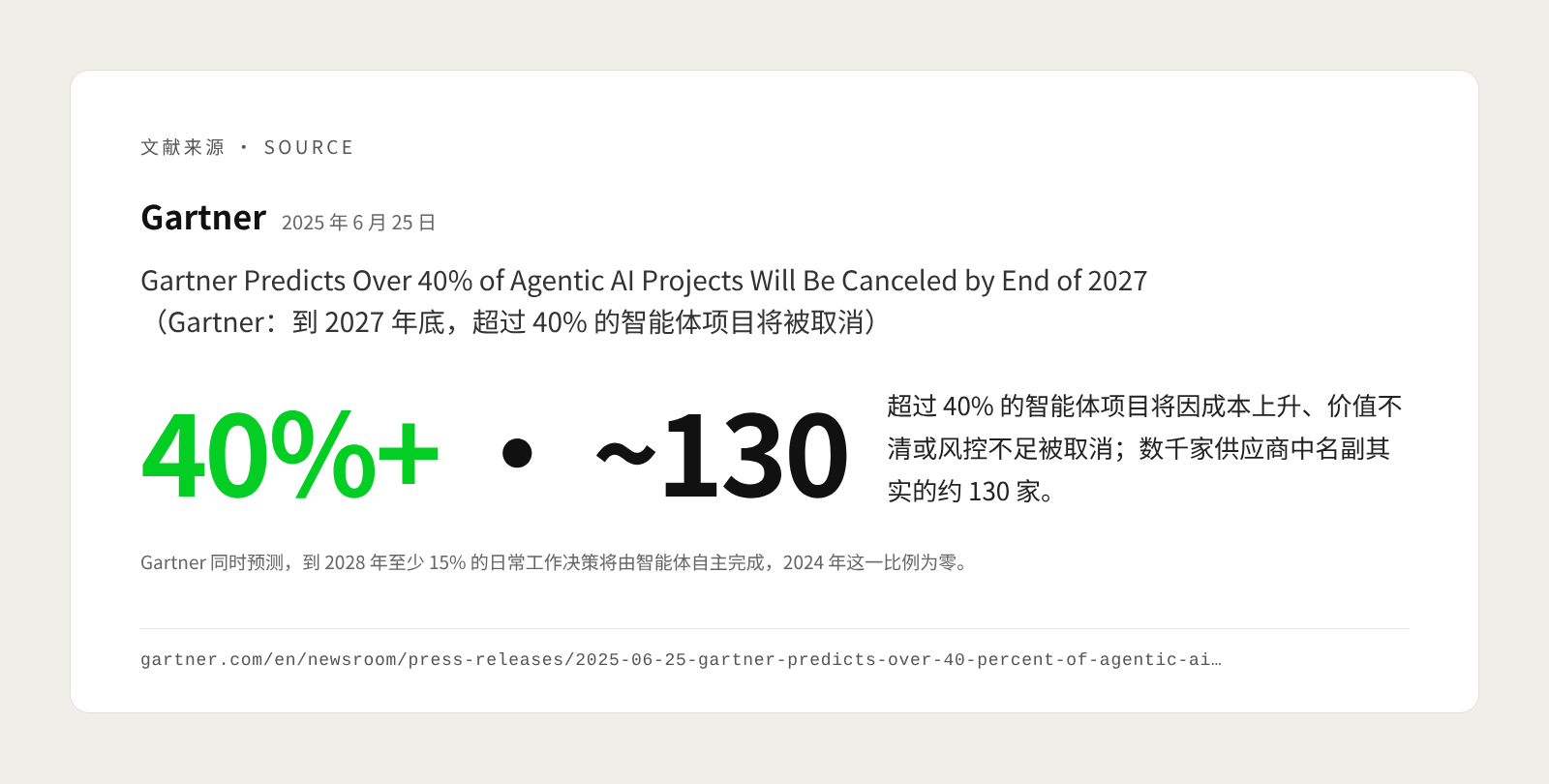
Note that not every product on the market that calls itself an “agent” actually has these capabilities. Gartner calls the practice of rebranding existing products as agents “agent washing,” and estimates that of the thousands of agentic AI vendors, only about 130 are the real thing.
Why do most agent projects struggle to reach production?
Interest in agents is high, but companies that have moved from experimentation to scale are still in the minority. What holds agents back from going live is usually not “can it do this?” but “can it do it right every time, and can errors be caught and corrected?”
Several studies show this gap:
- Scaling is still at an early stage. McKinsey's “The state of AI in 2026” found that 40% of large companies with annual revenue above $1 billion have scaled agents in at least one function, up from 27% the previous year, while smaller companies remain at 22% (source). The functions where agents have scaled most are IT, knowledge management and software development.
- Many projects may be canceled. Gartner predicts that by the end of 2027, more than 40% of agentic AI projects will be canceled due to escalating costs, unclear business value or inadequate risk controls (source).
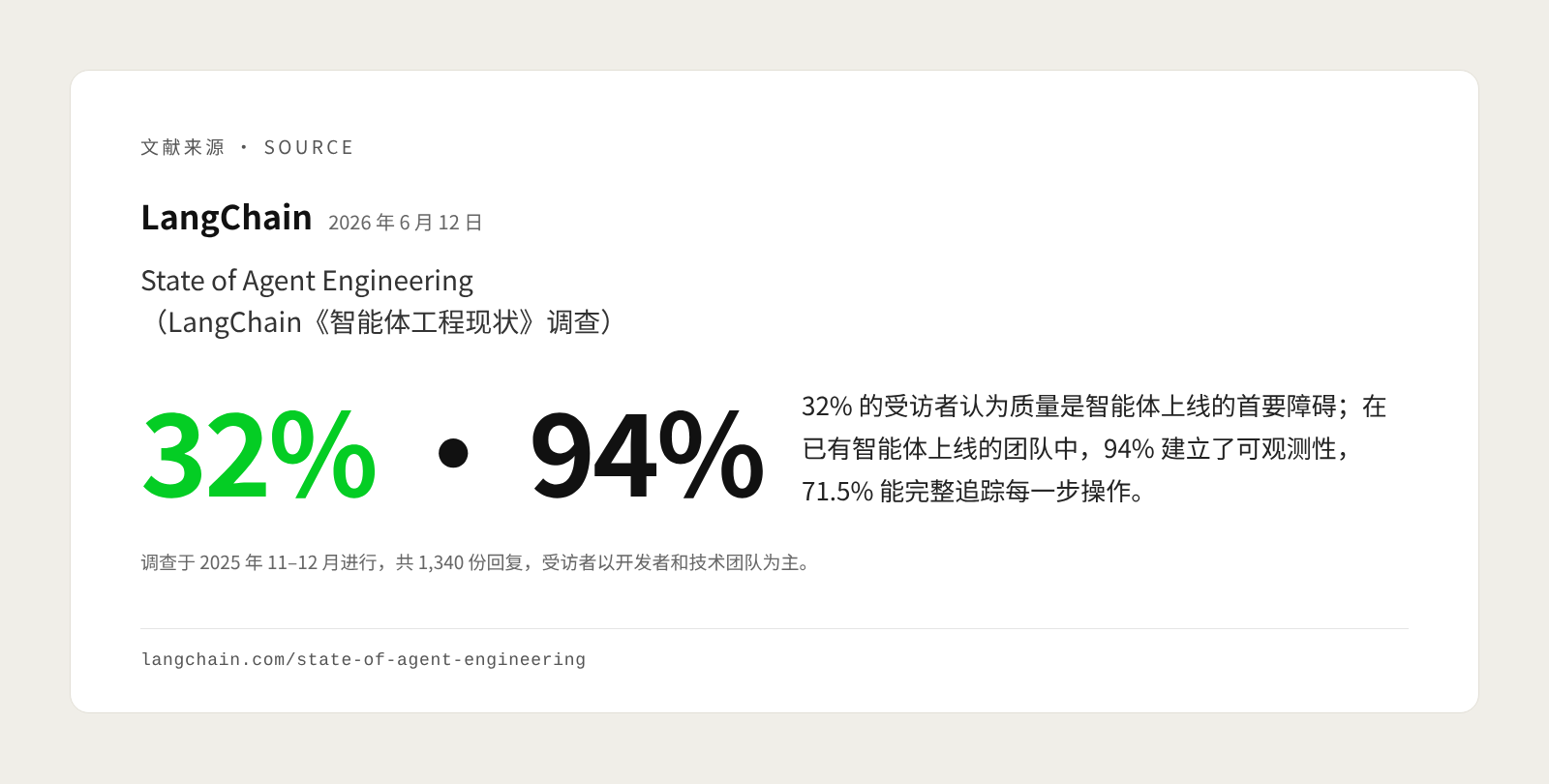
- Quality is the biggest barrier. LangChain's “State of Agent Engineering,” published in June 2026, surveyed 1,340 practitioners: 32% named quality as the top barrier to putting agents into production, followed by latency (20%) (source). Respondents were mainly developers and technical teams, and 57% of them said they already have agents running in production, a higher share than across companies as a whole.
Taken together, agents usually stall at the pilot stage for three reasons:
- Demo environments are too ideal. In a pilot, data is clean and tasks are simple; in real operations, exceptions, ambiguous requests and system failures appear in large numbers.
- Errors compound. Each step an agent takes depends on the result of the previous one. However accurate each individual step, the overall success rate can drop noticeably after a dozen or so steps.
- There is no accountability mechanism. When an agent takes a wrong action and there are no logs, permission boundaries or rollback plan, a company can neither pinpoint the problem nor feel confident continuing to use it.
For example, an agent handling refund requests may complete ten standard cases smoothly in a demo. But once live, when it encounters partial returns, cross-currency orders or fraudulent claims, without human review and amount limits, a small error of judgment can turn into a very real financial loss.
What must be resolved before an agent goes into production?
For an agent to run reliably in real operations, four areas must be addressed in advance: orchestration, monitoring, risk management and systems integration. Together they determine whether an agent is a “demo that does things” or a “system you can rely on.”
Orchestration. Orchestration determines the order in which an agent does things, when it calls which tool and how work is divided among multiple agents. For tasks with fixed processes and higher risk, it is often better to hard-code the main steps as a deterministic workflow and leave only the judgment calls to the model. The more freedom you give an agent, the stricter its boundaries need to be.
Monitoring and observability. Companies need to see every step an agent takes: what it saw, which tools it called and why it made a particular decision. LangChain's survey shows that among teams with agents in production, 94% have some form of observability in place, and 71.5% can fully trace every step and tool call. Beyond logs, continuous evaluation is needed: test sets to check quality, and human spot checks to catch issues that automated evaluation misses.
Risk management. An agent's risks go beyond “wrong answers” to include unauthorized actions, data leaks and manipulation by malicious instructions. McKinsey's survey also found that AI high performers are more likely to actively guard against “unauthorized or unintended actions.” Basic measures include least privilege, limits on transaction amounts or frequency, human approval for sensitive operations, and a “kill switch” that can pause the agent at any time.
Systems integration. An agent's value comes from the systems it can reach. If the interfaces to your ERP, CRM or ticketing system are unstable, or data definitions are inconsistent, the agent's judgments will not be reliable either. Integration also has to account for failure handling: when an interface times out or data is missing, should the agent stop, retry or hand over to a human?
The table below summarizes the key questions and common practices for each area and can serve as a pre-launch checklist:
| Area | Question to answer before launch | Common practices |
|---|---|---|
| Orchestration | Which steps are fixed, and which are left to the model's judgment? | Deterministic workflows with local autonomy, task decomposition, division of labor across multiple agents |
| Monitoring | When something goes wrong, can it be detected and diagnosed quickly? | End-to-end tracing, offline and online evaluation, human spot checks |
| Risk | What is the worst case, and can losses be contained? | Least privilege, action limits, human approval, kill switch |
| Integration | Are data and interfaces reliable, and what happens when they fail? | Consistent data definitions, stable interfaces, retries and human handover on failure |
This checklist is for reference only; specific requirements should be adjusted to the risk level of the task.
How to take an agent into production safely: a step-by-step guide
The safest way to take an agent into production is to start with a clearly bounded scenario and expand gradually. First get it right within a controlled scope, then let it do more.
Step 1: Choose a clearly bounded scenario. Prioritize tasks with clear rules, high volume and repetition, and manageable consequences when errors occur, such as ticket classification and routing, order status inquiries, or matching invoices against orders. For now, avoid scenarios that move money directly or make commitments to external parties.
Step 2: Define success criteria and failure handling. Before launch, specify the metrics to track, such as task completion rate, error rate, handling time and human handover rate. Also spell out the situations in which the agent must stop and hand over to a person.
Step 3: Run in “shadow mode.” Let the agent process real business requests but only make recommendations without executing any actions, then compare its output with how humans handled the same cases. This is the lowest-cost stage at which to uncover real problems.
Step 4: Open up on a small scale with human approval. Once shadow mode results meet the bar, let the agent execute actions after human confirmation, limiting its scope to one team, one region or a set amount.
Step 5: Let data decide whether to expand autonomy. Continuously track the human rejection rate and error types. When a category of task remains stable over time, move it from “approval required” to “post-hoc spot checks.”
Step 6: Turn lessons into platform capabilities. Permission management, logging and tracing, evaluation processes and approval mechanisms should become shared infrastructure for all agents, rather than being rebuilt for every project. That way, your second and third agents will go live much faster.
How do you expand autonomy while staying in control?
Autonomy is not an on/off switch but a range that can be adjusted level by level. The same agent can act autonomously on low-risk tasks and only make recommendations on high-risk ones. The key is to decide which level it operates at for each type of task, based on the task's risk and the agent's actual performance.
A common way to define the levels:
- Recommend only. The agent analyzes the situation and makes a recommendation; a person decides and acts. Suitable for newly launched or high-risk tasks.
- Execute after approval. The agent prepares the action, which is executed after human confirmation. Suitable for tasks involving money, customer commitments or sensitive data.
- Execute autonomously, with post-hoc spot checks. The agent completes the action directly; people periodically spot-check and handle exceptions. Suitable for tasks with a long track record of stable performance where errors are recoverable.
- Fully autonomous. The agent completes tasks independently within set boundaries and notifies a person only when an alert is triggered. Suitable only for low-risk, reversible tasks with very clear rules.
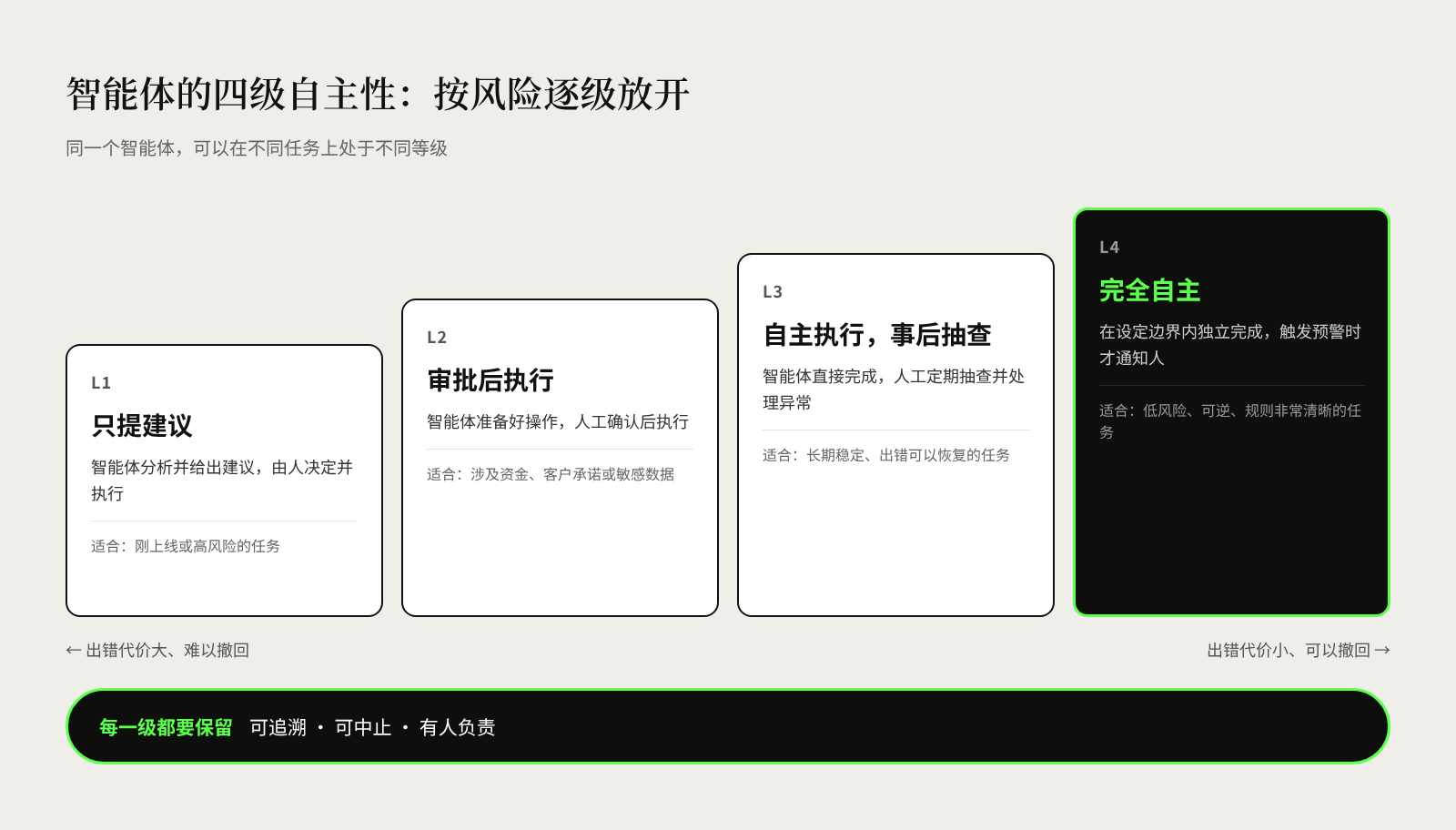
To decide which level a type of task belongs at, ask two questions: How costly is a mistake? Can it be undone? For example, mislabeling a ticket costs little and can be corrected at any time, so it suits a higher level of autonomy; issuing a customer refund or changing contract terms is costly and hard to reverse, so human approval should remain.
Whatever the level, three basic controls should always be in place:
- Traceable. Every action is recorded, so you can explain what the agent did and why.
- Stoppable. When something looks wrong, you can pause the agent immediately or drop it to a lower level of autonomy.
- Owned. Every agent has a clearly designated business owner who is accountable for its results. The agent may be autonomous, but a person is always accountable.
Frequently asked questions about AI agents in production
Are agents suitable for small and medium-sized businesses? Yes, but start with a clearly bounded, high-volume process, such as order inquiries or document matching. Validating value in one scenario before expanding is safer than building a complex multi-agent system from the outset.
What should you do when an agent makes a mistake? First pause it or lower its level of autonomy, then use the logs to pinpoint the step where it went wrong. Once it is fixed, add the case to your test set to make sure the same problem does not recur.
Do you have to build agents yourself? Not necessarily. Many business applications already have built-in agent capabilities. When choosing, watch out for “agent washing”: confirm that the product can genuinely plan steps, call systems, and provide permission controls and action logs.
Will agents replace employees? More commonly, agents take over the repetitive, rule-based steps in a process. Employees' roles shift toward approvals, handling exceptions and taking responsibility for results.
References
- The state of AI in 2026: On the road to ROI, McKinsey, August 2026
- Gartner Predicts Over 40% of Agentic AI Projects Will Be Canceled by End of 2027, Gartner, June 2025
- State of Agent Engineering, LangChain, June 2026