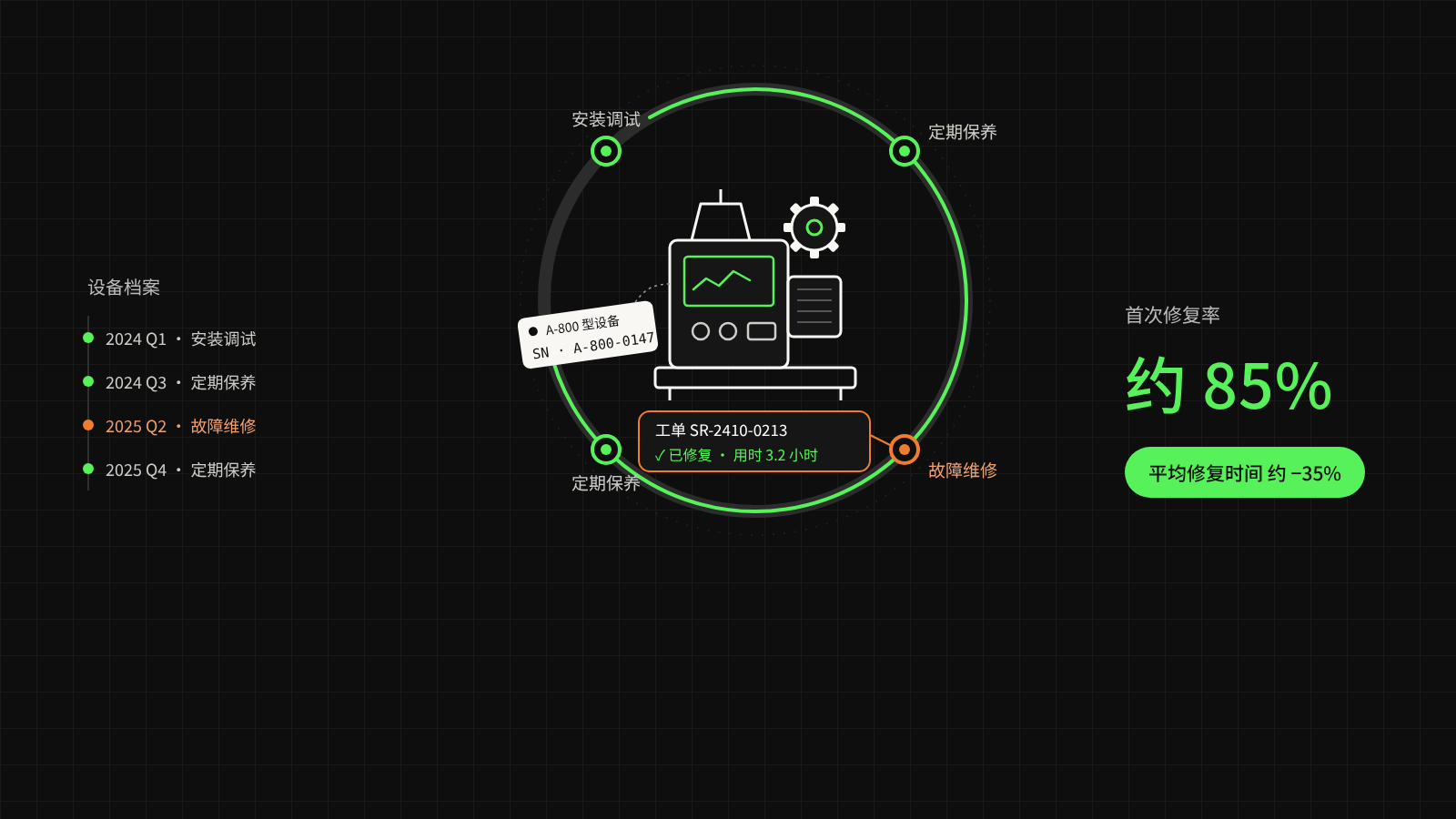
A digital record for every machine lifts first-time fix rate to around 85%
An industrial equipment manufacturer built its after-sales operation around the serial number, linking customers, warranties, service orders, spare parts and repair costs. Technicians now see a machine's full history before they arrive on site, and after-sales has moved from reactive firefighting to ongoing management.
The company sells industrial equipment to factory customers. Its business goes well beyond the sale itself, covering installation and commissioning, scheduled maintenance, repairs and spare parts supply.
As the installed base kept growing, after-sales service became an increasingly important source of revenue.
Yet sales worked in a CRM, technicians received repair jobs through WeChat groups, spare parts stock was managed by the warehouse, and repair costs were accounted for separately in the finance system.
Once a machine had been sold, the company found it surprisingly hard to maintain a complete, long-term record of the equipment at each customer.
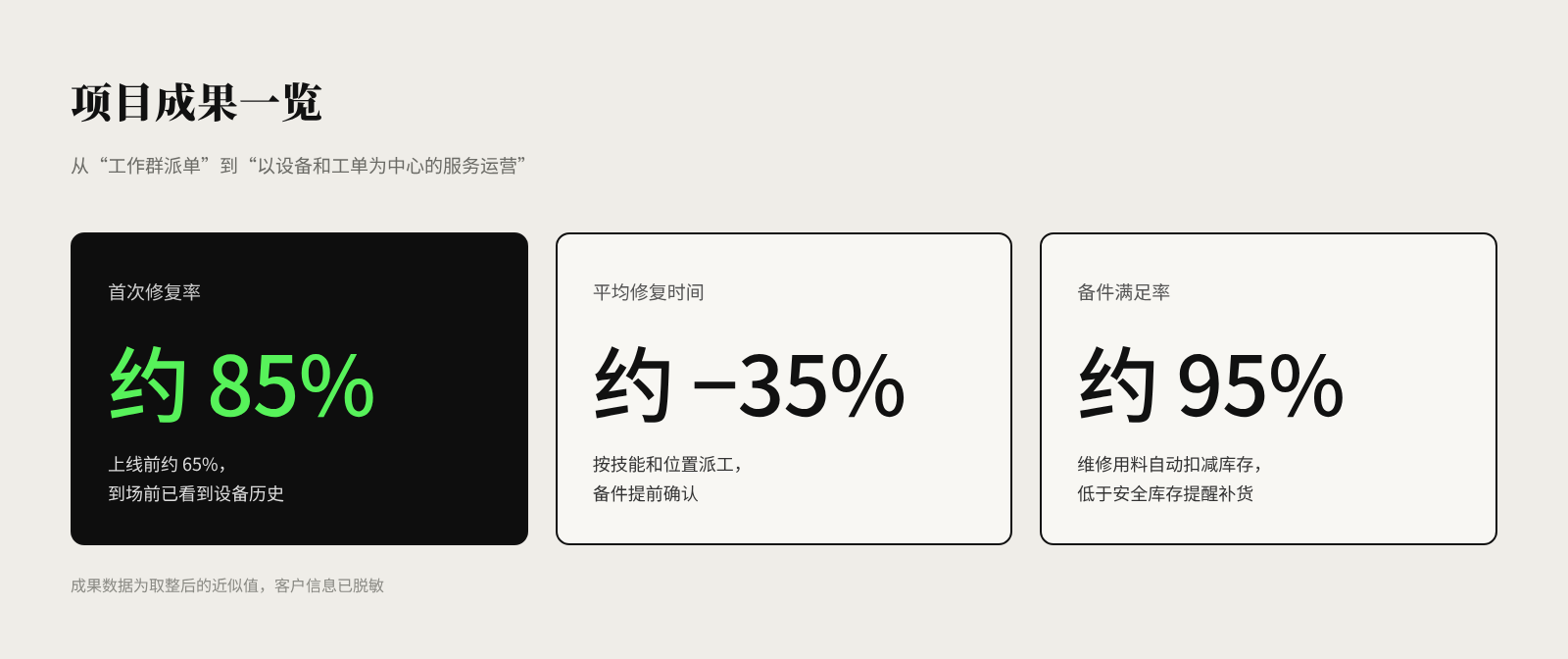
Results: first-time fix rate approx. 85%; mean time to repair approx. −35%; spare parts fill rate approx. 95%
The challenge
Equipment history was hard to find
Model, serial number, installation date, warranty period and repair history were scattered across different files.
Technicians arriving at a customer site often had to re-establish the condition of the machine from scratch.
Repair jobs could not be dispatched centrally
When a customer reported a fault, the after-sales manager relied on judgement to work out which technicians were free and had the right skills.
There was no transparent record of job priority, response times or repair status.
Spare parts consumption was disconnected from repair costs
Parts used in field repairs were not deducted from stock in time, and labour hours and travel expenses could go unrecorded.
The company struggled to tell which equipment models were expensive to maintain and which service contracts had profitability problems.
SHEPHARD's digital solution
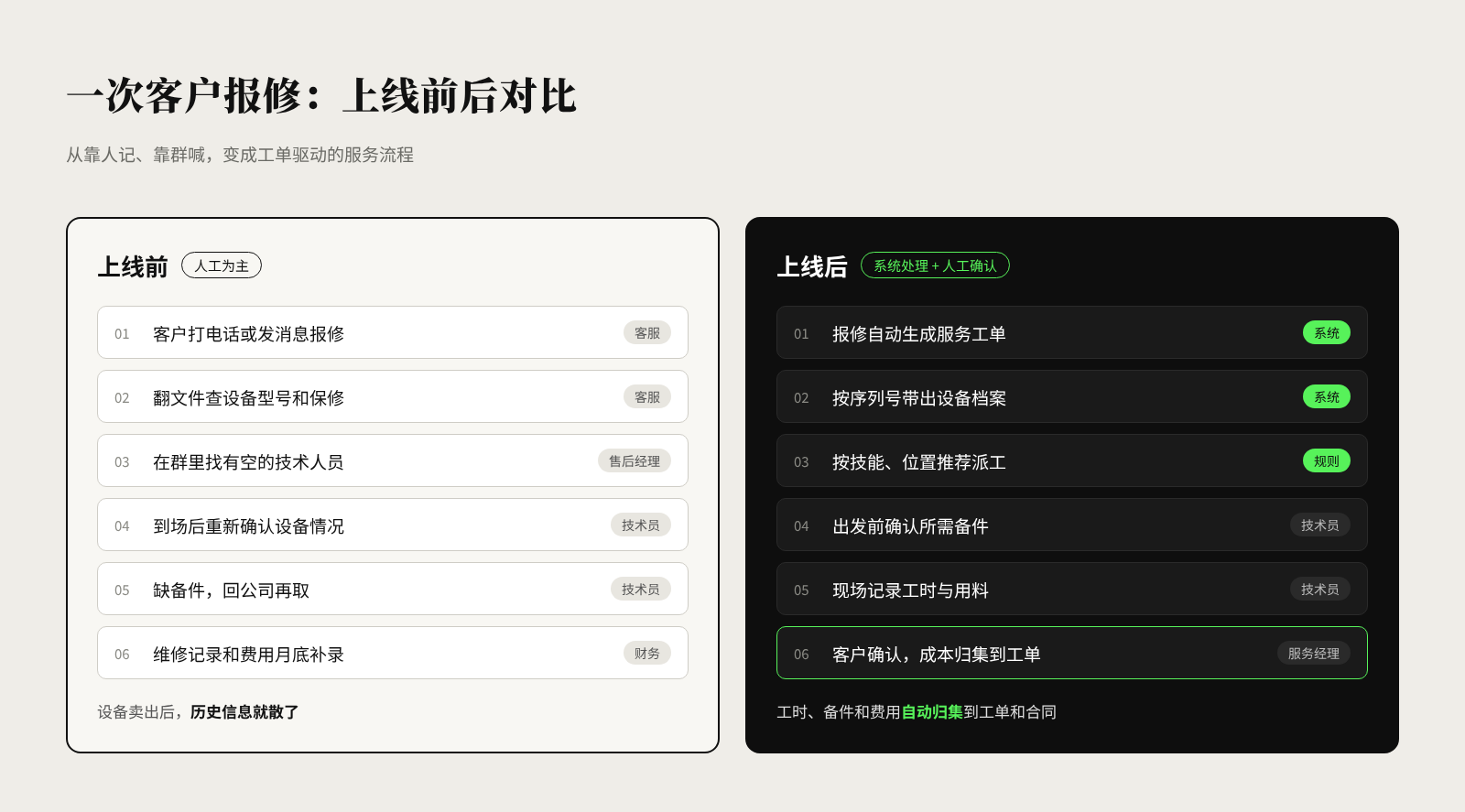
A customer repair request: before and after go-live
Step 1: Give every machine a digital identity
We built a complete record for every delivered machine, anchored on its serial number.
Each record links the customer, installation site, delivery date, warranty terms, service contract and repair history.
Equipment data stays linked to the original sales orders, so nothing has to be recorded twice.
Step 2: Unify service orders
After-sales requests arriving by phone, email or the customer portal are all logged as service orders.
Jobs are assigned by equipment type, fault severity, customer contract and location.
The system records every key milestone: first response, dispatch, arrival on site, repair completion and customer sign-off.
Step 3: Equip technicians with a mobile app
On site, technicians can view the machine's history, repair manuals and related technical documentation.
Through the mobile app they record the fault cause, the work carried out, actual hours and the parts used.
Where needed, they upload photos, customer sign-off and the repair report.
Step 4: Connect spare parts stock with service costs
Parts used in a repair automatically trigger the corresponding stock issue, and eligible replaced parts enter the return or refurbishment process.
Labour, materials and other service costs are all allocated to the specific service order or service contract.
Step 5: Introduce preventive maintenance plans
For equipment that needs periodic servicing, the system generates service reminders automatically based on operating hours, contract terms or maintenance intervals.
For machines with reliable data capture, the company will gradually assess connecting IoT operating data to enable condition monitoring and predictive maintenance.
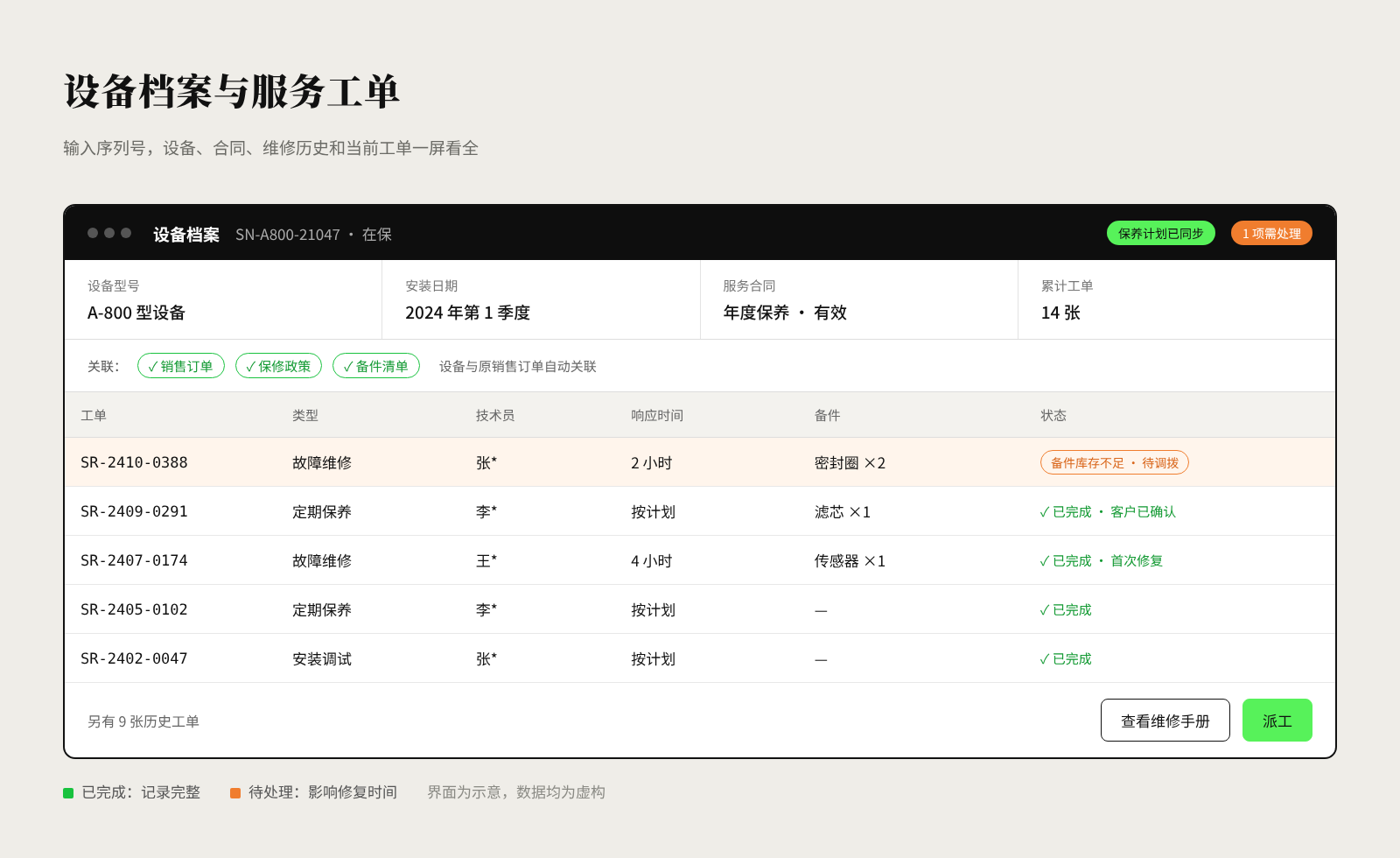
Equipment record and service orders (illustrative interface; all data fictitious)
Implementation approach
We first standardised equipment records and service orders, then linked spare parts to repair records.
Mobile repair reporting and service performance analysis followed.
Anything involving equipment data capture is validated separately, so that predictive maintenance is never promoted before trustworthy sensor data is in place.
Business value
After-sales service has shifted from reactive work that depended on individual experience to ongoing management centred on equipment assets and service orders.
The company can now analyse equipment reliability, after-sales costs and customer service quality far more clearly.
Results (approximate): First-time fix rate approx. 85%; mean time to repair approx. −35%; spare parts fill rate approx. 95%.
Metrics tracked on an ongoing basis: First response time, mean time to repair (MTTR), first-time fix rate (FTFR), spare parts fill rate, service contract gross margin.
What this case teaches us
For equipment manufacturers, every machine delivered is the start of a long-term service relationship.
A digital equipment record connects product quality, customer experience and after-sales performance in one place.
*To protect client confidentiality, company details in this case study have been anonymised; screenshots are illustrative and results are rounded approximations.*
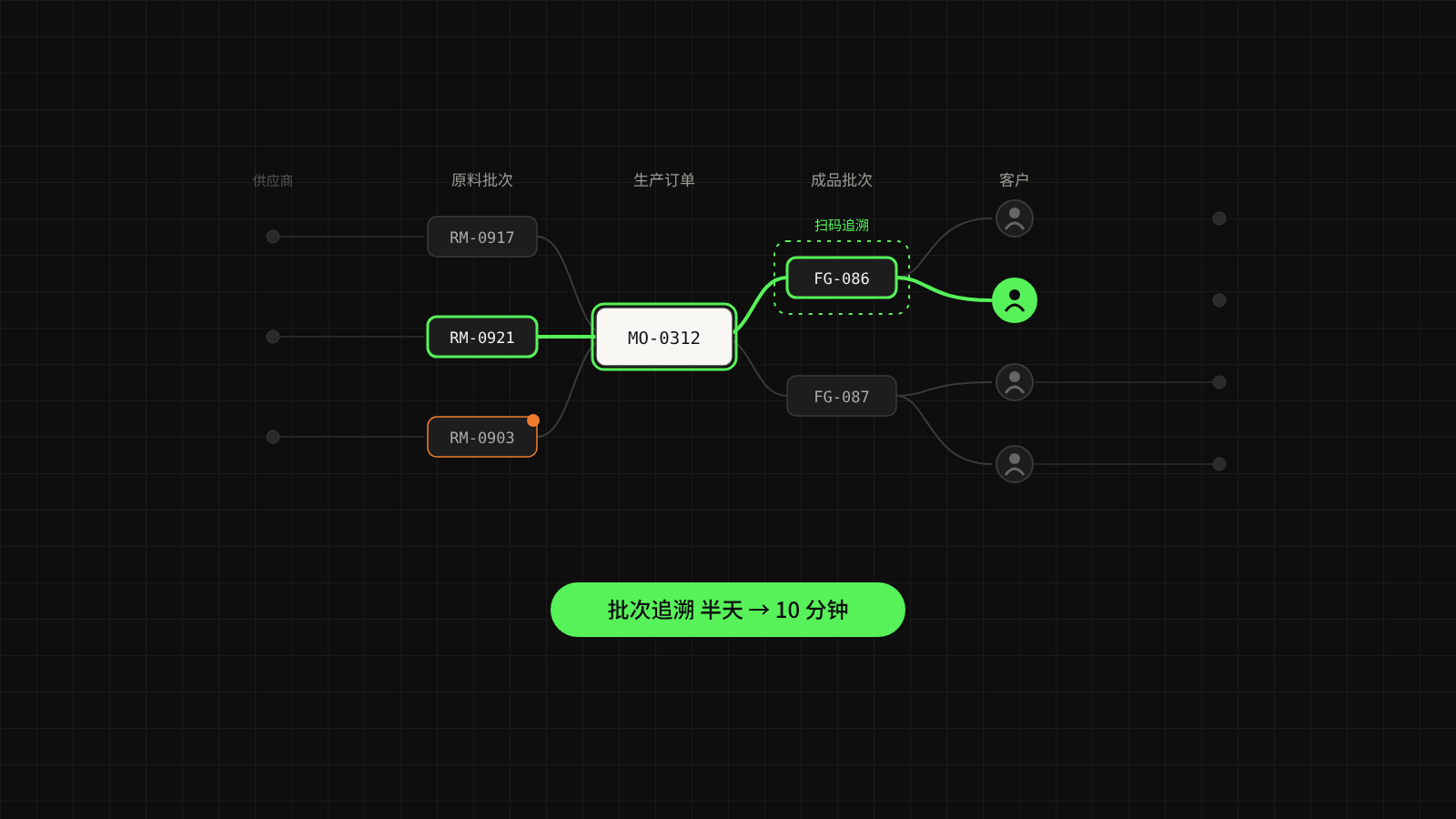
Batch Traceability Cut from Half a Day to 10 Minutes, with Every Batch Accounted For
A multi-category food manufacturer linked purchasing, production, warehousing and sales delivery into a single data chain. Any finished-goods batch can now be traced back to its raw material sources and forward to its customers, and batch traceability has dropped from about half a day to under 10 minutes.
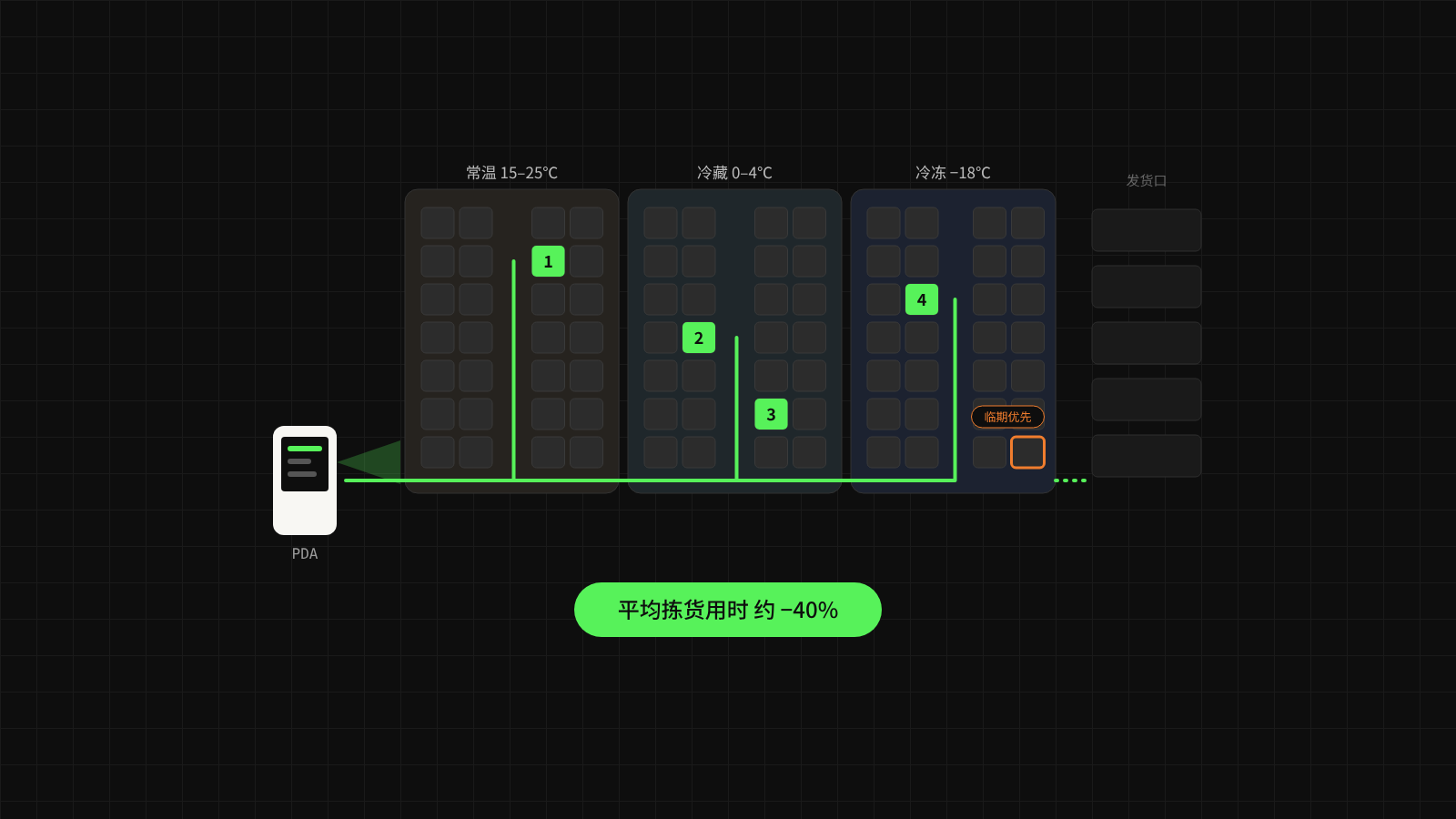
Three-Temperature Inventory Tracked to the Bin, Average Picking Time Down About 40%
A wholesaler of ambient, chilled and frozen food tracked inventory down to bin location and batch, used PDAs for receiving, replenishment and picking, and dispatched stock on a first-expired, first-out basis. Average picking time fell by about 40%, and the value of stock nearing expiry dropped significantly.
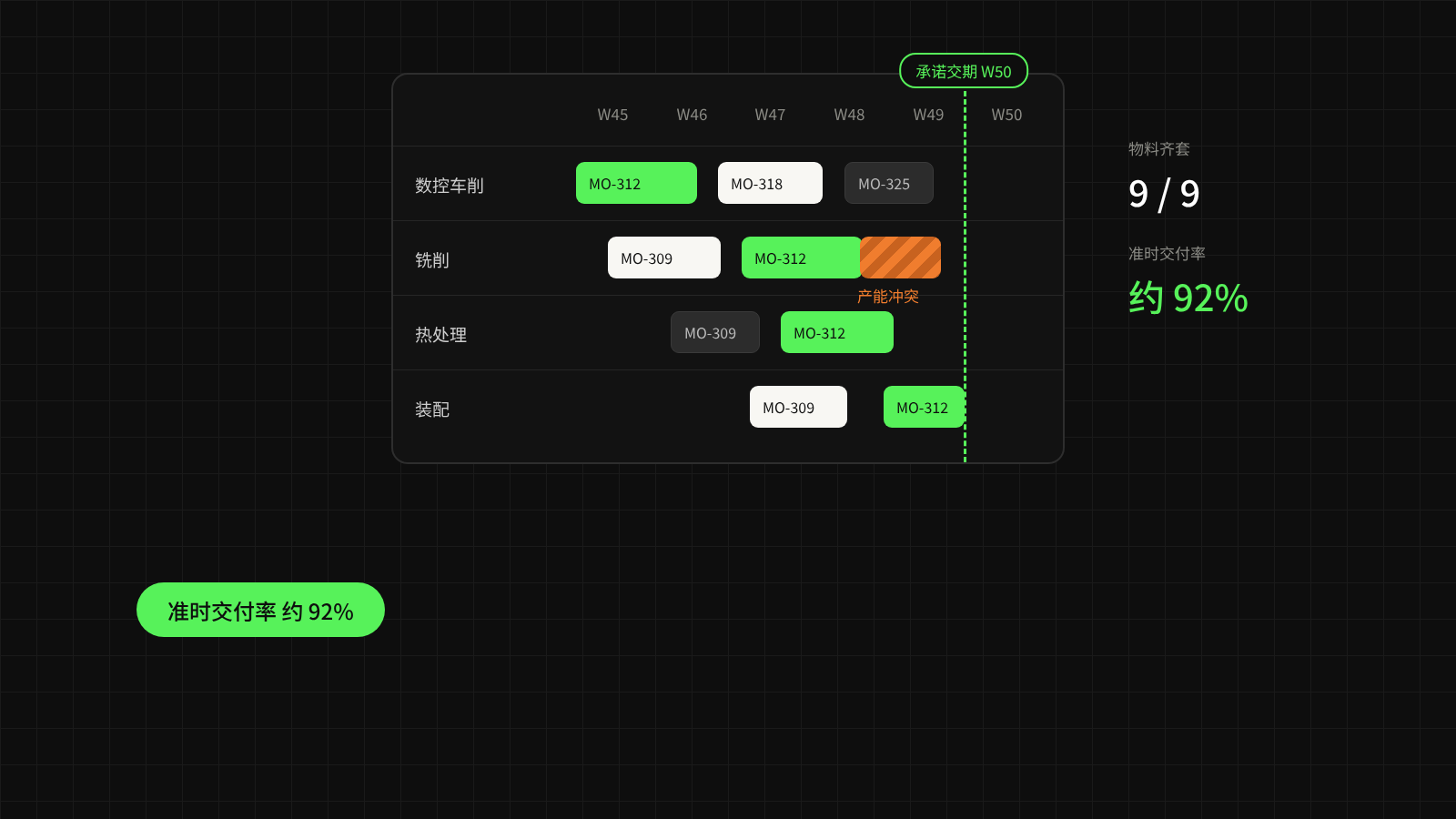
Sales Orders Drive the Production Plan Directly, Lifting On-Time Delivery to About 92%
A high-mix, low-volume machining company let sales orders drive material requirements and capacity checks directly, with shop-floor terminals reporting progress in real time. Delivery promises are now grounded in data, on-time delivery rose from about 75% to about 92%, and stoppages due to material shortages fell markedly.