Batch Traceability Cut from Half a Day to 10 Minutes, with Every Batch Accounted For
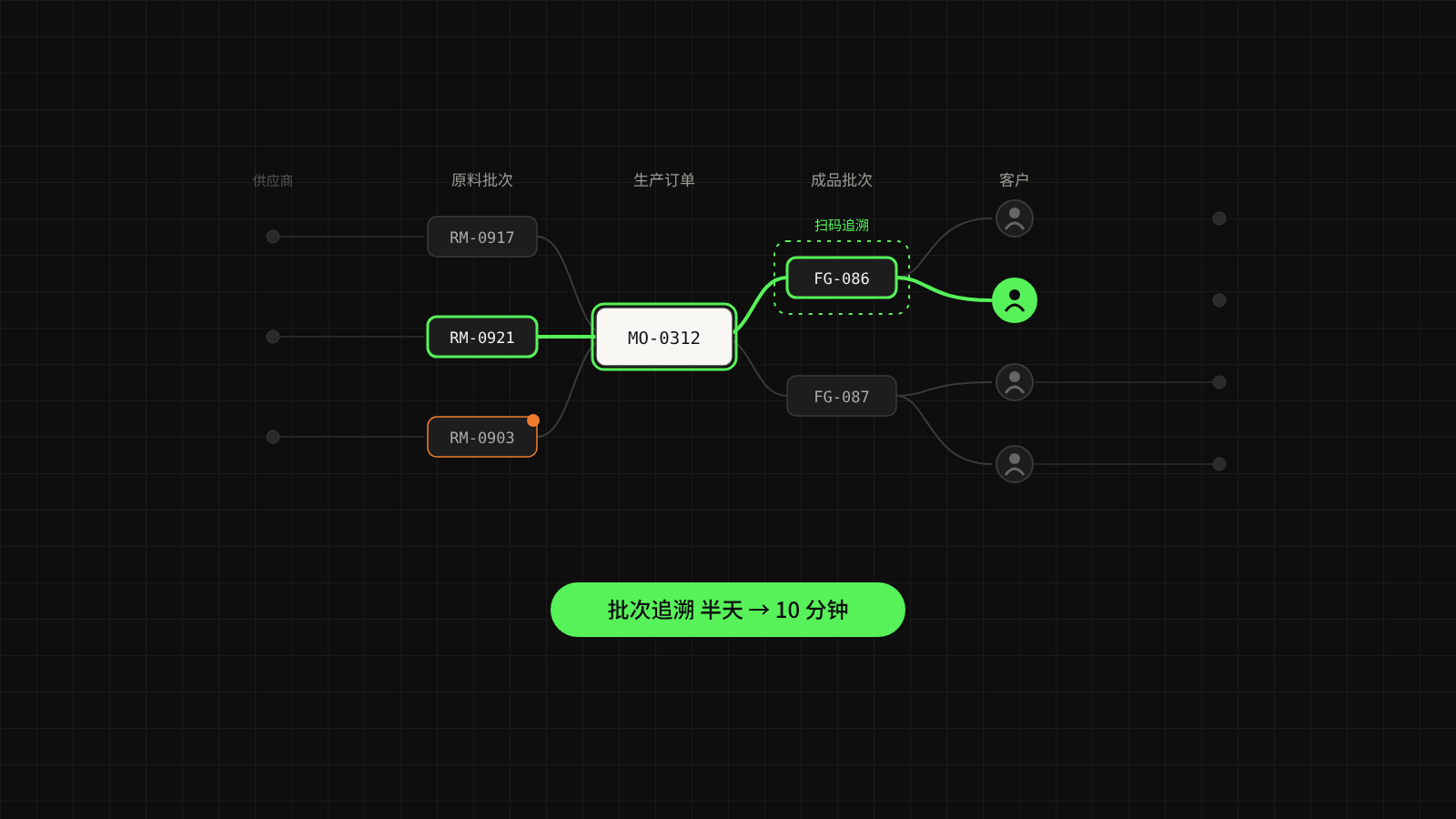
A multi-category food manufacturer linked purchasing, production, warehousing and sales delivery into a single data chain. Any finished-goods batch can now be traced back to its raw material sources and forward to its customers, and batch traceability has dropped from about half a day to under 10 minutes.
A food manufacturer with several product lines found that, as order volumes and product categories kept growing, its existing inventory software and manual production records could no longer support day-to-day operations. Purchasing knew when raw materials arrived, production planned runs in Excel, the warehouse handled receipts and dispatches from paper documents, and sales struggled to know exactly when products could be delivered.
The real problem was not a lack of software, but that the data and processes used by each department were not connected.
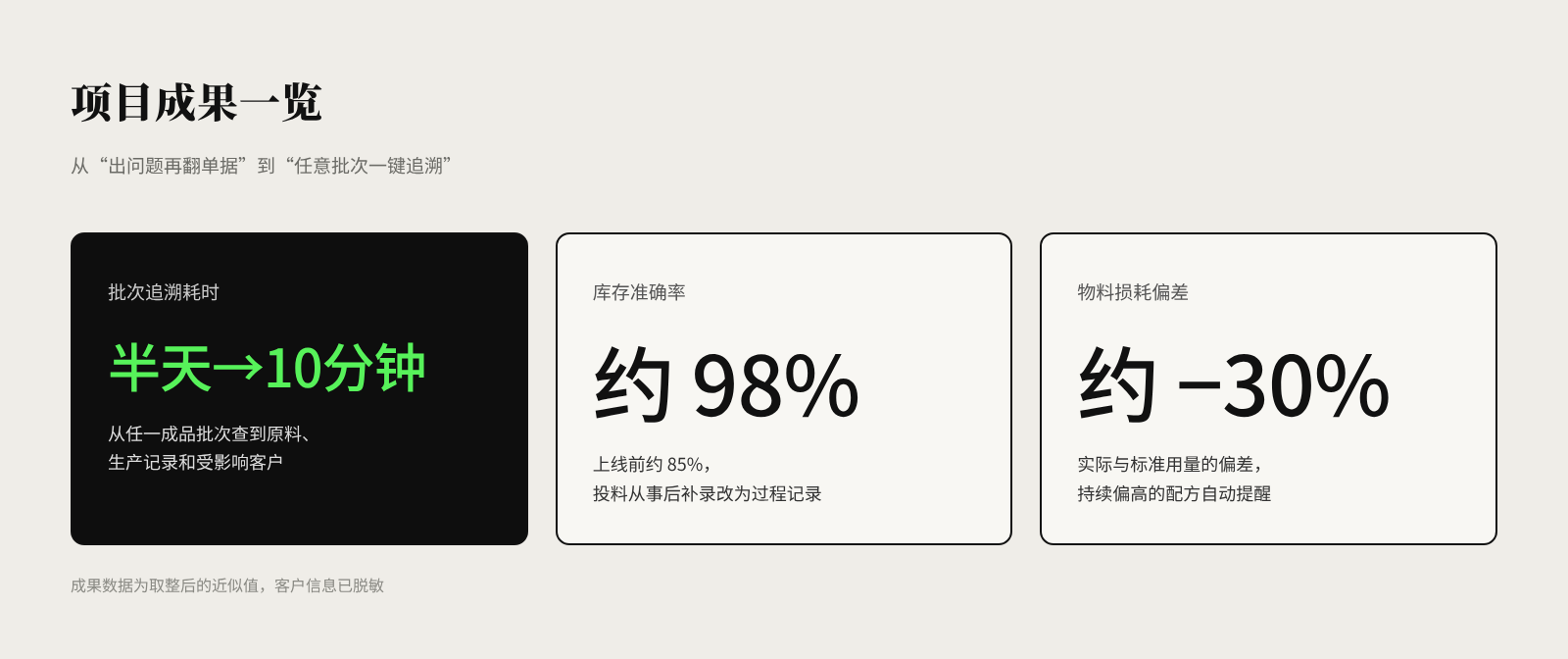
Project results: batch traceability time half a day → 10 minutes; inventory accuracy about 98%; material loss variance about −30%
Client background
Food manufacturers like this typically manage raw materials, semi-finished goods and finished products in many specifications, while also dealing with recipe management, production batches, material losses, shelf life and customer deliveries.
As the business scales, the difficulty is no longer just more inventory, but the increasingly complex relationships between raw materials, production activity and sales orders.
Management cares most about three questions: Where did purchased raw materials actually end up? What did a given batch really cost to make? And if a quality issue arises, can every affected customer be found quickly?
The challenge
Raw material stock and production consumption did not match
Raw materials were received into stock, but actual usage depended on manual entries. Production staff often recorded consumption in bulk after a run had finished, creating a time lag between system stock and physical stock.
When one batch of raw material was used across several production orders, it was hard to tell exactly how much each order consumed and how much was lost.
Product costs relied on after-the-fact finance calculations
The company generally knew raw material purchase prices, but not necessarily the actual manufacturing cost of each batch.
Theoretical recipe quantities, actual usage, production losses and labour costs were scattered across different records, making it hard to analyse margin changes promptly once production was complete.
Batch tracing depended on manual searches
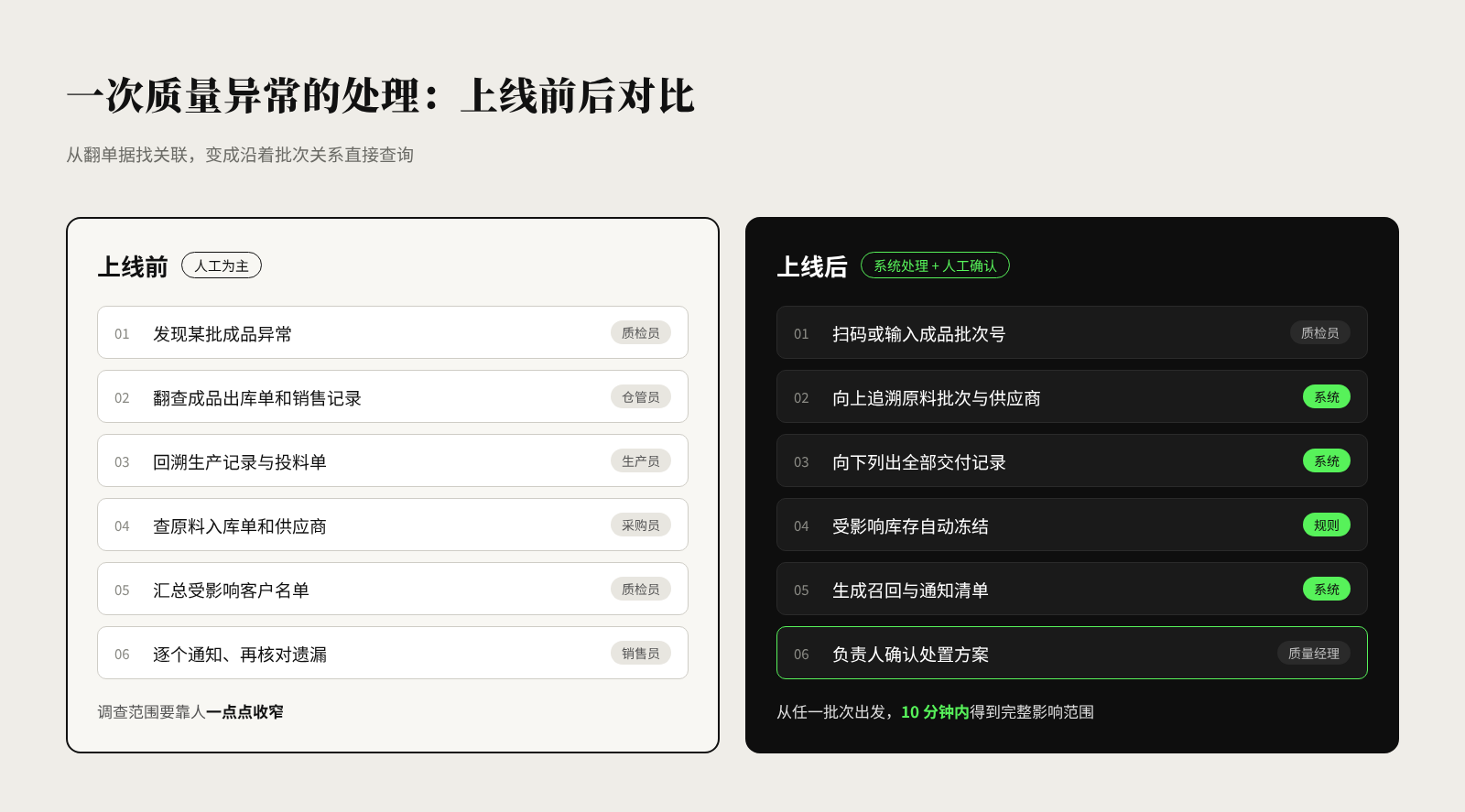
When a quality problem occurred, staff had to work item by item through raw material receipts, production records, finished-goods dispatch notes and customer sales records.
Without a unified link between batches, the scope of an investigation was hard to narrow quickly.
SHEPHARD's digital solution
Handling a quality exception: before and after go-live
Step 1: Unify material and product master data
We first established a structured product master data framework covering raw materials, semi-finished goods, finished products, units of measure, purchase specifications, product categories and storage attributes.
Unified material codes and data management rules removed the problem of different departments naming the same material in different ways.
On this basis, suppliers, purchase orders, raw material batches and storage locations were brought into a single ERP data model.
Step 2: Standardize production management
We built a digital production process around BOMs (bills of materials), production orders and actual material consumption.
The company can generate production orders based on sales demand, stock levels and production capacity, and record actual usage, output and losses during production.
Standard recipes and actual consumption are stored separately, so the company can calculate production costs and also analyse recipe variances and production losses.
Step 3: Enable two-way batch traceability
Batch management links raw material batches, production orders, finished-goods batches and sales delivery records.
When a raw material batch has a quality problem, the system can trace forward through production to find the affected finished-goods batches and customer deliveries.
Conversely, when a finished-goods batch shows a problem, it can trace back to the raw materials, suppliers and production records involved.
Step 4: Build quality control into business processes
We set up quality checkpoints for raw material acceptance, in-process inspection and finished-goods release.
Stock that has not completed the required inspections, or that has been marked as non-conforming, enters the appropriate quarantine and approval process, so quality risks are no longer managed through word of mouth between staff.
Step 5: Build production and business analytics
With a unified data foundation, management can analyse production order completion, actual material losses, product cost variances, inventory turnover and batch quality issues.
Exception rules identify persistently high losses, production delays and stock nearing expiry, and automatically notify the responsible owners.
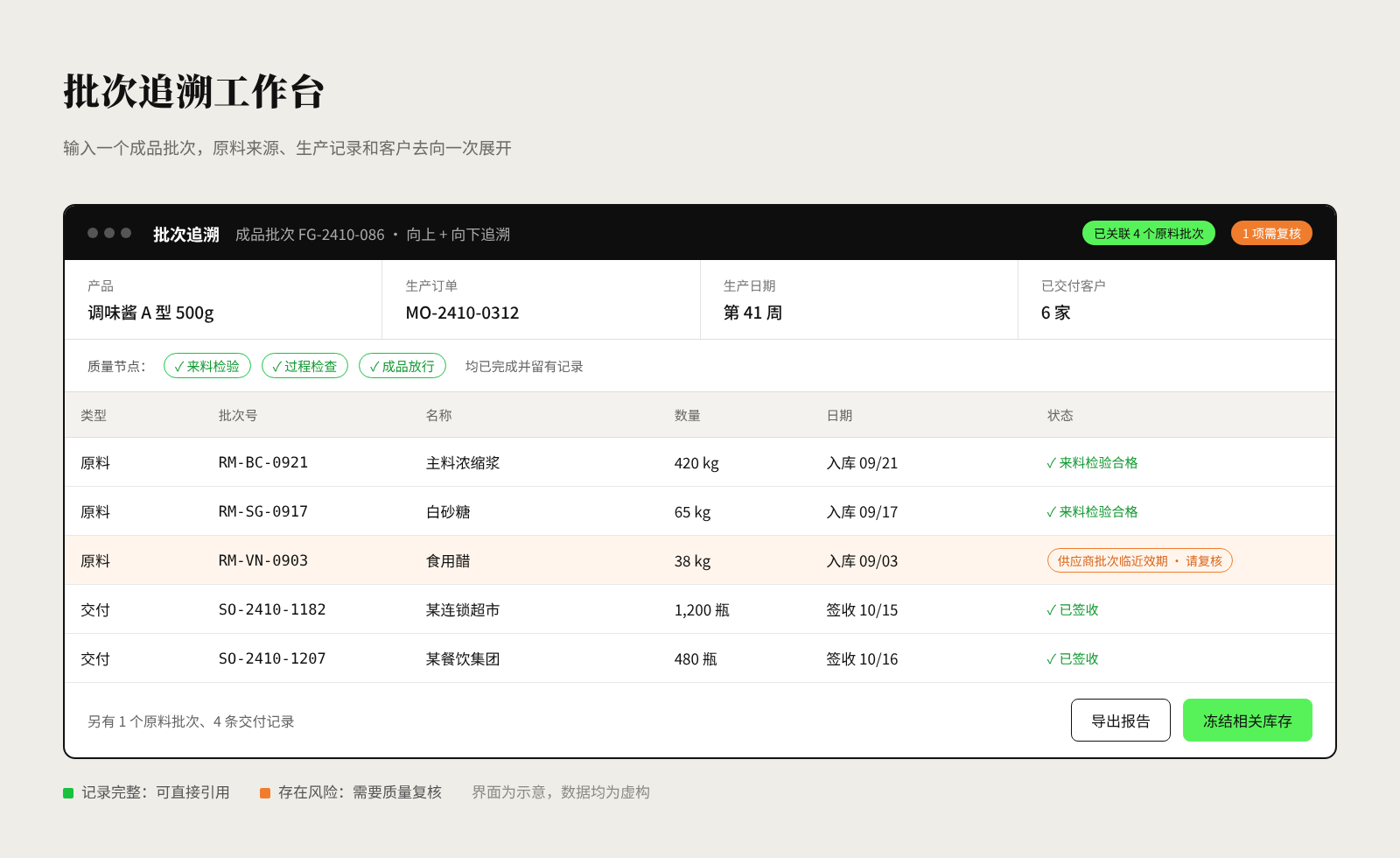
Batch traceability workbench (illustrative interface, all data fictitious)
Implementation roadmap
The project progressed step by step through master data cleansing, standardized inventory management, digital production orders, batch traceability and business analytics.
Before go-live, two-way traceability was tested on typical production orders to validate complex scenarios such as one raw material batch used across several production orders, or several raw material batches used to make the same finished product.
The core acceptance criterion was not whether the system screens opened correctly, but whether the production history and raw material sources of any delivered finished-goods batch could be reconstructed accurately.
Business value
The company now has a continuous data chain from purchasing and inventory through production to sales delivery.
Production management has moved from after-the-fact recording to in-process recording, quality tracing has moved from manual searching to data queries based on business relationships, and management can analyse operating issues at the level of orders and materials.
Project results (approximate): batch traceability time half a day → 10 minutes; inventory accuracy about 98%; material loss variance about −30%.
Metrics tracked on an ongoing basis: batch traceability time, timeliness of production consumption records, variance between actual and standard material consumption, inventory accuracy, quality exception closure time.
What this case teaches us
Digital transformation in food manufacturing cannot focus only on how much stock is left in the warehouse.
A truly valuable system should know what a product is made of, how it was produced, which steps it went through, who it was delivered to, and what action to take when something goes wrong.
*To protect client confidentiality, company details in this case study have been anonymized, interface screenshots are illustrative, and results are rounded approximations.*
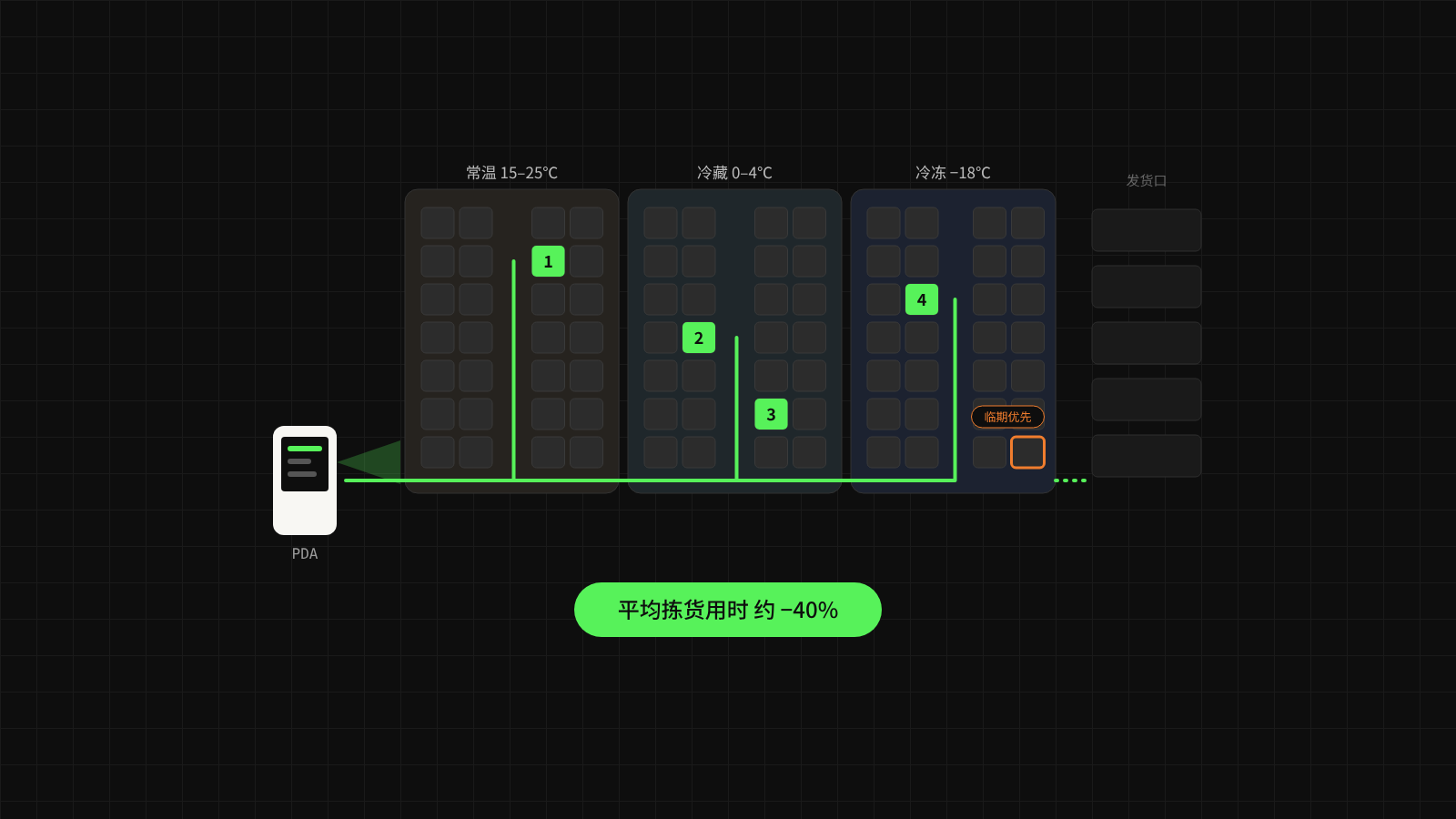
Three-Temperature Inventory Tracked to the Bin, Average Picking Time Down About 40%
A wholesaler of ambient, chilled and frozen food tracked inventory down to bin location and batch, used PDAs for receiving, replenishment and picking, and dispatched stock on a first-expired, first-out basis. Average picking time fell by about 40%, and the value of stock nearing expiry dropped significantly.
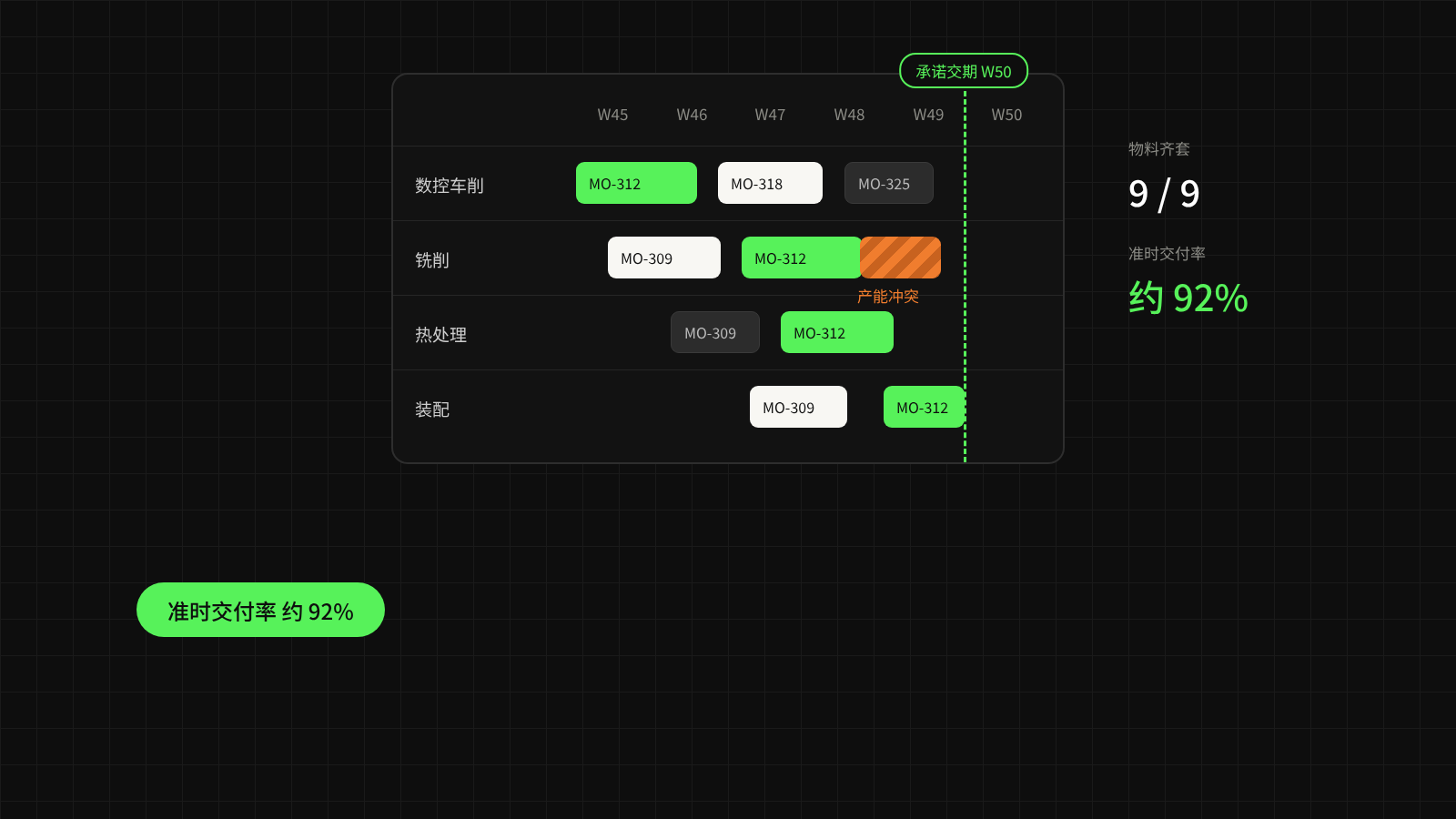
Sales Orders Drive the Production Plan Directly, Lifting On-Time Delivery to About 92%
A high-mix, low-volume machining company let sales orders drive material requirements and capacity checks directly, with shop-floor terminals reporting progress in real time. Delivery promises are now grounded in data, on-time delivery rose from about 75% to about 92%, and stoppages due to material shortages fell markedly.
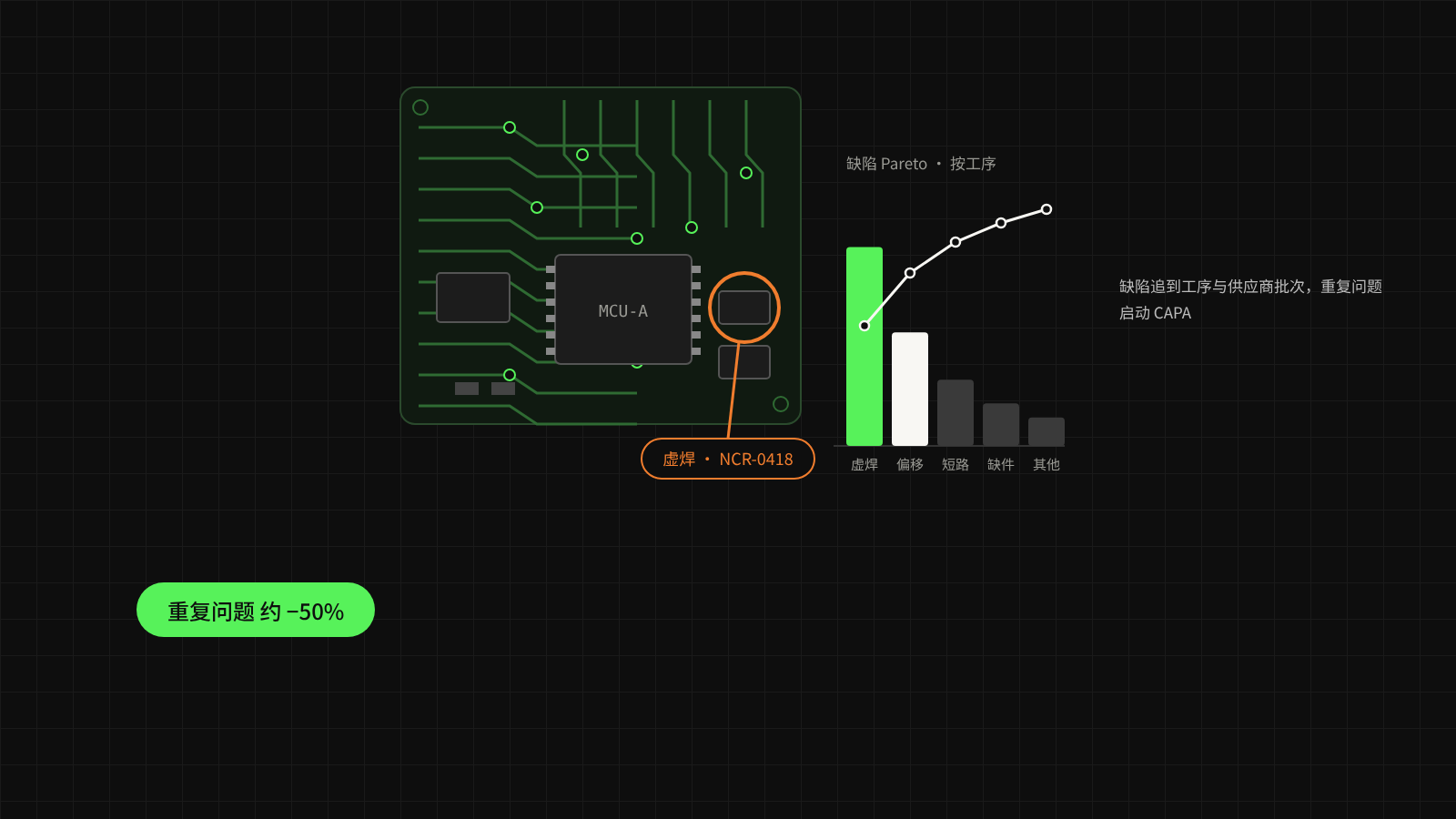
Quality issues traced to process step and supplier batch, with repeat issues down about 50%
A manufacturer of electronic assemblies and control modules linked inspection data to batches and serial numbers, tracked quality incidents through NCRs and launched CAPA for recurring and high-risk issues. Customer complaints can now be traced by serial number, and recurring quality issues have fallen by about 50%.