When companies talk about AI, the first discussion is usually which model to choose and which tool to buy. But once the work begins, they find that what actually holds a project back is something else: duplicate customer records, inconsistent product codes, key data scattered across individual spreadsheets, and no one able to say which figure is right. The first hurdle in putting AI to work is usually not the model but the data: it is inaccurate, incomplete, impossible to find, or nobody is responsible for it.
So which data should a company get in order before pushing ahead with AI? This article covers why the bottleneck in AI projects is so often data, the five most common data problems in companies, the conditions “AI-ready data” should meet, seven steps to prepare data starting from a business use case, and how to use simple metrics to tell whether your data is ready, and closes with answers to a few frequently asked questions.
Why is data so often the bottleneck in AI projects?
The quality of AI output depends on the data it can see. AI does not automatically correct errors, gaps and contradictions in data; it amplifies them, faster and at greater scale.
Multiple surveys point to the same problem:
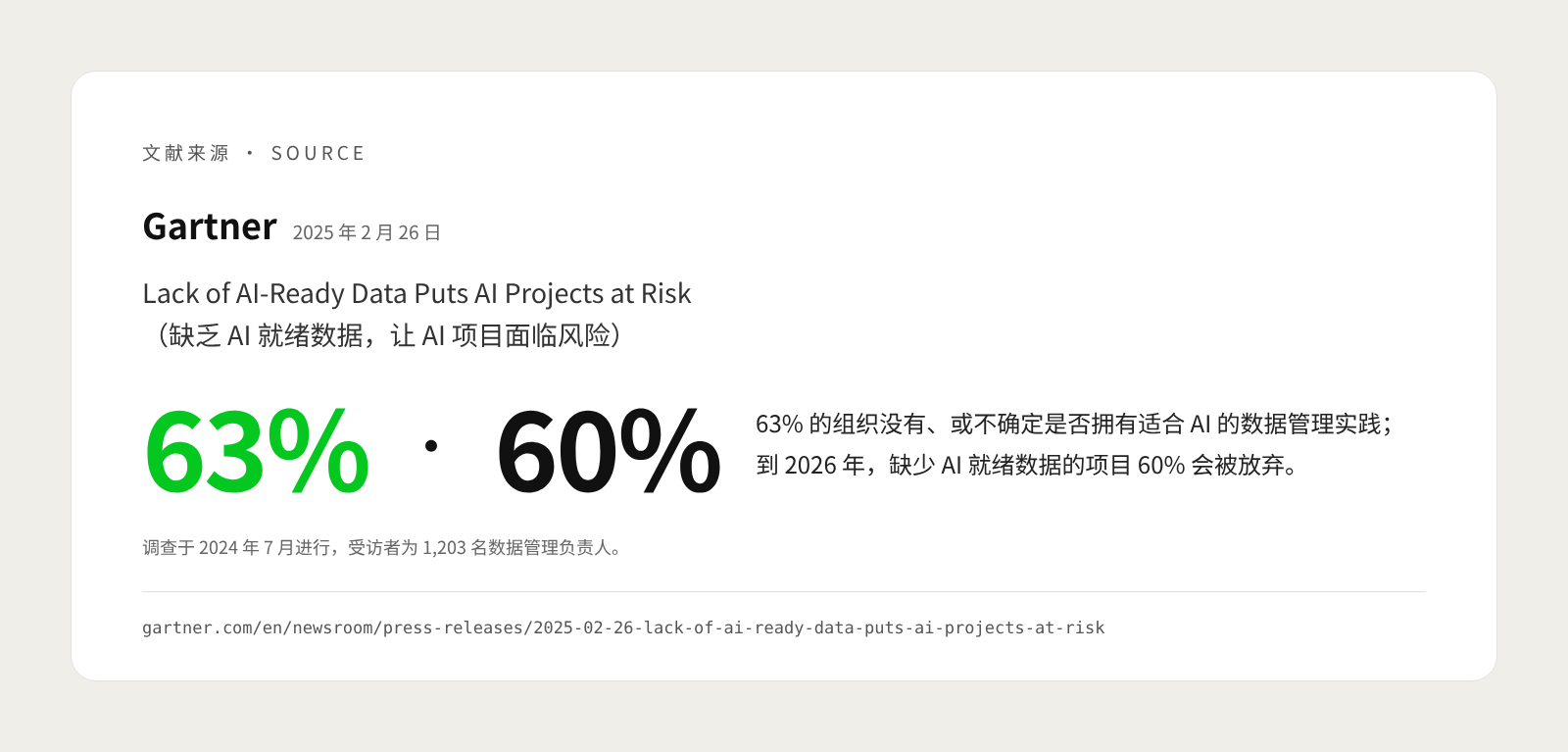
- Most companies’ data management has not kept pace. A Gartner survey published in February 2025 found that of 1,203 data management leaders surveyed in July 2024, 63% said their organization either does not have, or is unsure whether it has, the right data management practices for AI. Gartner also predicts that through 2026, organizations will abandon 60% of AI projects unsupported by AI-ready data (source).
- Mature organizations can’t escape data issues either. A Gartner survey of 432 respondents in the US, UK, France, Germany, India and Japan in Q4 2024 found that, regardless of AI maturity, data availability and quality is among the top challenges to AI implementation: 34% of leaders in low-maturity organizations said so, as did 29% in high-maturity organizations (source).
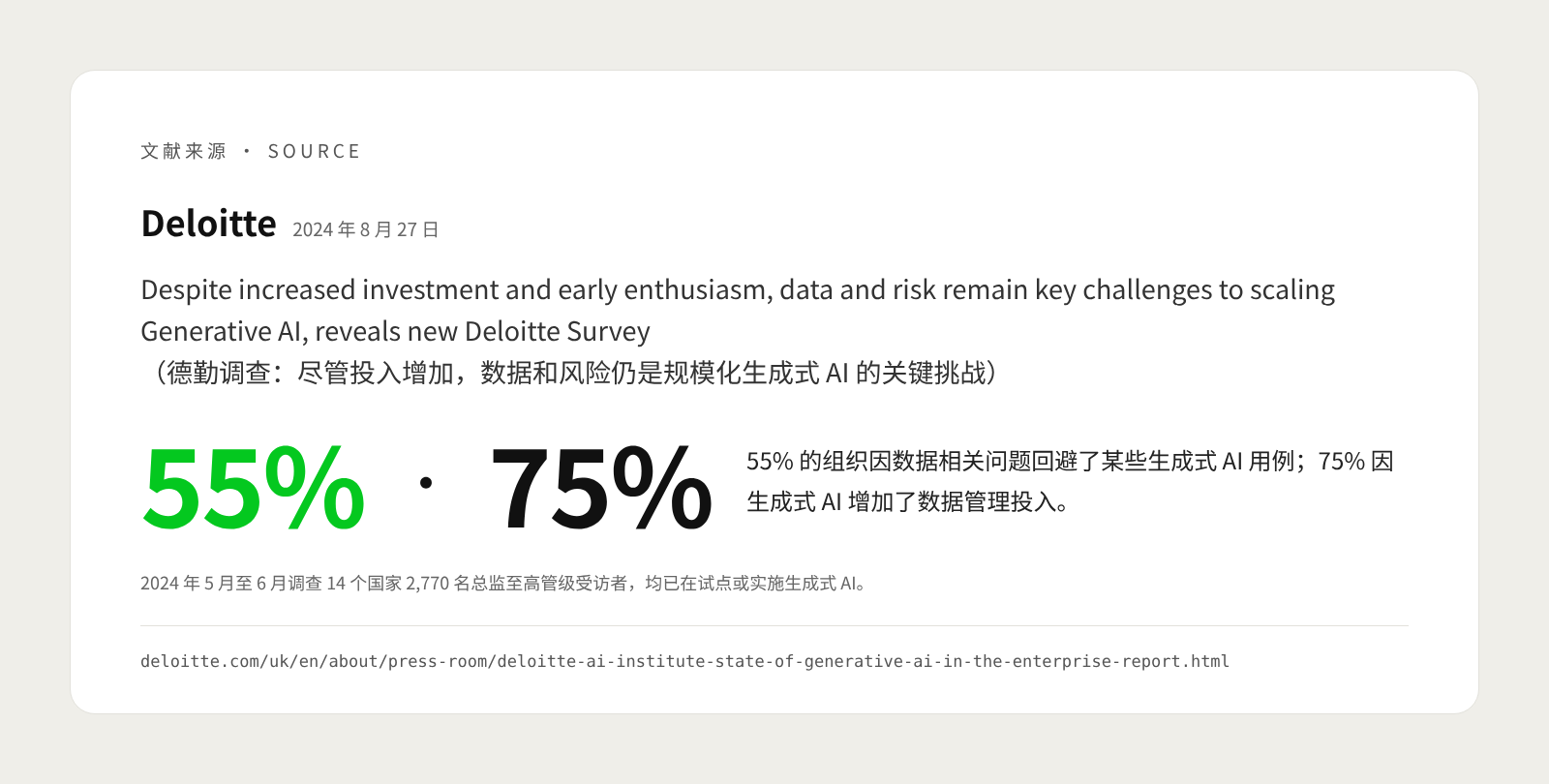
- Data issues directly narrow the scope of AI use. A Deloitte survey of 2,770 director- to C-suite-level respondents across 14 countries, conducted from May to June 2024, found that 55% of organizations had avoided certain generative AI use cases because of data-related issues, and 75% had increased their investment in data management because of generative AI (source). Note that all respondents to this survey had AI experience and were already piloting or implementing generative AI, which puts them further along than the typical company.
Why do data problems stand out so sharply in AI projects? There are two reasons. First, when a traditional report is wrong, the person reading it can often tell from experience that “this number doesn’t look right”; AI, by contrast, will make recommendations directly on the basis of flawed data, or even take actions automatically. Second, AI is more “demanding” about data. Gartner notes that AI-ready data must be representative of the use case, including every pattern, error, outlier and unexpected occurrence (source).
For example, a distributor wants to use AI to forecast replenishment volumes for each warehouse. If its sales history is mixed with large numbers of return reversals, and zero sales during stockouts are treated as “no demand,” the model learns the wrong patterns, and the more “confident” the forecast, the bigger the replenishment error.
What are the most common data problems in companies?
Most companies’ data problems are nothing mysterious; they are everyday management issues that have built up over time. Day to day, they are merely a “nuisance”; in an AI project, they become “obstacles.”
The same customer recorded several ways. Sales enters “East China XX Trading Co., Ltd.”, finance enters “XX Trading (Shanghai)”, and in the customer service system it appears as a contact’s mobile number. For example, when AI analyzes customer value, it may split one major customer with a high annual purchase volume into three ordinary customers, and credit limits and discount terms go wrong as a result.
Inconsistent master data. Master data refers to relatively stable, foundational data shared across multiple processes, such as customers, suppliers, products, materials and employees. For example, if the same product has a different code in the sales system, the warehouse and finance, then before AI can answer “what is this product’s true gross margin?”, it first has to guess which codes refer to the same item.
Data scattered across spreadsheets and different systems. The price list is on the purchasing manager’s computer, promotion rules are in email attachments, and store inventory adjustments are recorded in group chats. AI cannot access this data, nor can it tell which version is the latest.
Inconsistent definitions. Different departments interpret the same metric differently. For example, sales’ “revenue” includes tax and does not deduct returns, while finance’s “revenue” excludes tax and is net of returns; some measure “on-time delivery” against the promised date, others against the customer’s requested date. Whatever answer AI gives across two sets of definitions, one side is bound to consider it wrong.
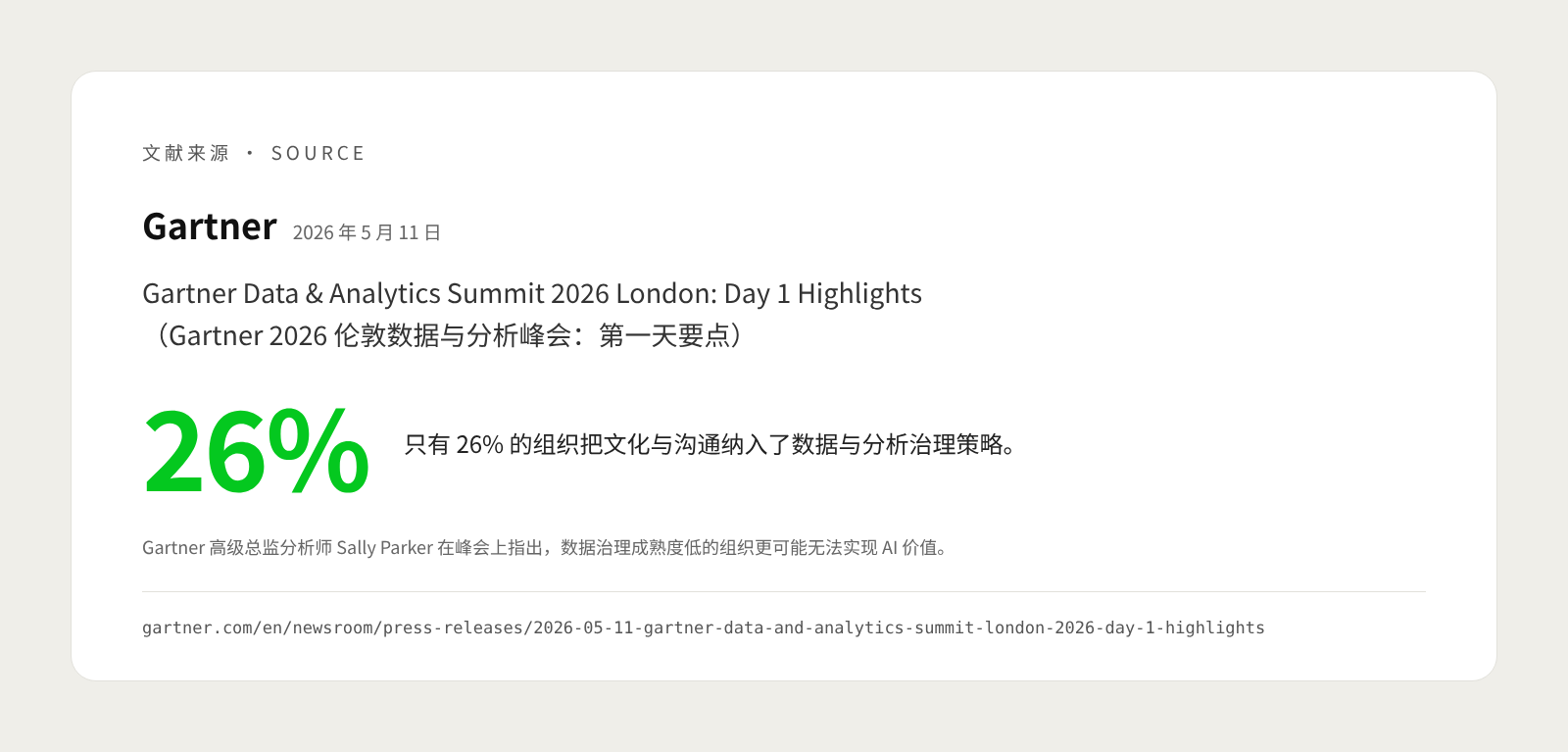
No one is accountable for data. You find that a customer’s address is wrong or a product specification is out of date, but don’t know who should fix it; every department uses the data, but no one is responsible for its accuracy. At the Gartner Data & Analytics Summit in London in May 2026, Sally Parker, Senior Director Analyst at Gartner, noted that organizations with low data governance maturity are significantly more likely to fail to realize value from AI; the same session also noted that only 26% of organizations include culture and communication in their data and analytics governance strategy (source). This shows that data management is not just a technical issue; it is also a matter of roles and habits.
What makes data “AI-ready”?
“AI-ready” does not mean that all of a company’s data is flawless; it means the data supporting a specific AI use case meets a usable standard. To judge whether data is ready, start from the use case, not from the database.
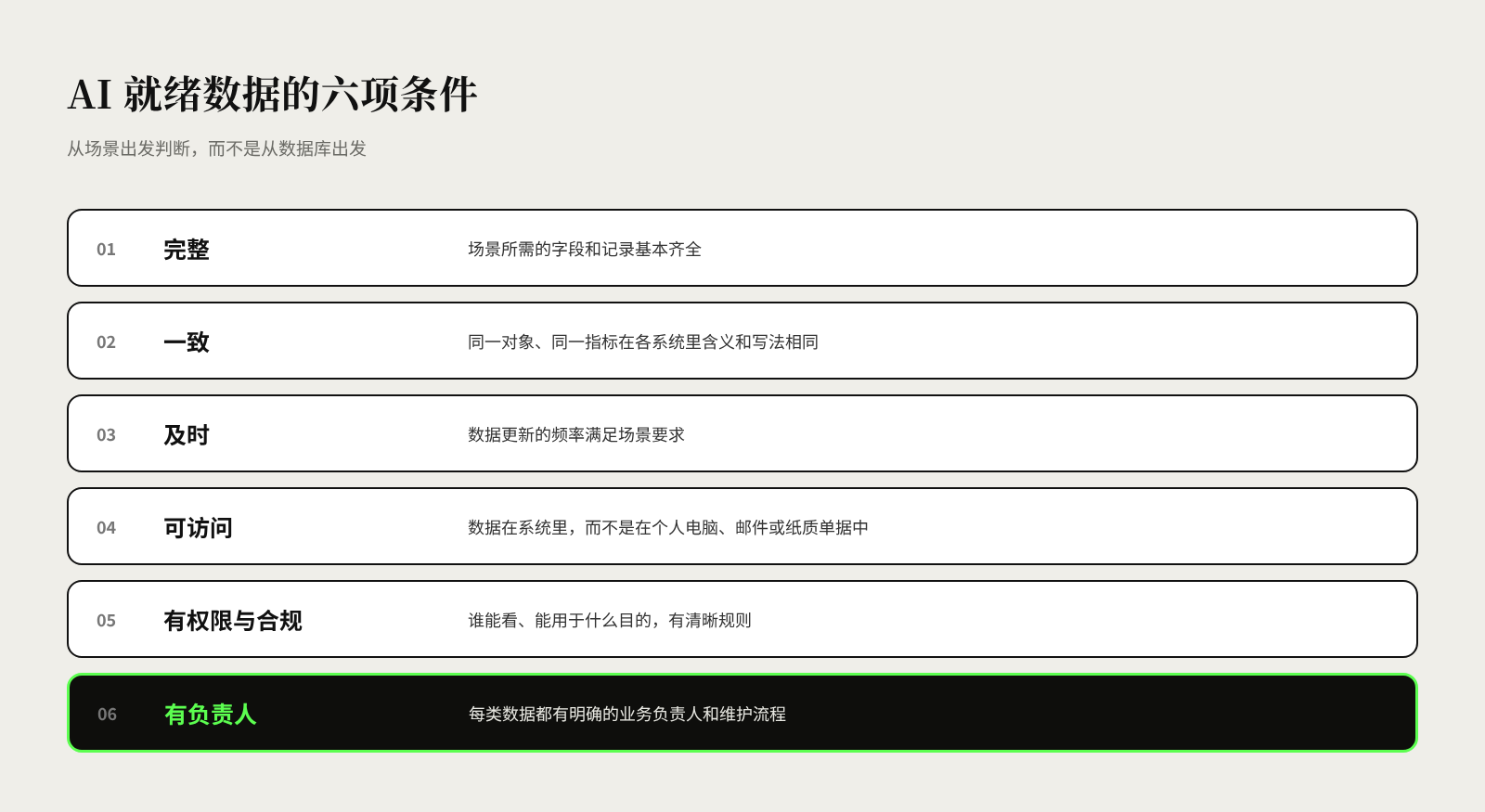
The table below lists six conditions that AI-ready data usually needs to meet, and can serve as a self-assessment checklist:
| Condition | Meaning | Self-check question | Common counterexample |
|---|---|---|---|
| Complete | The fields and records the use case needs are largely all there | What share of key fields are missing? | 30% of orders have no customer industry filled in |
| Consistent | The same object or metric has the same meaning and format across systems | Does each customer and each product have only one identifier? | One customer has three different names in three systems |
| Timely | Data is updated often enough for the use case | How often is the data updated, and is AI using the latest version? | Inventory syncs only overnight, so AI answers during the day always lag behind |
| Accessible | Data is stored in a location and format that systems can read | Is the data in a system, rather than on personal computers, in emails or on paper? | The pricing policy exists only in one manager’s spreadsheet |
| Authorized and compliant | Clear rules on who can see it and what it can be used for | Does it involve personal information? Is the purpose of use compliant? | Sending a full list containing customers’ mobile numbers straight to an external AI tool |
| Owned | Each category of data has a clear business owner and maintenance process | When data is wrong, do you know whom to contact and how quickly it will be fixed? | Who updates product information “depends” |
The standards for these conditions need to be set per use case. For example, when using AI to draft marketing copy, data timeliness matters little; but when using AI to answer customer questions about stock and lead times, the data must be close to real time.
Two further points are worth noting. First, Gartner stresses that data readiness is a process of aligning, qualifying and governing data using metadata (data that describes data, such as field meanings, sources and update times), not a “one-and-done” task, and it requires continuous improvement (source). Second, unstructured data such as contracts, emails and policy documents needs managing too: if outdated policy documents remain in the knowledge base, an AI customer service assistant may answer customers based on old policies.
How do you prepare data for AI? A step-by-step guide
The most effective way to prepare data for AI is not to start with a company-wide “big data project,” but to focus on one specific use case and get the relevant data to a usable state. Get one use case’s data up to standard, then replicate the approach for the next.
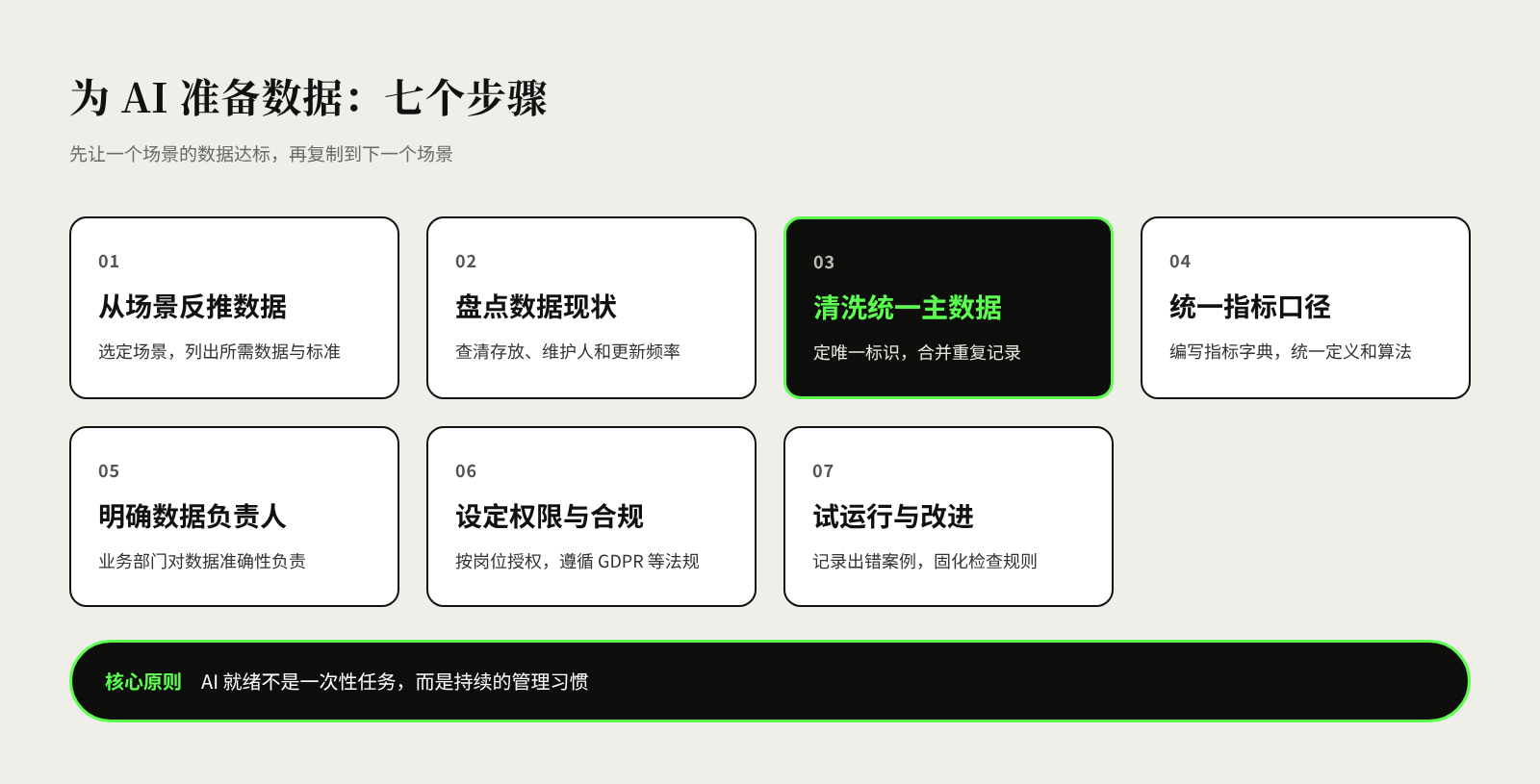
Step 1: Work back from one business use case to the data it needs. First choose a use case with clear value, then list the data it requires. For example, using AI to automatically match supplier invoices requires purchase orders, goods receipts, invoices, supplier master data and contract prices. As you draw up the list, also note the standard each type of data must meet.
Step 2: Take stock of the current state of your data. Go through the list item by item: which system or file the data is stored in, who maintains it, how often it is updated and what format it is in. Then check the quality of a sample, for example by taking 200 invoices and seeing how many can be matched to orders and goods receipts. The output of this review is a data inventory and an issues list.
Step 3: Clean and unify master data. Prioritize the master data the use case depends on most, usually customers, products and suppliers. Set rules first, for example using the unified social credit code or tax ID as the unique customer identifier, then merge duplicate records and fill in key fields. Even more important is control at the source: new customers and products must be entered under the unified rules and reviewed, or the data will soon become messy again after cleaning.
Step 4: Standardize metric definitions. Write up the key metrics involved in the use case in a “metrics dictionary” that sets out each metric’s definition, calculation method, data source and owner. For example, specify whether “gross margin” is net of freight and rebates. Once the definitions are fixed, reports, dashboards and AI all use the same ones.
Step 5: Assign data owners and set up an update mechanism. Each category of key data should have a named owner in a business function, accountable for its accuracy: customer data might belong to sales operations, for example, and product data to the product or purchasing team. Also agree on update frequency, quality checks and a channel for reporting issues, so anyone who spots an error knows whom to contact.
Step 6: Set permissions and ensure compliance. Define by role who can view and use which data, taking particular care where personal information is involved. Taking the EU General Data Protection Regulation (GDPR) as an example, Article 5 requires personal data to be processed in line with the principles of lawfulness, fairness and transparency, purpose limitation, data minimization, accuracy, storage limitation, and integrity and confidentiality, with the controller responsible for, and able to demonstrate, compliance; Article 25 requires data protection by design and by default, for example through pseudonymization and by processing only the personal data that is necessary by default (source). Companies operating in China and other regions should likewise check against local personal information protection laws. In practice, before providing data to external AI tools, remove or replace any personal information that is not needed.
Step 7: Pilot on a small scale and keep improving. Once the data is ready, run the AI use case on a small scale first, record the cases where AI gets things wrong, and trace whether the cause lies in the data or the model. Pass data issues to the relevant owners for correction, and make the checking rules permanent. That way, the second use case can reuse the master data and metrics dictionary you have already put in order, and preparation time will drop markedly.
How do you know whether your data is ready?
Whether data is ready can’t be judged by gut feel, nor should you wait until AI goes live to see how it performs. The most practical approach is to set a few simple, regularly measurable quality metrics for the key data the use case involves.
You can start with the following:
- Duplicate rate. What share of customer, product and supplier records are suspected duplicates. For example, count once a month the customer records with similar names and the same tax ID, and check whether the number is falling.
- Missing rate. How many of the key fields the use case needs are empty, such as order delivery addresses or product specifications and units.
- Consistency rate. Whether the same data matches across systems, for example discrepancies between ERP inventory and warehouse system inventory, or between order amounts and invoice amounts.
- Update latency. How long after a business event it shows up in the system, for example how long it takes store sales to sync to head office, or price changes to take effect.
- Issue resolution time. How many days it takes from discovering a data issue to fixing it, and whether issues are piling up unaddressed.
These metrics don’t require sophisticated tools; at the outset, a spreadsheet updated monthly is enough to track them. What matters is that each metric has an owner and a target, and is reviewed regularly in management meetings. For example, when a restaurant chain was preparing to use AI to analyze ingredient waste across its outlets, it first set two metrics, “missing rate of store waste records” and “waste entry delay,” and only began modeling after both had met target for two consecutive months. Metrics that consistently meet target are the signal to launch an AI use case.
Frequently asked questions about preparing data for AI
Does all our data have to be cleaned up before we can start with AI? No. A more pragmatic approach is to focus on one use case and get only the data it needs to a usable state. Comprehensive data governance can be advanced step by step as more use cases are added.
What if an SME doesn’t have a dedicated data team? Start by naming data owners within business departments and managing key data with simple checklists and rules. Many data problems improve noticeably with unified data entry rules and regular checks, without necessarily needing complex tools.
We already have an ERP or CRM in place. Does that make our data AI-ready? Not necessarily. A system only provides a place to store data; whether that data is complete, consistent and maintained depends on day-to-day management. In addition, AI use cases often need to combine data from several systems, so consistent definitions remain essential.
Should data preparation be led by the business or by IT? It should be led by the business and supported by IT. Business users know best what the data means and whether it is right, while IT handles the technical side: systems, interfaces and permissions. Both are indispensable.
Is it safe to give company data to external AI tools? The key is to assess this in advance. Confirm how the provider stores and uses data and whether it will be used to train models, and remove unnecessary personal information and commercially sensitive information. Where personal data is involved, also confirm that the purpose of use meets the requirements of GDPR and other applicable regulations.
References
- Lack of AI-Ready Data Puts AI Projects at Risk, Gartner, February 2025
- Gartner Survey Finds 45% of Organizations With High AI Maturity Keep AI Projects Operational for at Least Three Years, Gartner, June 2025
- Gartner Data & Analytics Summit 2026 London: Day 1 Highlights, Gartner, May 2026
- Despite increased investment and early enthusiasm, data and risk remain key challenges to scaling Generative AI, reveals new Deloitte Survey, Deloitte, August 2024
- Regulation (EU) 2016/679 (General Data Protection Regulation), Official Journal of the European Union (EUR-Lex), April 2016