What happened
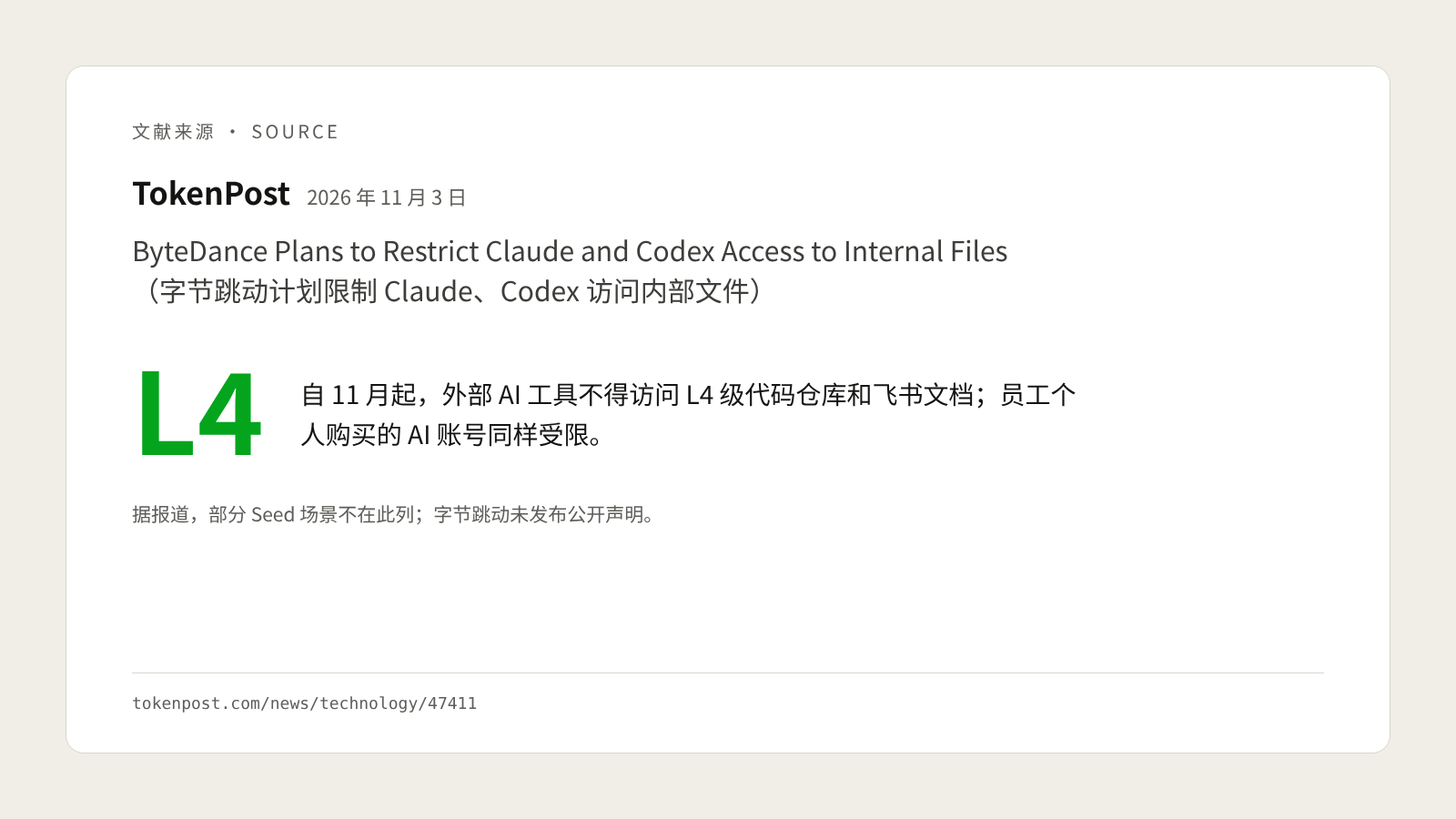
On November 3, the outlet Dachang Ribao reported that ByteDance had introduced new rules tightening internal use of external AI tools such as Claude and Codex. TokenPost reported the same news that day (source). ByteDance has not issued a public statement on the matter; everything below is based on media reports.
The new rules have three main elements:
- Scope: From November, external AI is restricted company-wide from accessing L4-level code repositories and Lark documents. According to TokenPost, some Seed scenarios are exempt.
- Personal accounts are restricted too: Personal Claude, Codex and other AI accounts that employees have bought themselves may not be used to access this content either.
- Not a blanket ban: The rules do not prohibit employees from using external AI; the focus is on restricting its access to sensitive internal data.
The new rules sparked internal debate. Dingkun Hong, ByteDance’s vice president of technology, reportedly responded on the intranet: “If L3-and-above content leaks, the consequences are extremely serious.” Addressing outside speculation that the move was “to promote our own AI products,” he said: “Promoting a product doesn’t require banning the other options to force people to use it, because that works very poorly.”
This isn’t the first time ByteDance has restricted external AI tools. In May 2025, Yicai reported that ByteDance was restricting employees’ use of third-party AI coding tools such as Cursor and Windsurf in phases, citing the risk of data leaks, and recommending its own Trae instead (source). The approach has clearly become more granular: from restricting certain types of tools to drawing boundaries by data classification level.

The rules govern data boundaries, not AI
What stands out most about the new rules isn’t the word “restriction,” but how the restriction works.
First, they are based on data classification, not a blanket ban on tools. The rules target L4-level code repositories and Lark documents; content at other levels is not prohibited along with them. This means ByteDance already has an internal data classification system and knows which content is public, which is internal and which would cause serious harm if leaked. Controls are built on top of classification.
Second, they bring personal accounts under management. Many companies’ AI policies cover only tools the company purchases, not accounts employees pay for themselves. Yet once data enters a personal account, it leaves the company’s control: the company neither knows where it is stored nor can retrieve it when the employee leaves. When ByteDance restricted Cursor and other tools in 2025, TokenPost reported that the trigger was precisely business data being stored in personal accounts.
Third, they don’t set the company against its employees. One line in Hong’s response is key: forcing employees to use a tool by banning the alternatives “works very poorly.” This effectively acknowledges a fact: employees use external AI because it genuinely works well. Blanket bans only drive usage underground, leaving the company even less able to see where the risks lie.
In other words, the rules don’t answer “Should we use AI?” but “Which data can AI touch?”
Why even big tech companies are tightening up
The risk of external AI tools lies not in the tools being unreliable, but in the company no longer controlling where its data goes. The moment an employee pastes a piece of code, a contract or a customer spreadsheet into a chat window, that content has left the company’s systems. Where it will be stored, for how long and whether it is subject to third-party terms is often unclear to everyone.
ByteDance is not the first large company to impose restrictions for this reason:
| Date | Company | Action | Main reason |
|---|---|---|---|
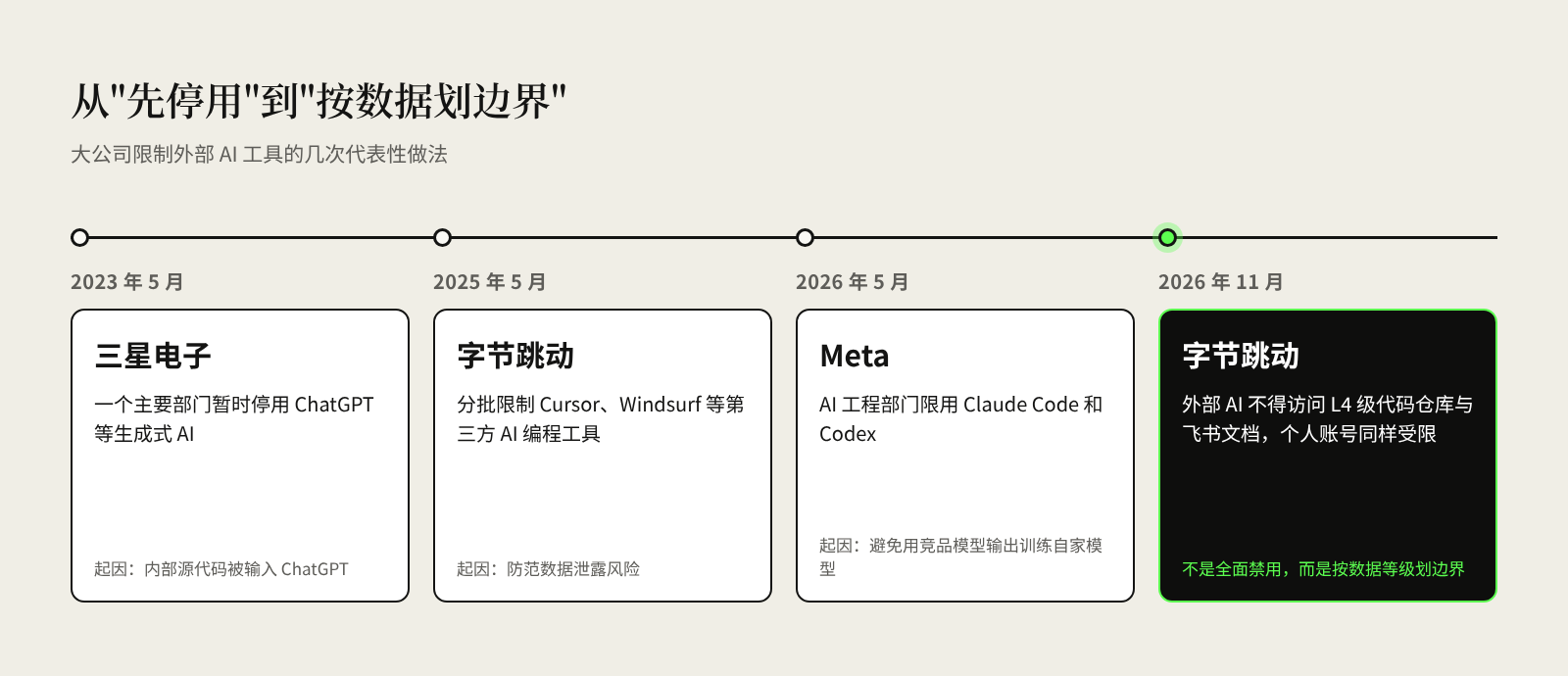
| May 2023 | Samsung Electronics | Temporarily banned employees in a major division from using ChatGPT and other generative AI | Engineers reportedly entered internal source code into ChatGPT while debugging (source) |
| May 2025 | ByteDance | Restricted third-party AI coding tools such as Cursor and Windsurf in phases | To guard against data leaks (source) |
| May 2026 | Meta | Restricted its AI engineering division from using Claude Code and Codex | To avoid inadvertently training its own models on competitors’ model outputs (source) |
| November 2026 | ByteDance | Restricted external AI from accessing L4-level code repositories and Lark documents, including via personal accounts | To prevent leaks of sensitive data (source) |
Each company’s motives differ somewhat, but the trend is clear: from Samsung’s “shut everything down first” back then to ByteDance’s “draw boundaries by data level” today, large companies are moving from blunt bans to fine-grained governance.
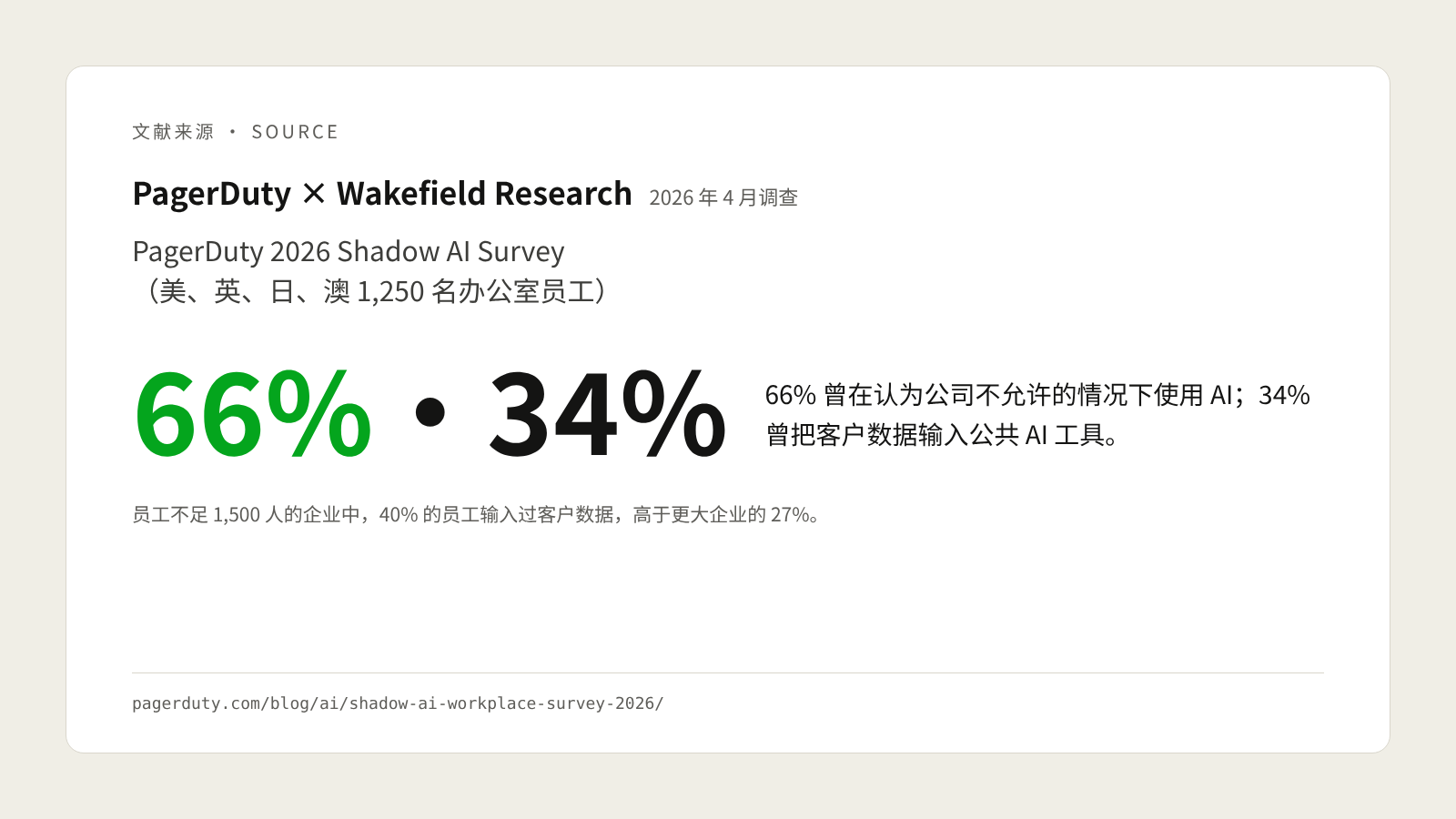
This isn’t just a big-company problem. A survey commissioned by PagerDuty and conducted by Wakefield Research in April 2026 found that 34% of office workers had entered customer data into public AI tools; at companies with fewer than 1,500 employees, the figure was 40%, higher than at larger companies (source). Large companies at least have security teams and classification systems; SMEs often have nothing at all.
What SMEs can learn
SMEs don’t need to copy big-company policies wholesale, but the thinking behind ByteDance’s new rules is easy to adopt. It comes down to three things.
First, classify your data. You don’t need a complex system; a single table can make it clear. Here is one possible approach:
| Level | Typical content | Can it go into external AI tools? |
|---|---|---|
| Public | Website copy, published product descriptions, public policies | Yes |
| Internal | General work emails, meeting notes, internal process guides | Only into company-approved tools, with names and amounts removed |
| Sensitive | Customer lists and personal data, quotes and costs, contracts, employee information | Not into external public tools; handle only within the company’s own environment |
| Core | Financial data, supplier terms, source code, business strategy | Never into external tools, and restrict who can access it |
For companies operating in Spain and the EU, customers’ and employees’ personal data is also subject to the General Data Protection Regulation (GDPR). Entering it into external tools that haven’t been assessed is not only a management issue but potentially a compliance one too.
Second, set an approved tools list and be clear about personal accounts. List the AI tools the company approves, favoring enterprise editions: they usually let the company manage accounts centrally and set out in the contract how data is handled, though the specific terms need to be checked one by one. At the same time, tell employees clearly that personal accounts can be used for learning and for working with public information, but sensitive and core data must not go into personal accounts.
Third, give employees a good alternative. This is the point most easily overlooked, and it is what Hong’s remark means: banning without offering an alternative works poorly. If employees genuinely need AI to handle customer queries, organize orders or reconcile accounts, the company should provide a tool within its own control — one that connects to the company’s own data and knowledge base, assigns permissions by role and keeps traceable usage records. With a better option available, employees will no longer quietly paste information into external tools.
This is also the first step SHEPHARD takes when designing AI solutions for companies: define data boundaries and permissions first, then connect AI to the business, so that everything stays secure and under control.
Conclusion: draw the boundaries first, then use AI with confidence
On the surface, ByteDance’s new rules are a “tightening”; in reality, they draw a line: AI can be used, but there must be clear boundaries on which data can be given to it, and to which tools.
AI tools will only get better, and employees will only use them more. A company’s job is not to hold back this force, but to define its data boundaries clearly first and then let AI into the business with confidence. Large companies are already catching up on this lesson; SMEs don’t need to wait until something goes wrong.
If you’d like to map out your company’s data classification and AI usage rules, book a free consultation.
References
- ByteDance Plans to Restrict Claude and Codex Access to Internal Files, TokenPost, November 3, 2026
- ByteDance to restrict internal use of Cursor and other third-party AI development software, 36Kr (citing Yicai), May 2025
- To prevent distillation of third-party models, Meta restricts AI engineers from using Claude and Codex, IT Home (citing The Information), June 2026
- Samsung bans staff from using generative AI after privacy gaffe, The Register, May 2023
- PagerDuty 2026 Shadow AI Survey, PagerDuty, 2026